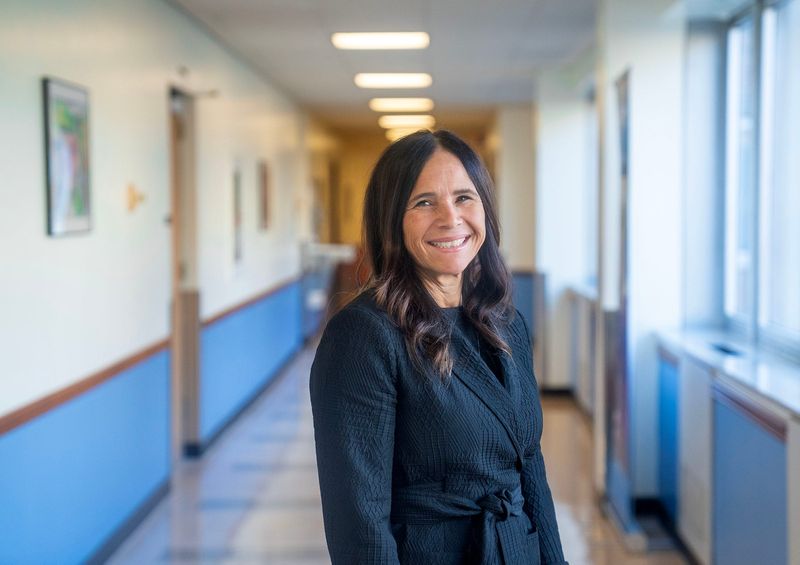
A little over a year into the job, Superintendent Brenda Cassellius grades her tenure leading Milwaukee Public Schools a B or B+.
It’s been a challenging first year, Cassellius told the Milwaukee Journal Sentinel editorial board in April. She took over just as a state audit found the district’s central office and finance department in disarray. She needed to clear about 100 MPS buildings of lead paint. And more recently, she learned the district overspent its budget by $46 million last school year.

Even so, Cassellius said she’s proud to have begun pursuing aggressive measures to close the budget deficit and shift resources from the district’s central office into schools, though she downgraded her performance over her turbulent relationship with the Milwaukee teachers union.
Following about two months of negotiations, MPS and the Milwaukee Teachers’ Education Association remain at an impasse over inflationary wage increases. Union leaders have criticized Cassellius’ approach in handling the district’s budget gap and decried her decision this March to cut more than 260 jobs, including 59 assistant principals.
Throughout April, union members have staged protests outside schools to rally against Cassellius’ budget and demand full inflationary raises for staff by July 1. Cassellius has instead proposed delaying those raises to help save MPS about $10 million to $20 million.
Reflecting on the superintendent’s first year, MTEA President Ingrid Walker-Henry said parents and workers feel lied to, and union members feel she is backtracking on her promises.
“What it feels like for parents and for workers is it’s chaotic,” Walker-Henry said. “People feel like they have whiplash because one day, you are being told that your job is safe, and then three days later, you get a letter saying your job has been cut.”
“Students and workers deserve stable, consistent and predictable learning and work environments,” she added. “Superintendent Cassellius is not providing that for them. She’s doing the opposite.”
Walker-Henry said Cassellius could mend the relationship by reversing the layoffs and providing raises on the union’s timeline.
“There is time to fix these disastrous unforced errors that have been made,” she said. “She can work to rebuild the trust that she has lost through the … the actions that have just done nothing but cause upheaval, stress and instability.”
Cassellius acknowledged it’s been a struggle to improve rapport but told the editorial board she has been generous in granting many of the union’s wishes and improved transparency and communications with families and staff.
“I’ve given them almost everything that they want,” she said of the union. “I don’t think that our challenges are insurmountable. … We just need to get through this challenging, difficult spot.”
Cassellius said she respects the union’s position, but said she must balance competing priorities.
“My job is to govern a $1.6 billion [budget], 11,000 employee interests and the interests of 65,000 children and their families,” she said. “Sometimes when you’re doing that, [you] have to take into account the wishes of the entire community, and I hope that people will have seen … that children, and especially our most vulnerable children, will always be first in any decision that I make.”
What’s next on Cassellius’ agenda?
Now in her second year as superintendent, Cassellius said she remains focused on balancing the district’s budget and ensuring all schools are fully staffed. This spring, she announced an ambitious plan to add over 150 teachers and paraprofessionals to classrooms next school year.
Citing historic difficulties in filling staff vacancies, the union has called the plan “a fantasy that will not come to fruition.”
After the Milwaukee School Board approves next year’s budget, Cassellius said she plans to devote more time seeking feedback from families on impending school closures or mergers and adding sixth grade at some K-5 schools. Those efforts are necessary, Cassellius said, as enrollment in MPS continues to decline and many school buildings remain underutilized or in disrepair.
The district’s buildings average 85 years old, Cassellius said, and its deferred maintenance backlog is growing.
“We have just kicked this can down the curb … for too long,” she said. “It’s time that we take on a serious conversation about the conditions of the learning environments in which we send our children.”
Results of an audit into the district’s special education services are also forthcoming, and Cassellius expects it will point to significant work ahead – with a potentially hefty price tag.
How well the district serves students with disabilities, a group MPS enrolls at disproportionately high rates, is one of the concerns that keep Cassellius up at night. While the state budget increased special education funding, Wisconsin public schools are receiving less state aid than expected, further compounding the district’s budget problems.
“We’ve been not getting funding for what our needs are for our students, and particularly our students with special needs,” Cassellius said.
She said MPS will need to pursue a property tax referendum in the future if state funding continues to fall short, but voters won’t support it until the district has rebuilt trust and proved it has cleaned up its finances, with “sufficient controls in place.”
Cassellius’ other goals are to better address gun violence and improve the district’s high rate of chronic absenteeism. Over 46% of students in the district were chronically absent last school year, meaning they missed more than 10% of school days.
“Quite honestly, I’ve been so mired in the operations of the district that I have not had enough time to really follow through on attendance,” she said. “We will be working on that next year very intentionally.”
While greater awareness and collaboration with city partners have reduced student deaths from gun violence – nine this year, compared with 25 students last year – Cassellius said the district still has work to do. She suggested providing parents with gun locks and offering more prevention programs to students, including gun safety training and after-school programs that explore alternatives to violence.
From stabilizing finances to mending relationships with staff and improving student outcomes, Cassellius said the path forward will require “courageous decisions.”
“There is an urgency. I feel that everywhere,” she said. “I think everybody feels a sense of urgency around Milwaukee Public Schools improving. Change is hard, but it is necessary.”
Kayla Huynh covers K-12 education, teachers and solutions for the Journal Sentinel. Contact: khuynh@gannett.com. Follow her on X: @_kaylahuynh.
Kayla’s reporting is supported by Herb Kohl Philanthropies and reader contributions to the Journal Sentinel Community-Funded Journalism Project. Journal Sentinel editors maintain full editorial control over all content. To support this work, visit jsonline.com/support. Checks can be addressed to Local Media Foundation (memo: “JS Community Journalism”) and mailed to P.O. Box 85015, Chicago, IL 60689.
The JS Community-Funded Journalism Project is made possible through our partnership with Local Media Foundation, tax ID #36-4427750, a Section 501(c)(3) charitable trust affiliated with Local Media Association, and EnMotive, LLC, a subsidiary of USA TODAY Co., Inc. USA TODAY Co., Inc. is the parent company of this publication.
This article originally appeared on Milwaukee Journal Sentinel: MPS superintendent reflects on ‘challenging’ first year in role
Reporting by Kayla Huynh, Milwaukee Journal Sentinel / Milwaukee Journal Sentinel
USA TODAY Network via Reuters Connect