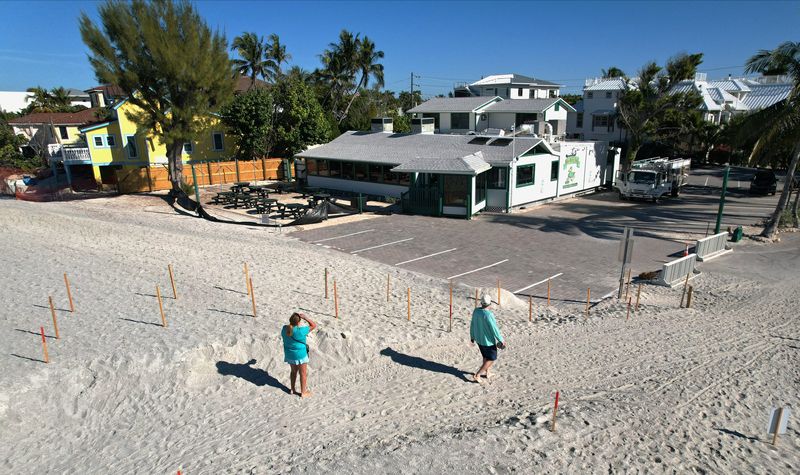
The iconic “Mucky Duck” beach bar on Captiva is commemorating its 50th anniversary with a lawsuit seeking to remove an artificial 12-foot dune next to the historic watering hole. The 218-page lawsuit reflects how the law has evolved here in Florida regarding clashes between rights of property owners and environmental concerns.
The massive complaint filed in Lee Circuit County Court, as previously reported in this publication (“Beachfront Captiva Restaurant Lawsuit Says Barrier Blocks Gulf Sunsets,” December 19, 2025), asserts 12 different claims of constitutional rights, nuisance and other matters against the Captiva Erosion Prevention District, the governing body that constructed the 12-foot-high barrier and plans to increase it to 17 feet high. The project, in excess of what the “Duck” claims is a 9.8-foot maximum, is intended to stem rising waters and storms, like surge from the pair of 2024 hurricanes, Milton and Helene, which have kept the facility closed, although it plans to re-open, subject to obtaining appropriate governmental compliance, by the end of this month, the 50th anniversary of its opening on January 29, 1976.

The lawsuit centers on the alleged impingement of the bar’s “rights of view” and “rights of visibility” of the body of water (whether called the Gulf of Mexico or Gulf of America, as denominated by the president), the beach and the sunsets. The “Duck” claims that the barrier causes a $7.5 million diminution of its value from an estimated $10 million to $2.5 million, along with harm to health and safety, among other assertions.
The Diamond anniversary of the Mucky Duck, a sobriquet that also happens to grace a classic British Pub in Brighton in that country, provides an opportune occasion to review a landmark lawsuit here in Florida that addressed similar issues to the current Lee County case.
The litigation was a brouhaha between a pair of beachfront heavyweights in Miami, the internationally famed Fontainebleau Hotel and its newer next-door neighbor, The Eden Rock. The case, entitled Fontainebleau Hotel Corp. v. 4525, Inc., was brought by the upstart Eden Rock, constructed in 1958, adjacent to its four-year-old neighbor, the Fontainebleau, when the latter sought to construct a 14-story, 165-foot tower. The Eden Rock claimed the expanded edifice would block sunlight and visibility of the Atlantic Ocean from the swimming pool, beachfront, and cabana area, from approximately 2 p.m. through the rest of the day during the in-season winter months.
A trial judge in Miami bought into the claims and issued an injunction barring construction of the upward expansion. However, the Fontainebleau elevated the case to the Third Circuit Court of Appeals, which reversed the decision and set aside the injunction. It reasoned that long established court rulings dating back to medieval English cases established a “universal rule” that a landowner has “no legal right to the free flow of land and air from the adjoining land.” The court recognized the Latin maxim of Sic Utere Tuo Ut Alienum Nom Lades, which means, for the uninitiated in that language, that one can use their own land in any way they please as long as they do not injure others.
But the justices deemed that concept, even older than the medieval British cases, inapplicable since the Fontainebleau’s construction was done for a beneficial “purpose.” That objective exists, the justices felt, because the Fountainbleu, which gained renown for hosting the Saturday night Jackie Gleason’s television shows, replete with the June Taylor dancers and the memorable “Honeymooners” skits, had a legitimate reason to expand its horizons for enhanced financial purposes, notwithstanding its curbing the view of the horizon next door.
But times have changed since the late 1950’s lawsuit. New legal precepts, statutes, and environmental concerns have established more legal protection for landowners to prevent actions by adjoining properties that adversely impact them, including limiting their view and other protected natural resources, which are not solely within the prerogative of one landowner at the expense of others.
The clash between the competing concepts in the Eden Rock-Fontainebleau litigation will be at the center of the Mucky Duck lawsuit as it progresses through the court system.
The beachfront bistro’s emergence from its closure and continued viability may depend upon how the judges on the lower court and possibly an appellate tribunal look at the “rights of view.”
Marshall H. Tanick of Naples is a constitutional law attorney and has been involved in cases regarding access to light and view.
This article originally appeared on Fort Myers News-Press: Mucky Duck lawsuit for Gulf view echoes landmark litigation | Opinion
Reporting by Marshall H. Tanick / Fort Myers News-Press
USA TODAY Network via Reuters Connect