President Donald Trump’s move to reclassify marijuana from a dangerous Schedule I drug to one with accepted medical uses isn’t expected to change the way police and prosecutors in Tallahassee handle cases involving weed.
On April 23, the Department of Justice moved marijuana products that are either licensed by states for medical use or approved by the Food and Drug Administration from Schedule I – a group of dangerous drugs that includes cocaine and heroin – to Schedule III, a less tightly regulated group that includes numerous prescription medicines.

Acting Attorney General Todd Blanche, who signed the order reclassifying pot, said in a statement that DOJ was “delivering on President Trump’s promise” to expand Americans’ access to medical marijuana treatment options.
“This rescheduling action allows for research on the safety and efficacy of this substance, ultimately providing patients with better care and doctors with more reliable information,” Blanche said.
The marijuana industry — including major Tallahassee-based players, one considered “the Trump whisperer” — hailed the move.
On the law enforcement side, however, State Attorney Jack Campbell said it would have no impact on the way he approaches marijuana, which remains illegal without a medical card.
“The real question is whether the Legislature will follow suit,” he said. “Could the Legislature legalize weed? Maybe. But … I’m the state attorney, so I enforce Florida law. Here in Florida, it’s against the law to possess.”
Law enforcement in Tallahassee and Leon County don’t make many marijuana-related arrests. Since the start of the year, only 15 people have been booked into the Leon County Detention Facility on pot charges, according to online booking reports.
One was charged with trafficking, another with smuggling weed into a detention center and a third with multiple drug offenses, including the sale of meth. The others mostly involved people who failed to appear in court in years-old cases or were wanted in out-of-state cases that included other more serious charges.
“There’s very, very, very few,” Campbell said. “Usually it’s we arrest you for something else, and you happen to have marijuana in your pocket.”
Campbell, chief state prosecutor for the 2nd Judicial Circuit, which includes Franklin, Gadsden, Jefferson, Leon, Liberty and Wakulla counties, said marijuana is still a factor in violent crime, with links to shootings, and DUIs and DUI manslaughters.
“The biggest problem I see with marijuana is the violence that comes out of it,” he said. “Because this is by far our most popular illegal drug, and we get a lot of violence of people buying, selling and robbing in those circumstances.”
Trulieve CEO: First ‘meaningful policy shift’ on cannabis in American history
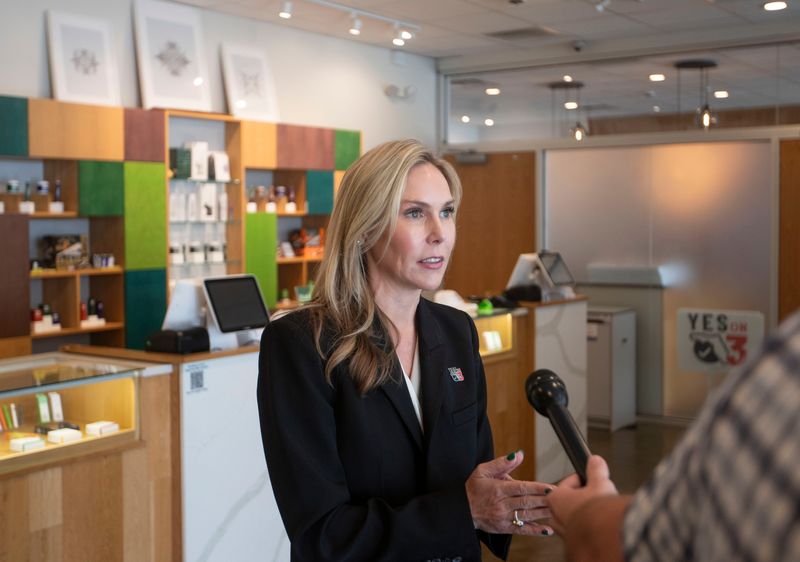
Trulieve Cannabis Corp, one of the nation’s leading cannabis companies and the biggest grower of medical marijuana in Florida, issued a statement applauding the move by the federal government.
“The Administration is delivering on its promise to address long overdue cannabis reform by rescheduling medical marijuana,” said Trulieve CEO Kim Rivers. “President Trump and Attorney General Blanche have, through this final order, completed the first ever meaningful policy shift related to cannabis in the history of America.”
Rivers, cofounder of the company, which started with a single Tallahassee-based dispensary, personally lobbied the president for the reclassification, according to a recent profile in Forbes magazine, which dubbed her “the Trump whisperer.”
She was at the White House on Dec. 18, 2025, when Trump signed an executive order directing the attorney general to redesignate marijuana as a less dangerous drug.
“By rescheduling medical marijuana to Schedule III, American-led research, utilizing products that Americans are consuming, can begin in earnest and will shape the future state of cannabis in this country,” Rivers added in the statement. “Trulieve welcomes this decisive action to more closely align federal policy with current medical practice and state laws.”
Contact Jeff Burlew at jburlew@tallahassee.com or 850-599-2180.
This article originally appeared on Tallahassee Democrat: Marijuana downgraded by DOJ, but Florida law still rules in Tallahassee
Reporting by Jeff Burlew, Tallahassee Democrat / Tallahassee Democrat
USA TODAY Network via Reuters Connect