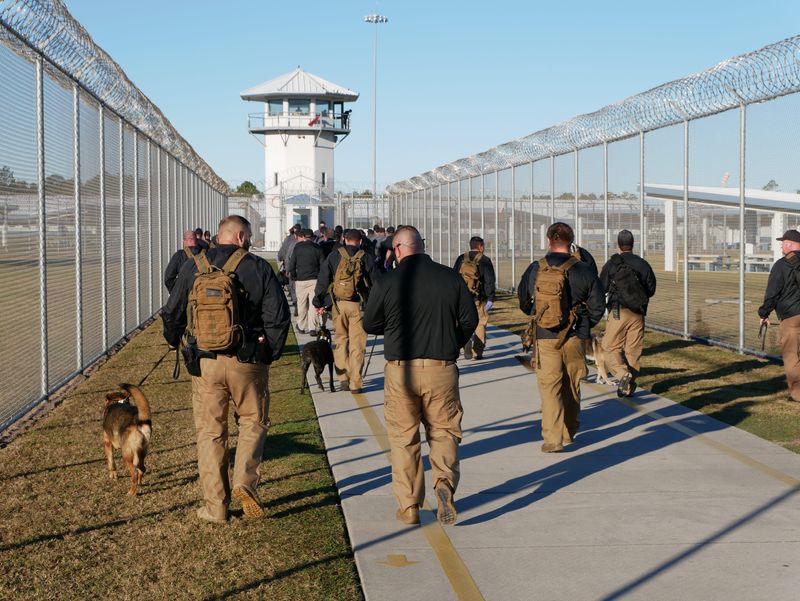
The Florida Department of Corrections has been trying to chip away at its years-long staffing shortage after numbers took a turn for the worse following the COVID-19 pandemic, but the issue continues to vex the state.
Little inside a prison happens without corrections officers. Mealtime, programs, medical care and recreation all depend on corrections officers — and how many are on guard.

Experts say a lot of the realities about life and death behind bars can be traced to how staffed or understaffed an institution is.
“When there aren’t enough COs (corrections officers) … all of those little things that require a CO presence break down,” said Wanda Bertram, communications strategist for the Prison Policy Initiative. “And those things I think have an indirect impact on people’s mental health and their well-being, and that contributes to violence.”
A Tallahassee Democrat review of jail and prison mortality data found that some of the most homicides reported between 2016 and 2019 were at prisons that later received aid from the Florida National Guard in 2022 because of how critically understaffed they were.
When asked about the DOC’s current staffing ratio, a department spokesperson said they employ nearly 24,000 people and supervise more than 90,000 inmates statewide. Staffing needs vary and “specific information regarding security staffing is exempt from public disclosure.”
But Corrections Secretary Ricky Dixon told the state Senate Appropriations Committee on Criminal and Civil Justice last October that in many cases, young officers are tasked with supervising 150 inmates or more by themselves while other states maintain ratios around one officer to every 35 inmates.
James Baiardi, the president of the state corrections chapter of the Florida Police Benevolent Association, said in an interview that Florida officers are terribly outnumbered.
The numbers are starting to bounce back, but Baiardi said they still aren’t where they need to be. He said the lack of officers – or rather the lack of seasoned officers – could have played into higher homicide numbers at institutions.
“You’re getting younger officers with less experience and you’re getting a more violent inmate population, and those two put together is a bad formula,” Baiardi said.
How staffing shortages can lead to violence, deaths
Staffing shortages don’t go unnoticed. Inmates know when a post isn’t properly manned, Baiardi said.
“I remember one time there was an incident where it happened on different ends of the prison, and there’re only so many people,” he said.
When he spoke to lawmakers last year, Dixon noted that inmate-on-inmate violence has increased by 50% in the last few years.
Baiardi, a former corrections officer, said he believes more robust staffing could decrease the amount of inmate-on-inmate and inmate-on-officer violence, but “some of that violence is always going to be there.”
Mark Caruso, a Winter Springs city commissioner, previously was a Florida corrections officer for 10 years, working in three different institutions between 2010 and 2020. His time as an officer ended right before staffing numbers plummeted.
Even with proper staff, Caruso said prisons can be a powder keg. He said violence was commonplace during his time, and it’s more prevalent today.
According to unredacted in-custody death reports obtained by USA TODAY from the U.S. Department of Justice, Jackson Correctional Institution had the most homicides, with at least four murders reported between 2016 and 2019.
Hamilton Correctional Institution is another prison with some of the highest homicide numbers. It had at least two reported homicides during the same time period.
Both of these institutions are two of the nine critically understaffed prisons Gov. Ron DeSantis mobilized the Florida National Guard into until statewide staffing numbers were stabilized.
DeSantis temporarily directed hundreds from the Florida National Guard in 2022 to fill the critical labor shortage in the state prisons. Members of the guard worked in the prisons until June 2025 after the DOC determined its staffing numbers weren’t as low as they once were.
Had he not “activated the National Guard when he did … we would’ve imploded as an agency,” Dixon said during an October legislative committee hearing.
Baiardi said he couldn’t speak to whether the National Guard’s presence made the prisons better or safer, but both Jackson C.I. and Hamilton C.I. didn’t have any reported homicides after the Guard stepped in, according to the Democrat’s review of the DOC’s inmate mortality data between July 2020 and March 2026.
“The best thing for the corrections system, to keep it safe and secure, is to stop the turnover,” he said.
The more experienced an officer is, the better equipped they are to handle an emergency and pick up on signs that something’s about to happen, he said.
“You don’t want to have a facility where the inmates know more than the staff about what’s going on,” Baiardi said.
Expert: Understaffing might be tied to higher suicide, overdose rates
Violence, addiction, aggression and depression are a given in a prison setting, and without proper staff to preserve order, Bertram said the risk for bad outcomes increases.
Santa Rosa Correctional Institution — another one of the nine understaffed institutions that received aid from the Florida National Guard — had among the highest number of deaths in the state because of suicides and drug overdoses.
According to USA TODAY’s data set, at least seven, or 21%, of deaths reported at Santa Rosa C.I. were suicides. The prison also reported at least seven deaths due to accidental overdoses, the second most overdose deaths in the data set.
The Prison Policy Initiative – a non-profit that conducts research on the effects of mass incarceration – has studied instances where corrections officers have put facilities on lockdown as a way to better manage inmates in an understaffed institution.
But this quick fix creates a new ripple effect of problems.
Bertram said a Wisconsin prison in 2023 initiated a lockdown that lasted longer than a year, and the institution saw a “pretty high number” of people die by suicide and overdose during the lockdown period.
Lockdown means inmates were stuck in their cells for days on end, getting limited to no recreation time and completely prohibited from having loved ones visit, as reported by the New York Times.
Caruso said lockdowns should follow violent encounters like fights, stabbings and officer assaults.
But he said Florida prisons often initiate informal lockdowns because there isn’t enough staff to count the dorm populations, and facilities will remain on lockdown until they have enough officers to respond or they’ve completed an accurate count.
The DOC countered this, saying lockdowns are only initiated in narrow circumstances and not for staffing issues: “Institutional lockdowns are implemented only when necessary to address institutional safety and security concerns, such as contraband interdiction efforts, inmate disturbances, or other operational threats. This is done to ensure the safety of staff and inmates, and normal operations resume as soon as possible following the lockdown.”
Being able to see family and be outside one’s cell improves mental health, Bertram said, and that’s crucial to guaranteeing safety inside a facility.
“Those are conditions that just breed despair,” she said of the Wisconsin prison’s lockdown.
Inmates need to keep their minds occupied, Caruso said. Going to the recreation yard, library, barbershop, chapel and educational classes keep them out of trouble more than keeping them locked away in their bunks.
“They get agitated,” he said. “It’s 120 degrees in the dormitories. They’re getting agitated, the officers are getting agitated because everybody’s just sitting there looking at each other. They have nothing to do.”
Are there ‘simple’ fixes? Weighing solutions to prison understaffing
Working eight hours or more in a prison every day “isn’t a cakewalk,” Baiardi said. A corrections officer’s job is physically and mentally taxing, and even more so when forced to work overtime due to labor shortages.
But he says “the fix is simple:” Raise officers’ wages.
“You can imagine how frustrating it is with all the risks they take in a day and then they (see) a sign at Buc-ee’s and see that the starting pay is almost what they make,” Baiardi said.
The Florida DOC and PBA for years have been asking lawmakers to increase funding to the state corrections system. “Everybody wants to be tough on crime, and I support that, but part of being tough on crime is funding the prisons so they run properly,” Baiardi said.
During a Senate Appropriations Committee on Criminal and Civil Justice hearing in January, Dixon asked for $430.6 million to support corrections officers with a competitive pay package that would raise hourly wages from $22 an hour to $28.
DeSantis signed the 2026-27 budget June 29, vetoing a $91 million pay raise for correctional officers lawmakers thought they had made veto proof by tying it to a prison construction bill.
During the budget signing, DeSantis explained that he would’ve supported a request to increase officer pay if it was a stand-alone item, but they tied it to incurring new debt to build a new prison facility.
“They tried to hold hostage the corrections pay in order to generate more debt on behalf of the state of Florida when we’ve made so much progress in reducing debt,” he said. “So I vetoed the bill. I’m not playing those games.”
Caruso said the idea that pay raises will solve the staffing problem “is 100% not true … They always say that because that’s the easiest way to blame staffing.”
The biggest issue contributing to the staffing crisis is the work hours, he said. The second is how officers are treated by administration, especially if they speak up about corruption, and money would be third.
Numbers would go back up if the administration reinstated the 12-hour work day, he said. Under Dixon’s leadership, officers were switched to 8-hour shifts, which Caruso said upset people because that decision cut into the number of days officers have off.
Caruso said there’s a “big push out there” for him to become the DOC’s next secretary now that Dixon is retiring, and if the new governor appoints him, these are the top three things he’d address first to improve the state corrections system.
“A pay raise would be awesome, but they want to be able to have time with their families,” Caruso said. “It’s not about the money.”
Bertram also agrees that pay raises haven’t proven to be helpful because the conditions inside the prisons are why people don’t want to work in them.
“Corrections officers’ salaries have risen quite a bit … and the staffing problems are worse than ever,” she said.
Bertram and the Prison Policy Institute are advocates for reducing prison populations as a solution to staffing shortages. There’s a staffing crisis because there are too many people in prison, she said.
The organization advocates for the release of inmates who are ill, elderly or a good candidate for parole, saying it would help lower inmate populations and balance out the inmate to officer ratio.
“Sociologically speaking, we know that older people are far less likely to commit crimes,” Bertram said. “They’re also much more vulnerable from a health perspective, more likely to be expensive to care for and more likely to die.”
“We’ve been arguing that states need to be looking at this sort of low hanging fruit,” she added. “That’s a very hard sell in Florida.”
Elena Barrera can be reached at ebarrera@tallahassee.com. Follow her on X: @elenabarreraaa.
This article originally appeared on Tallahassee Democrat: Inside Florida’s prison staffing crisis: When 1 guard watches 150 inmates
Reporting by Elena Barrera, Tallahassee Democrat / Tallahassee Democrat
USA TODAY Network via Reuters Connect
By Elena Barrera, Tallahassee Democrat | USA TODAY Network