Editor’s note: Cheryl Smith attributes all reporting in this series to exhaustive research on newspapers.com, archives.com, fold3.com; Indian River County records; historical societies, museums and Facebook groups in Sebastian, St. Lucie County and Wisconsin; Green Bay Packers team historian Cliff Christl; Sebastian resident Judith Swingle; and Vero Beach attorney Eugene J. O’Neill’s book, “Raising the Bar: In and Before Indian River County — A History.” Contact her at cheryl.smith@tcpalm.com if you have any photos, records or information that corrects or adds to this account.
A rags-to-riches and riches-to-rags Atlanta developer made his post-WWI comeback in Florida, making an indelible mark on the Treasure Coast from Fort Pierce to Sebastian and points in between.

Charles Cleveland “C.C.” Braswell, described as a “live wire” in one news article:
Despite all his accomplishments, Braswell was bankrupt and $825,000 in debt by 1936, when he appeared in a Miami courtroom with just “$25 and the clothes on his back.”
Brother Samuel Asa Braswell lived in Sebastian
Braswell was a successful businessman, who in June 1914 was worth $100,000 in cash plus all his Atlanta properties. Six months after WWI started in July 1914, the value of all his assets had plummeted by Christmas.
He toiled as a real estate agent by day and a railroad worker by night, catnapping in between as he could.
“For many months, there were whole weeks when I did not remove even my shoes,” he said in a news article. He visited Florida and saw the “wonderful possibilities” to “try to retrieve his losses.”
Before deciding to settle in Fort Pierce, he spent days touring Florida on horseback and nights sleeping in the woods, for several months. He moved here with $2,000 in 1919, a year after the WWI armistice was signed in 1918.
However, 10 years earlier, his brother was already a well-established resident and businessman in Sebastian, when the city was in St. Lucie County. Samuel Asa Braswell was:
From Florida railroad to real estate mogul
While still in Atlanta, C.C. Braswell was appointed a Florida East Coast Railway boiler inspector for the Fort Pierce railyard.
His first investment was a seven-passenger Buick, and he started a taxi business and partnered with Fort Pierce Mayor W.E. Rountree in a real estate business in 1920.
Within the year, they changed the name from Braswell & Rountree to St. Lucie County Real Estate Agency. Rountree bought out Braswell, who formed Braswell Real Estate Agency, with an office in the St. Lucie County Bank Building.
Braswell developed McNurlen Farms; early St. Lucie subdivisions such as Biltmore, Tucker Terrace and Fairview Park; and early Indian River subdivisions such as Vero Beach Estates. He frequently took brochures to Georgia to market the area to tourists and homebuyers.
“A jungle of muck and water akin to the Everglades, where roved freely the alligator and the crocodile, today is a section of well-tilled farms,” he said of the area. He also touted Fellsmere as the “most productive farming district in the world. More veg are shipping from Quay (Winter Beach) than any other city in Florida.”
Yet Braswell clearly valued developed land more than nature and farmland.
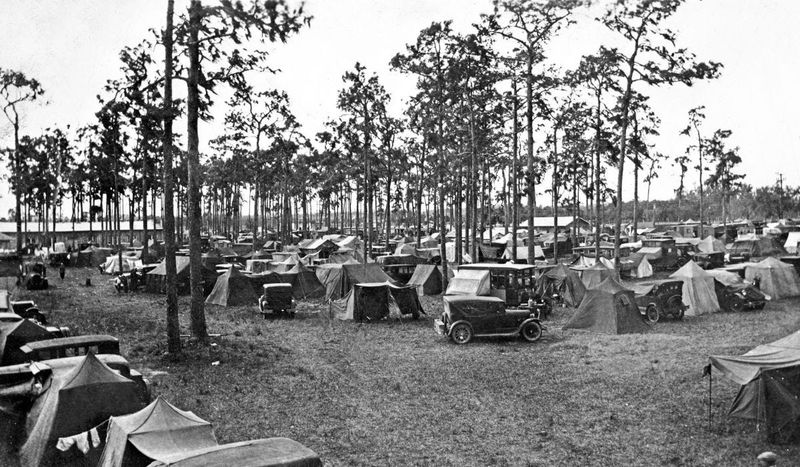
Tin Can Tourists camped all over Florida
“The day of backwoods farming is fast passing,” Braswell wrote in a 1922 letter urging the community to build tourist accommodations, claiming visitors were sleeping in their cars and leaving the next day because they couldn’t find anywhere to stay.
Miami and West Palm Beach had surpassed Fort Pierce too quickly, he said, claiming the city was missing out on 5,000 rentals per season, with 25 people a day unsuccessfully seeking accommodation.
Whenever Southern Railway employees came to town — be they friends or executives from Washington, D.C. — Braswell managed to sell them property, including “the old Eldred place” on Riverside Drive, now Indian River Drive, in 1921. He brokered a deal for Consolidated Land Co. to sell 32,000 acres on Okeechobee Road 11 miles west of Fort Pierce to J.F. Emerson. He partnered with businessman J.A. McNeill to form Braswell & McNeill real estate in 1921.
He was so busy buying and selling real estate in Fort Pierce and Vero Beach, he didn’t have time for his taxi business, so he turned it over to his brother. TCPalm doesn’t know which one, as there were more than one.
The White Way in downtown Fort Pierce
Braswell was a Fort Pierce civic leader, Chamber of Commerce member and one of 15 members appointed to the first Planning Board. He launched three major efforts in 1922-23:
Fort Pierce hosted a big celebration, complete with a parade on Second Street, to illuminate downtown “to nearly midday brightness” with 105 “high-powered” electric lights at 7:30 p.m. on Oct. 20, 1923. Lights stretched from the railyard to the Indian River Lagoon and lit the Fort Pierce Hotel grounds.
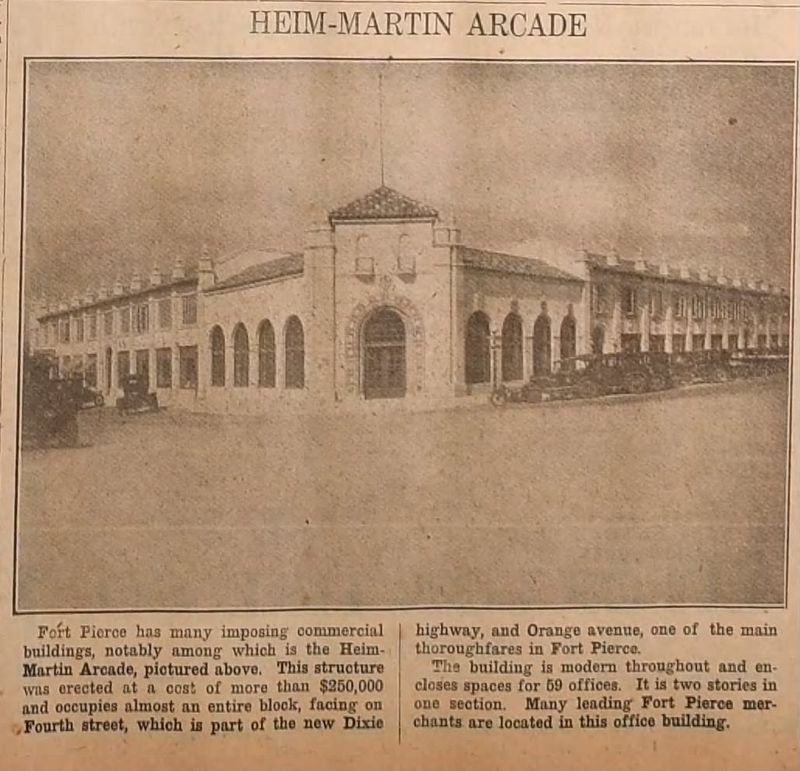
Once he got into real estate, he had the city’s “best-appointed office” in the new Arcade Building in 1926, and partnered with C.H. Peacock, a Philadelphia city commissioner, to buy three acres with six buildings fronting Orange Avenue at Seventh Street in 1924. The building housed Totten’s Casino and five cottages.
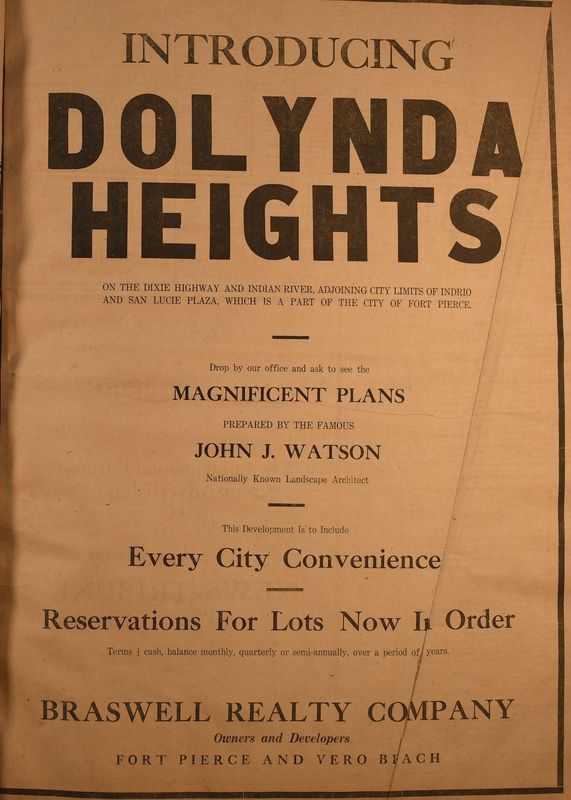
Braswell was among the developers who during the 1925 real estate boom proposed building new neighborhoods between Old Dixie Highway and the Indian River Lagoon between Indrio and Fort Pierce. Names included Indrio, Indrio Park, River View, San Lucia Plaza and his proposed development, Dolynda Heights.
Indrio-area proposed developments and cemetery
In 1926, Braswell announced plans to build the 10,000-acre plot Dolynda Hills Cemetery in the East Indrio area on 60 acres “north of St. Lucie on the ridge” facing Dixie Highway on the east, with the proposed new highway (now U.S. 1) traversing it. He planned to lay walks, pave streets and build vaults.
A government monument marker said it was 101.44 feet above sea level. Ads said it was the highest point on Florida’s east coast, and a news article said it was the highest point on the U.S. East Coast between South Carolina and Cuba, but TCPalm cannot confirm that.
Dolynda Heights nor the cemetery were mentioned again after 1930.
Braswell lived at 235 S. Second St. at Depot Avenue circa 1920-24, a house C.H. Peacock had bought from O. Radinsky. Braswell’s wife and children had relocated to Miami, and he followed them in 1928. His wife let a $750 a month seasonal rental from Jan. 1 to May 1, 1929. The large furnished house, with a servants’ room and two-car garage, was on Delaware Avenue near the high school.
He played in a 1920 baseball game to raise money for hot school lunches, playing on the Fatties team vs. the Skinnies.
Quay was developed in 1925, renamed Winter Beach
Winter Beach was Braswell’s “crowning work of his career,” he said in a news article.
He started visiting Quay and Gifford to look for real estate opportunities in 1923, and was a member of the Vero Beach Realty Board — with President Waldo Sexton — by 1925. In Gifford, he bought 98 acres that year, including a house and a packing house, and Walter Bobo’s 17-acre homestead.
Within 10 years of moving to Fort Pierce, Braswell had risen from “a railroad employee to a position of eminence” in Florida development circles” when he began buying land in Quay. There, he planned a $1 million development with 3,000 homes and 1.5 miles of beachfront.
He promised a $1,000 lot to whoever came up with the best new name for Quay. Winter Beach won and its slogan soon became “Where Sunshine Spends the Winter.”
Winter Beach slogan: Where Sunshine Spends the Winter
Braswell built a 120-foot-long boulevard from Dixie Highway to the Indian River Lagoon, a $3,000 archway across Granada Drive, and a $50,000 sales office on the corner of Dixie and Granada. He hired “famous” city planner and landscape engineer John J. Watson to design Winter Beach.
The city ordered him to remove the non-conforming “center pier” archway in 1926.
Braswell promised to create “eight beautiful islands” by pumping fill from the lagoon onto lowlands and marshlands, and build two hotels, a bathing casino, yacht basin, golf course, civic center, parks and plazas.
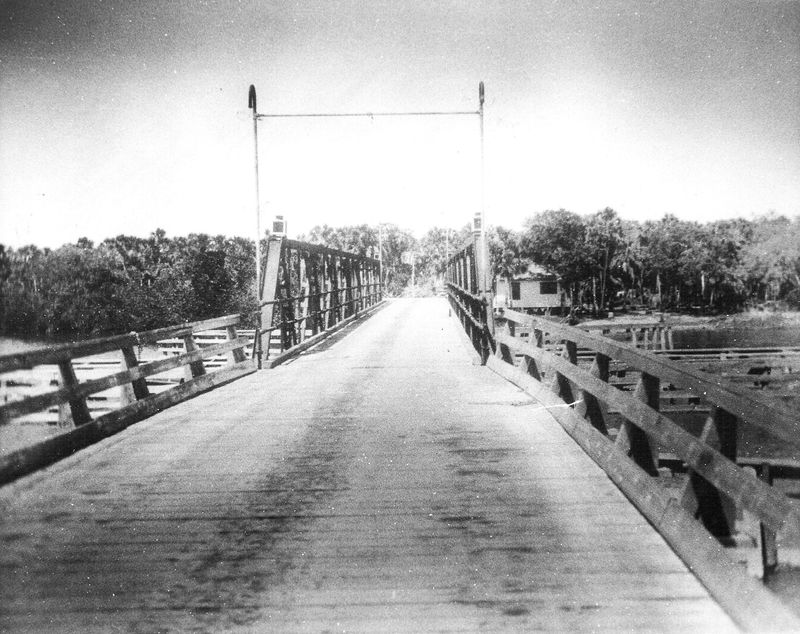
He debuted his development at the 1926 Indian River County Fair’s Braswell Realty booth. He increased traffic to the island by convincing the Quay bridge district to end the toll.
He also spent $36,000 on six seven-passenger Lincoln sedans that could do 90 mph and drive investors to his “gigantic Ocean and Dixie development now being sold to homebuyers and investors from nearly every state of the union.”
Braswell vowed to make Winter Beach the county seat and “one of the most important cities in Indian River County,” but lost his 1929 campaign to get the county courthouse built there instead of Vero Beach. Indian River Community College wrote a letter to the editor about “wild rumors” that Braswell was giving “high-dollar bribes to voters.”
Two Florida hotels: Sebastian Hotel and Sebastian Inn
The Braswell brothers individually owned two hotels in Sebastian.
The Sebastian Inn, a 40-room Spanish-Mediterranean hotel built along the Indian River Lagoon in 1925, was owned by George D. Barrick in 1944, when there was a flurry of confusing activity because documents and news articles give conflicting accounts of the sales transactions:
In U.S. vs. Sebastian Inn, the Navy’s legal action to temporarily commandeer the hotel for WWII barracks, named these interested parties:
Nearly 20 years before that, C.C. Braswell’s brother, S.A. Braswell, bought the Sebastian Hotel in 1925, with Adolf Pesat and William Hillebrand.
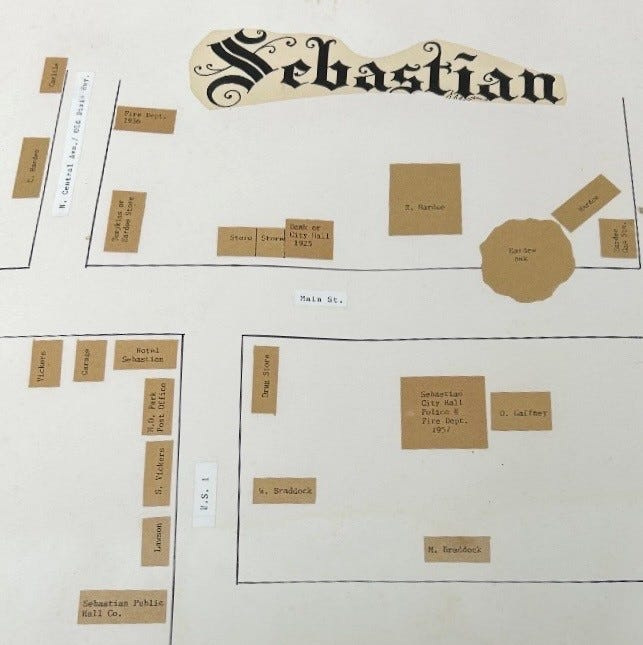
The three-story, 15-room hotel with a balcony across the front was built in 1912 and facing Main Street on the northwest corner of Central Avenue (now U.S. 1).
Sebastian Hotel and Braswell Building destroyed in 1927 fire
S.A. Braswell also built a modern, two-story, hollow-tile, stucco building adjoining the Vickers Bros. store in 1926, after moving Walters Garage to the back of the property in 1925. Of its four ground-floor stores, three faced north on Main Street and one faced east.
As fate would have it, S.A. Braswell didn’t move the Sebastian Hotel to build it, as he originally planned.
In a fire that started on the hotel’s third floor and jumped to his building, both burned to the ground. It was the worst fire in Sebastian’s history at that time: Jan. 27, 1927. Braswell had sold the hotel to Minnie Bridges, who renamed it Bridges Hotel, and it was Indian River County’s oldest hotel when it was destroyed.
In the wee hours of the morning, the fire was discovered about 3:45 a.m. by a Miami Herald newspaper delivery truck driver. After an alarm sounded, hundreds of townspeople rushed to the scene and formed a 200-person bucket brigade, as Sebastian had no firefighting equipment and the Vero Beach Fire Department arrived too late to help.
They saved the post office to the south. A northwest wind spared Vickers’ Bros. to the west.
When the fire jumped to Braswell’s building, his family, who lived in the upstairs apartments, escaped with only a few articles of clothes. Downstairs was Braswell’s real estate office and Arthur Kroegel’s general store. Both were destroyed.
Cheryl Smith is a TCPalm editor who can be contacted at cheryl.smith@tcpalm.com.
This article originally appeared on Treasure Coast Newspapers: Florida rags-riches-rags developer of Winter Beach tied to Earl’s bar
Reporting by Cheryl Smith, Treasure Coast Newspapers / Treasure Coast Newspapers
USA TODAY Network via Reuters Connect
By Cheryl Smith, Treasure Coast Newspapers | USA TODAY Network