Editor’s note: This article was updated to accurately reflect the most current information after TCPalm interviewed the Army Corps of Engineers and project contractor Southwind Construction of Indiana.
A Stuart dredging project is blanketing miles of the St. Lucie inlet, river and state park with sand, silt and muck that’s smothering reefs, sea fans, seagrass beds and habitat for snook and lobster.

Charter fishing captains called for an immediate stop and redesign of the project, but the Army Corps of Engineers that permitted it said that will not happen. Critics worry about the environmental damage and possibility the inlet will shoal up, causing a navigational safety hazard. The contractor told TCPalm the sand won’t inhibit boat traffic.
One critic is Scott Fawcett of Off The Chain fishing charters, who took TCPalm on a boat tour of the area May 7.
“We are in 2 feet of water and we can’t see the bottom,” Fawcett said near the inlet’s mouth. “This needs to be stopped immediately. This should not be being dumped here. I am not opposed to dredging, but this is not right. How this project is being executed is ridiculous.”
Dredge smothers Stuart inlet, river, state park, Jupiter Island
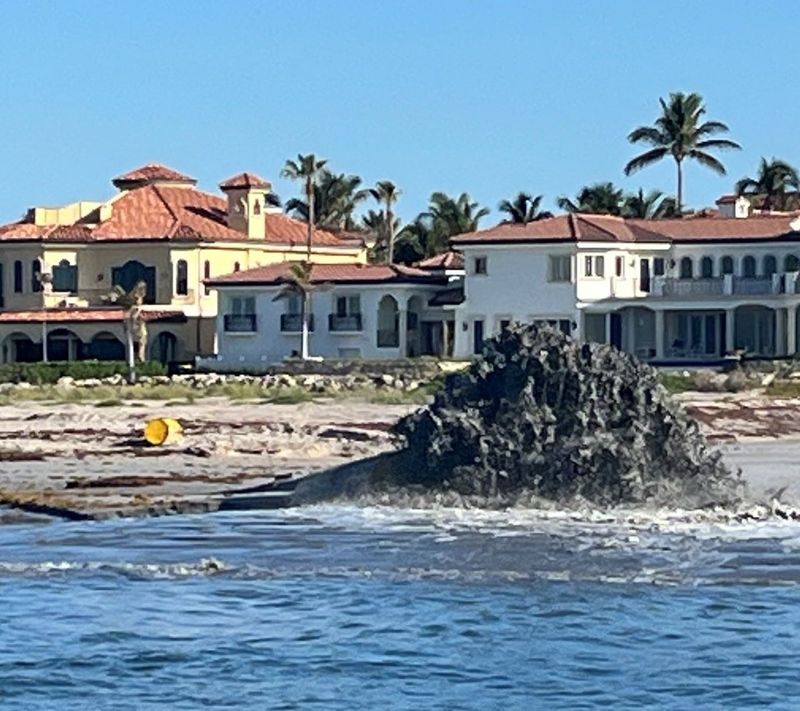
Sand is being dredged in front of the St. Lucie Inlet State Preserve and northern Jupiter Island, then pumped a mile east to the mouth of the inlet. A pipe at the beach’s waterline is blowing it out in front of two Sailfish Point homes.
On an outgoing tide, the sand and silt is being pushed 2.6 miles south along Jupiter Island and on an incoming tide, it’s being pushed onto seagrass flats, said offshore charter fishing captain Tony Ross.
“Why put it right there, where it could shoal up the inlet and make it impassible?” said Ross, who operates a 57-foot charter fishing vessel with DNT Charters. “I do 100 trips a year out of this inlet. This could be a problem for the bigger boats. This is scaring me.”
Florida charter fishing captains want project stopped immediately
The Army Corps awarded the $7.2 million contract to Southwind Construction of Evansville, Indiana, for “maintenance dredging” of Intracoastal Waterway navigation channels, starting near Jupiter and continuing near the St. Lucie Inlet, according to an Oct. 1 news release. The Florida Inland Navigation District (FIND) is the non-federal sponsor.
The contract calls for dredging 365,000 cubic yards of “shoaling” to reach “required depths of 10 feet and 8 feet, plus 2 feet of allowable over-depth,” the news release says. That would fill 36,500 dump trucks, a 15-story skyscraper, a a quarter of the Empire State Building in New York City, and cover 515 football fields with 4 inches of sand.
Southwind operations director Darrell Stewart said the company is placing only 140,000 cubic yards of sand at a Florida Department of Environmental permitted “sand impoundment” site. That’s less than what it had planned because of “capacity issues,” according to it and the Army Corps. That amount would cover a football field with 71 feet of sand.
“This project is being constructed in compliance with all necessary environmental permits,” Army Corps spokesperson John Paul Rebello told TCPalm May 7. “A thorough environmental analysis was completed” by a 2018 National Environmental Policy Act review, which found no significant impact, he said.
Southwind owns the Andi Rae dredge boat and other vessels seen in TCPalm’s photos.
Tim O’Hara is TCPalm’s environment reporter. Contact him at tim.ohara@tcpalm.com.
This article originally appeared on Treasure Coast Newspapers: Florida dredge puts sand on reefs, seagrass, snook & lobster habitat
Reporting by Timothy O’Hara, Treasure Coast Newspapers / Treasure Coast Newspapers
USA TODAY Network via Reuters Connect