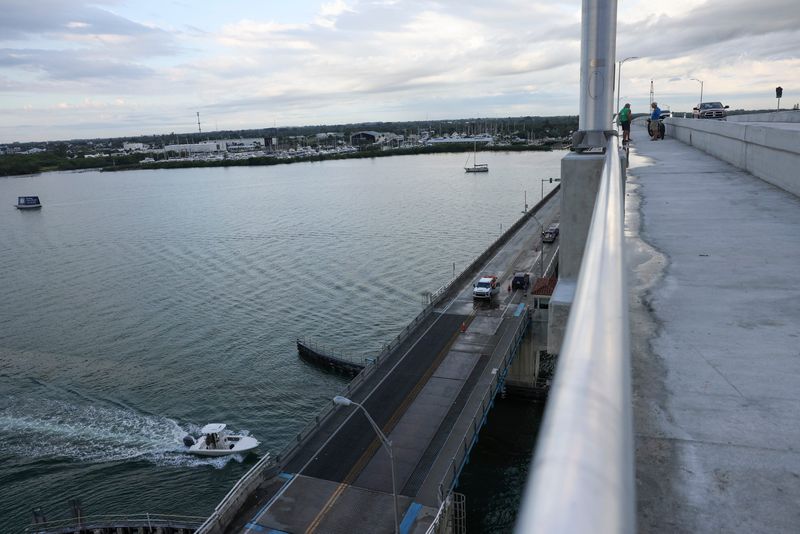
FORT PIERCE — The old North Causeway Bridge carried cars and trucks over the Indian River Lagoon, back and forth to North Hutchinson Island, for 63 years before being replaced in May.
The bridge is being demolished, but it soon will serve a new purpose for decades more to come: an artificial reef.

The Army Corps of Engineers is allowing the Florida Department of Transportation to deploy of the remains of the old drawbridge — called D.H. “Banty” Saunders Bridge and built in 1963 — on three, 60-acre sites in the Atlantic Ocean, roughly 6 miles northeast of the Fort Pierce Inlet, said Jim Oppenborn, St. Lucie County coastal resources director.
The project will bring 15,000 tons of materials to an existing reef site off Fort Pierce. St. Lucie County also has roughly 3,000 tons of concrete that it will try to get placed at the same time by the FDOT’s contractor, Oppenborn said.
FDOT has yet to announced when the rubble will be taken by barge to the artificial reef site.
“Artificial reefs have traditionally been made to benefit mankind by increasing harvest from the oceans,” Oppenborn said.
The new North Causeway Bridge, named the E.C. Summerlin Family Bridge, officially opened, May 15.
Artificial reefs attract fish and divers
The three 60-foot deep reef locations are in the Lee E. Harris artificial reef site, named after a coastal and civil engineering professor at the Florida Institute of Technology who was an artificial-reef supporter. The county has deployed construction debris from old bridges and other roadways there for 17 years.
The Harris reef provides juvenile fish habitat and attracts loggerhead sea turtles, goliath grouper, amberjack, snook and various snappers and groupers, according to Oppenborn. The reef supports massive schools of goggle eyes, blue runners and cigar minnows and other baitfish, which attracts larger predatory gamefish.
The site, between the Fort Pierce and St. Lucie inlets, is accessible to both anglers and scuba divers. It’s near other deployments such as the Blake Charron Foundation memorial reef and the Tug Lesley Lee.
In addition, St. Lucie County also has placed smaller reef modules in the closer, nearshore waters off Fort Pierce in the past year and plans to monitor them to see how they attract prized inshore gamefish such as snook, tarpon and redfish, Oppenborn said.
Florida and FWC invest in artificial reefs
Florida has one of the most ambitious reefing programs among the 15 Gulf and Atlantic coastal states that create artificial reefs, which attract fish, divers and anglers, according to the Florida Fish and Wildlife Conservation Commission.
The FWC Artificial Reef Program provides financial and technical assistance to local governments, nonprofits and state universities to construct, monitor and assess projects. The agency allocates about $600,000 a year for projects throughout the state, and has distributed more than $26.5 million for reefs and related activities.
Since the 1940s, more than 4,442 reefs have been placed in state and federal waters off Florida’s coast.
Artificial reef construction can be completed only by state or local city and county governments in authorized, permitted areas.
Any placement of artificial reef materials outside a valid Army Corps-permitted area may constitute illegal ocean dumping, an activity which carries significant federal penalties. Deployed material is required to be heavy, stable, durable and non-polluting, according to the FWC.
Tim O’Hara is TCPalm’s St. Lucie watchdog, environment and fisheries reporter. Contact him at tim.ohara@tcpalm.com.
This article originally appeared on Treasure Coast Newspapers: Florida drawbridge is becoming a reef. Find out where it will be sunk
Reporting by Timothy O’Hara, Treasure Coast Newspapers / Treasure Coast Newspapers
USA TODAY Network via Reuters Connect
By Timothy O'Hara, Treasure Coast Newspapers | USA TODAY Network