Most of us have heard of iguanas falling from trees in South Florida when temperatures dip. Maybe we already knew that when temperatures dip to around 70 degrees, Florida’s estimated 1.3 million alligators stop eating, and they become dormant at temperatures below 55 degrees.
But what about Florida’s invasive Burmese pythons?

While Florida might not literally be feeling the holiday season quite yet, it might be coming soon. The Old Farmer’s Almanac has released its prediction for what Florida could see during the holidays: “cold and sunny.”
As sections of the United States face a “blast of Arctic air” that could bring record lows, conditions are mixed in Florida, with some areas in the northern half of the state seeing heavy rain and others cooler temps.
Here’s what the potential cold weather means for our large invasive snakes.
Does cold weather affect Burmese pythons?
“In their native range, Burmese pythons are subtropical reptiles and are cold-sensitive animals,” Conservancy of Southwest Florida Environmental Science Coordinator Ian Bartoszek told The News-Press last year.
“Freezing temperatures can be lethal to pythons. Conservancy biologists have observed pythons using gopher tortoise and armadillo burrows to seek refuge from cold events.”
But, according to a USGS report on Burmese pythons in Florida, “there is evidence that evolutionary change has already altered parts of the genome responsible for cold tolerance, and there is the potential for behavioral plasticity to enhance cold tolerance.”
“This evidence suggests we may at least expect that pythons can tolerate climatic conditions farther north than where the population is currently established south of Lake Okeechobee,” the report says.
Where are Burmese pythons found in Florida? How north are Burmese pythons found?
According to Florida Fish and Wildlife, Burmese pythons are established from just south of Lake Okeechobee to Key Largo and from western Broward County west to Collier County, including:
Any pythons found outside of those areas are likely escaped or released captive animals. However, “due to the cryptic nature of pythons, it can take a while to gather enough evidence to confirm new areas of establishment,” FWC writes online.
Regardless, they are not protected in Florida except by anti-cruelty law and can be humanely killed on private property with the landowner’s permission. They can also be captured and humanely killed all year without a permit or hunting license on 32 commission-managed lands in South Florida.
Where are Burmese pythons from?
Burmese pythons are native to Southeast Asia. Many of the invasive snakes arrived in the U.S. due to their popularity in the pet trade, according to the U.S. Geological Survey.
What do Burmese pythons look like?
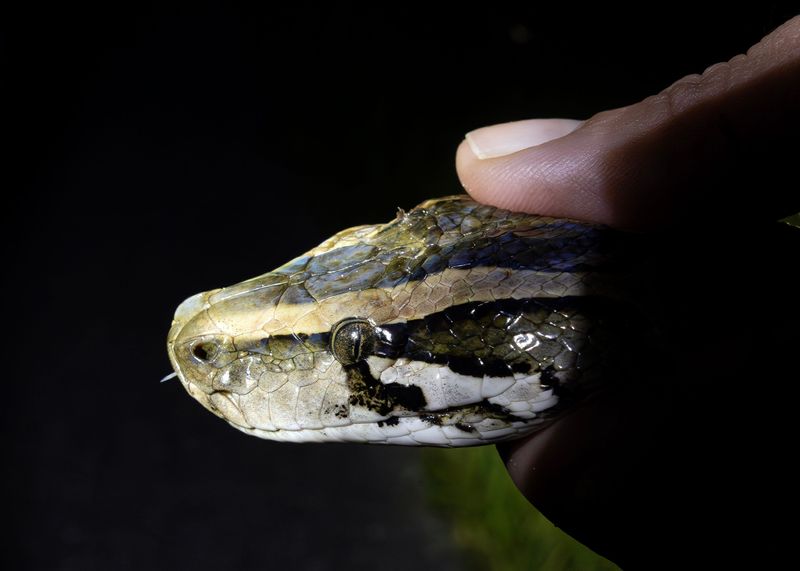
Burmese pythons are tan with dark blotches along the back and sides. The blotches look like puzzle pieces or the markings on a giraffe. They have a pyramid-shaped head with a dark, arrowhead-shaped wedge extending toward the nose.
They are one of the largest snakes in the world. Adult Burmese pythons caught in Florida average between 6 and 9 feet, and the largest one captured in Florida measured 19 feet.
Fast facts about Burmese pythons in Florida
Contributing: Cheryl McCloud, USA TODAY NETWORK Florida and Chad Gillis, Fort Myers News Press
This article originally appeared on Fort Myers News-Press: Cold weather is coming to Florida! What do low temps mean for Burmese pythons?
Reporting by Samantha Neely and Kim Luciani, USA TODAY NETWORK – Florida / Fort Myers News-Press
USA TODAY Network via Reuters Connect