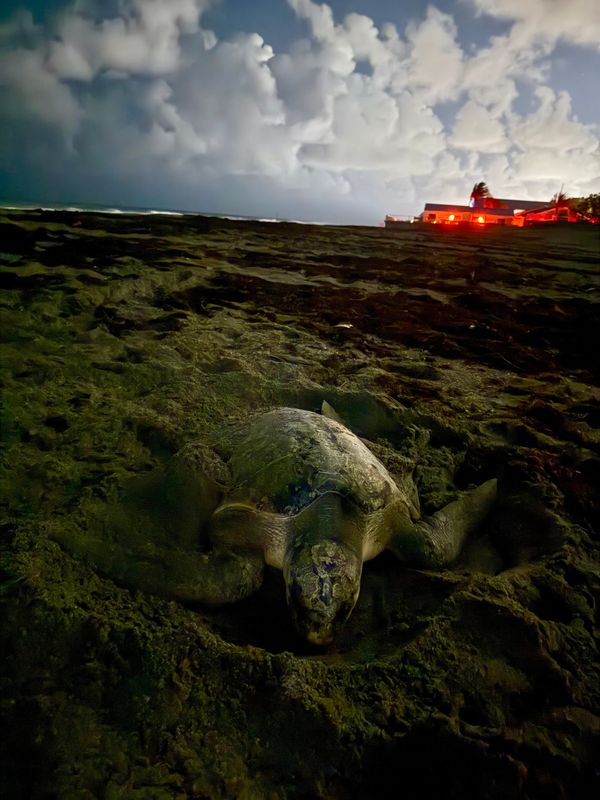
Wildlife researchers discovered an extremely rare olive ridley sea turtle nest at Jupiter Beach Park — the first documented olive ridley nest ever recorded in Florida.
Palm Beach County is already known for large numbers of loggerhead, green, and leatherback turtle nests, but olive ridleys have not previously been recorded nesting as far north as Florida.

Scientists are not certain why an olive ridley nested in Florida, but possible explanations include changing ocean conditions, shifts in sea turtle populations, or unusual migration patterns.
Here’s what we know about the rare olive ridley sea turtle nest found in Florida, and what beachgoers should know about turtle nesting season.
Where was the rare olive ridley sea turtle found in Florida?
Researchers at the Loggerhead Marinelife Center in Juno Beach filmed and photographed the turtle nesting May 18 on a Jupiter beach. They didn’t give a more specific location to protect the nest.
The turtle, named Tini, is known to nest only on beaches in the southern Atlantic Ocean, including Brazil, Trinidad, Suriname and Gabon.
Olive ridley sea turtles have never been seen nesting in Florida. What is changing?
“Maybe sea turtles are selecting new areas to nest,” Justin Perrault, the center’s vice president of research, told TCPalm. “Maybe Florida is the new hotspot. With ocean temperatures warming, more areas are becoming suitable for other species.”
Several factors may explain the species’ northward expansion of its typical range, researchers said:
“Our team had been on the lookout for our usual third species of nesting turtles — green turtles — when this small and distinctive turtle came ashore to nest,” Perrault said.
After the eggs hatch, the team plans to collect genetic samples from the nest and monitor whether Tini returns to a Florida beach, or even the same beach.
They submitted nesting information to the Florida Fish and Wildlife Conservation Commission.
What do we know about olive ridley sea turtles? Where are they usually found?
Olive ridley sea turtles are among the smallest species of sea turtles and are named for the olive-green color of their heart-shaped shells.
According to the National Oceanic and Atmospheric Administration, Olive ridleys are typically found in the tropical regions of the Atlantic, Pacific, and Indian oceans. In the Atlantic Ocean, they are found along the coasts of West Africa and northern South America, and until last month, they had never been recorded nesting in Florida. In the Eastern Pacific, olive ridley turtles can be found from Southern California to Northern Chile.
Olive ridley sea turtles are famous for their unique nesting strategies, which include solitary nesting and the ‘arribada,’ a mass-nesting event where thousands of females come ashore simultaneously.
What to know about Florida sea turtle nesting season guidelines, set by the FWC
Florida sea turtle nesting season typically runs May 1 through Oct. 31, but from Brevard to Broward counties, it begins earlier, on March 1, according to FWC.
Special protections are required on those beaches “because of the high density of turtle nests,” FWC says.
Noise, activity, obstacles, uneven sand and the wrong kind of sand can stop sea turtles from nesting, the FWC website says. Artificial lights also can disorient mothers and hatchlings, directing them away from the ocean. They can die from dehydration, exhaustion, predation and being hit by cars if they make it to A1A, FWC says.
You can get all of Florida’s best content directly in your inbox each weekday by signing up for the free newsletter, Florida TODAY, at https://tcpalm.com/newsletters.
This article originally appeared on Treasure Coast Newspapers: Rare olive ridley sea turtle nest on Florida beach. What to know
Reporting by Hana Khalyleh and Timothy O’Hara, USA TODAY NETWORK – Florida / Treasure Coast Newspapers
USA TODAY Network via Reuters Connect
By Hana Khalyleh and Timothy O'Hara, USA TODAY NETWORK – Florida | USA TODAY Network