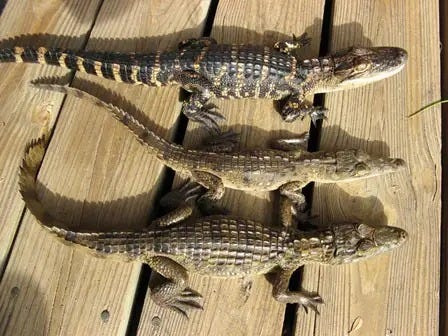
Move over alligators. And crocodiles.
There’s another reptile that’s been quietly making itself at home in South Florida for the past 45 years: the spectacled caiman.

They’ve established breeding populations in Miami-Dade and Broward counties, according to the Croc Docs.
Caimans were described as an invasive species “of highest impact concern” in an April 2026 report written by the Department of Wildlife Ecology and Conservation and the University of Florida Institute of Food and Agricultural Services Fort Lauderdale Research and Education Center.
Never heard of them? Here’s what you should know.
What is a spectacled caiman?
Originally from Central and South America, the spectacled caiman is another crocodylian — a smaller relative of the American alligator — that has been in the pet trade since the 1950s, with established populations in Florida documented since the 1970s, according to the report.
It has one of the widest ranges of all crocodylians in the Americas, spanning 17 countries from Mexico to Brazil.
What do spectacled caimans look like?
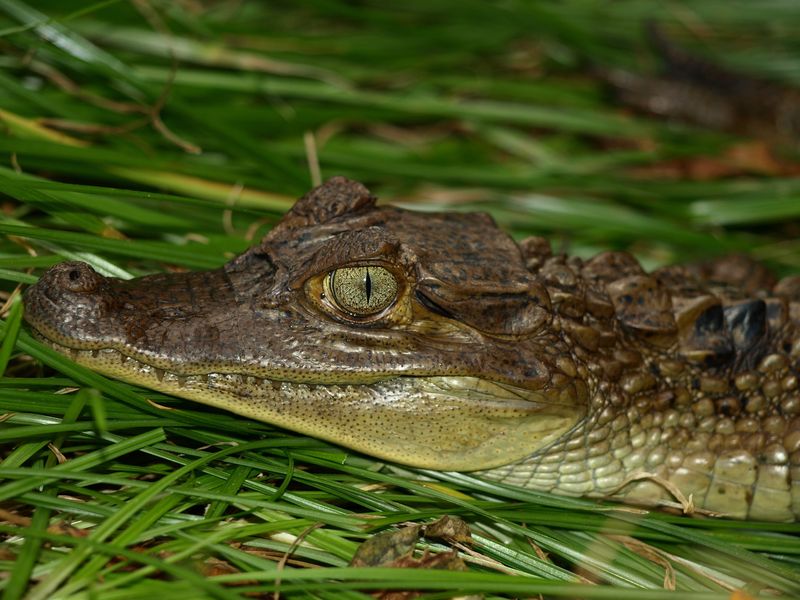
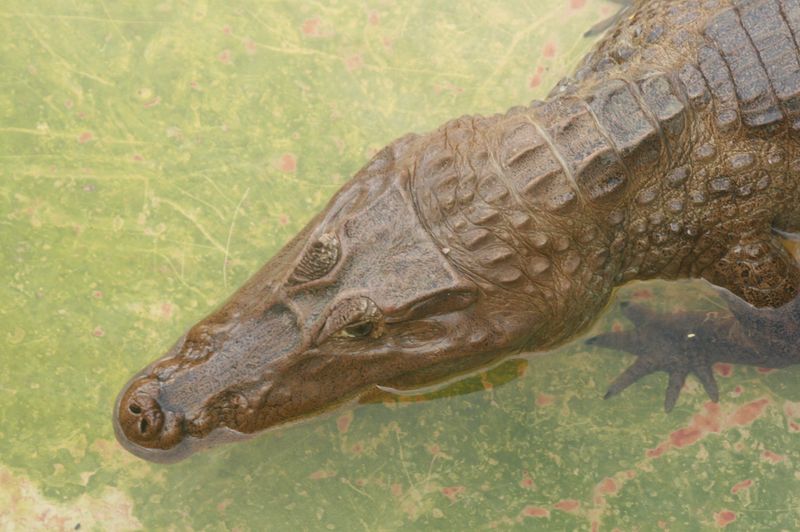
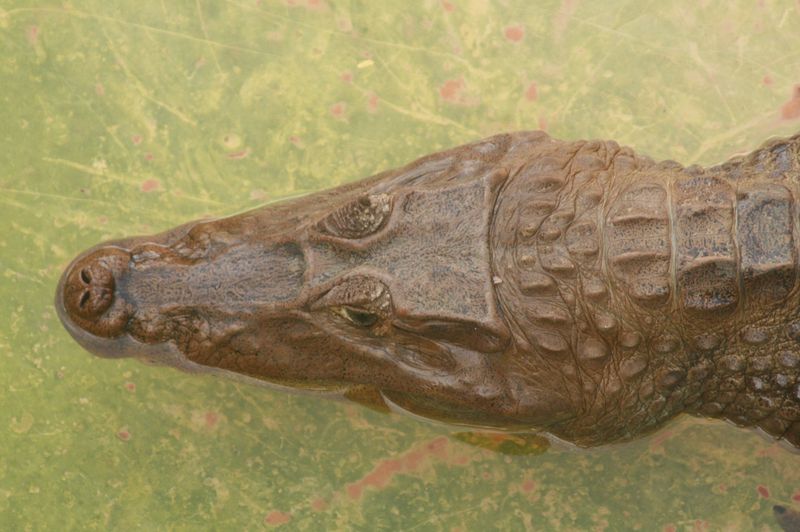
The common or spectacled caiman looks more like the American crocodile than the American alligator, according to Florida Fish and Wildlife Conservation Commission.
“Its color is similar to the crocodile’s but with a shorter more rounded snout.”
Spectacled caimans are mid-sized crocodylians, rarely exceeding 2.5 meters (8 feet) in total length. It has a broad skull and spectacle-like ridge between its eyes, giving it the appearance of wearing glasses.
The Florida Fish and Wildlife Conservation Commission said the common or spectacled caimans rarely exceed 5 feet in length.
What habitats do spectacled caimans prefer?
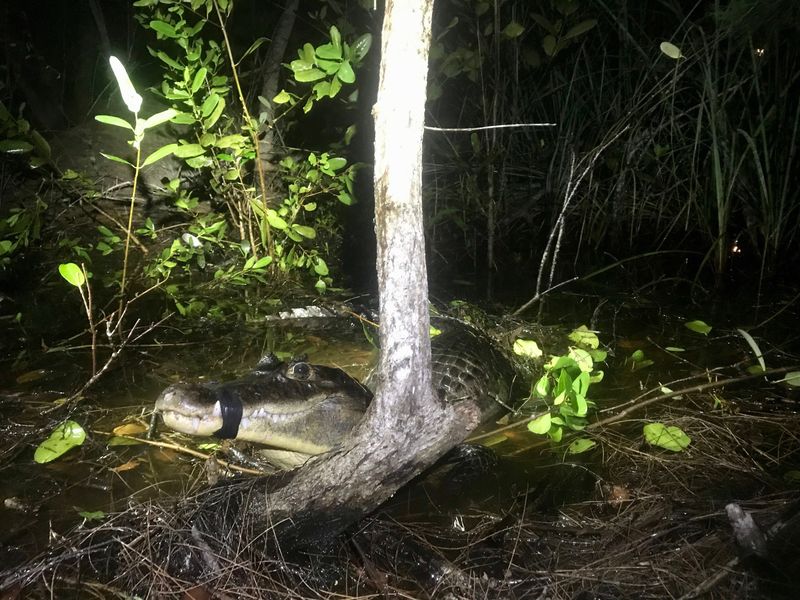
Spectacled caimans inhabit a variety of ecosystems throughout their native range from swamps, marshes, and water bodies in forested areas to manmade water reservoirs and canals in disturbed, urban, and agricultural areas.
Caiman nesting in South Florida occurs from mid-June to mid-July and hatching appears to happen in early September.
What do spectacled caimans eat?
Although there are few studies on what Florida caimans eat, the species has a broad diet that includes insects, fish, reptiles, birds, and mammals.
In South Florida, juveniles prey upon amphibians, small fishes, and invertebrates, and adults prey upon larger fish and birds.
“The spectacled caiman is a habitat and diet generalist, making it a prolific invader likely only being limited by temperature.”
Where have spectacled caimans been found in Florida?
“Early records of spectacled caiman in the wild in Florida started in the 1960s, with locals reporting individuals in Palm Beach County,” according to the report.
“In the 1970s, spectacled caimans were first found and removed from the Homestead Air Reserve Base and by 1980 it was determined that the spectacled caiman was established (reproducing and growing by itself in the wild) in South Florida.
“Since then, records of spectacled caiman in South Florida ecosystems have increased in areas such as:
Spectacled caimans in South Florida are mainly found in manmade habitats such as canals, artificial ponds/lakes, and ditches, although recent records have documented occurrence in natural areas such as marsh and slough areas within Water Conservation Area 3, which is located north of Everglades National Park and east of Big Cypress National Park and Everglades National Park
“There are now breeding populations in localized areas of Miami-Dade and Broward counties, due to escapes or deliberate releases,” according to the Croc Docs.
“Caiman are established within or adjacent to two important Everglades restoration sites (Biscayne Bay Coastal Wetlands and C-111N Spreader Canal Project), indicating potential to become a widespread problem in the Everglades.”
The Florida Fish and Wildlife Conservation Commission said caimans “will probably remain confined to South Florida because they cannot tolerate cold temperatures.”
Are spectacled caimans prohibited?
Spectacled caimans have been and are still active in the pet trade in the U.S. and Florida, according to the report.
The species is not currently listed as prohibited, allowing importation, transport, trade, possession, and breeding in Florida.
However, Florida law requires any nonnative species imported into the state be authorized by the FWC.
Caimans are listed as Class II wildlife, which are “considered to present a real or potential threat to human safety. Possession of Class II wildlife for personal or commercial purposes requires a permit,” according to FWC.
A total of 330,705 spectacled caimans were imported into the U.S. from 1977 to 2024, with 18,525 imported directly into Florida between 1999 and 2018. Miami was the main port of entrance.
Colombia was identified as the main source of introduced spectacled caimans in Florida although there are some that originated in northern Brazil-southern Guyana, which could provide more genetic diversity leading to an increased population.
Why are spectacled caimans so at home in Florida?
Spectacled caiman rapid establishment in South Florida can be attributed to:
“There is a potential for spectacled caimans to have a negative impact on Everglades ecosystem restoration.
“The creation of ponds, canals, and marshes as part of restoration infrastructure provides habitat for caimans immediately adjacent to (sometimes within) natural areas meant to be restored, while changes in environmental conditions (in this case lower salinities within the restored site) may make habitats more suitable for caimans
Has anyone tried to remove spectacled caimans from Florida?
“Few and sparse efforts to control/eradicate spectacled caimans have been documented in South Florida since their establishment in the 1970s,” according to the report.
A total of 44 spectacled caimans were removed between 1977 and 1978. In 2009, the U.S. Department of Agriculture personnel at Homestead started recording caiman removals, documenting another 44 removed.
A systematic removal effort was consolidated in 2017, which is still going on, has removed 342 spectacled caimans from Comprehensive Everglades Restoration Plan, Biscayne Bay Coastal Wetlands, C-111 Spreader Canal Project, and Everglades National Park as of November 2025.
“This is currently the only active effort to control or manage spectacled caiman populations and their effects on Everglades ecosystems in Florida.”
Do spectacled caimans pose a threat to Florida’s alligators and crocodiles?
Caimans not only pose a threat to native wildlife, but compete with Florida’s alligators and crocodiles for food and other resources.
“While American crocodiles are predicted to increase in growth, survival, abundance, and body condition …. lower salinities may also attract caimans, potentially limiting the response of crocodiles,” the report said.
“Caimans also pose a threat to alligators and Everglades National Park.
Cheryl McCloud is a journalist for the USA TODAY Network-Florida’s service journalism Connect team. You can get all of Florida’s best content directly in your inbox each weekday day by signing up for the free newsletter, Florida TODAY, at https://palmbeachpost.com/newsletters.
This article originally appeared on Naples Daily News: Alligators, crocodiles beware. Spectacled caimans moving into Florida
Reporting by Cheryl McCloud, USA TODAY NETWORK – Florida / Naples Daily News
USA TODAY Network via Reuters Connect