

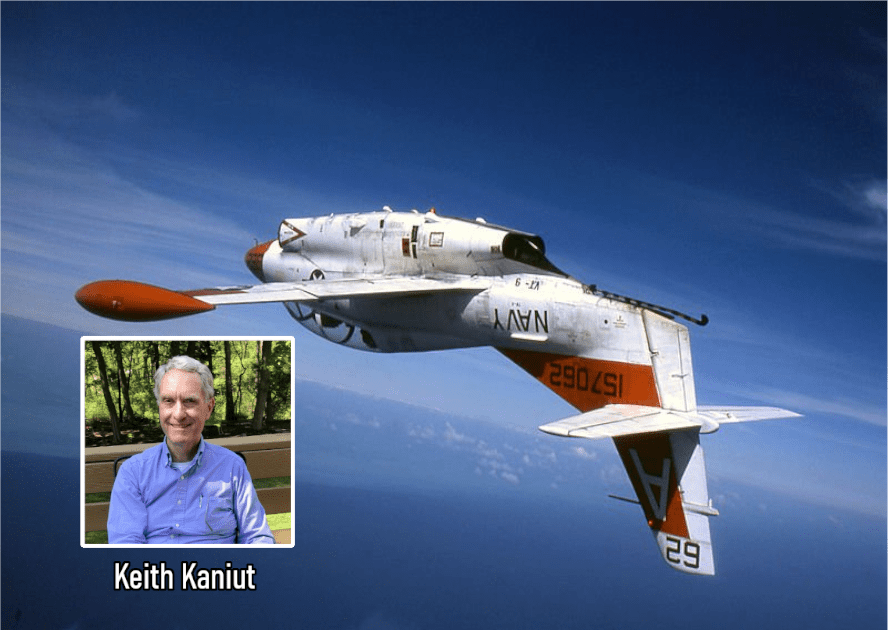
By Keith Kaniut

Loss of Controlled Flight: A fancy way of saying that for the next few moments, the airplane will be ignoring your inputs!
Inverted (upside down) spins are disorienting and dangerous. Tactical jets with short wings, big engines and long fuselages are particularly prone to them. I won’t bore you with the aerodynamics. I’ll just say that Inverted spins are pretty high on the list of Things-To-Avoid for a tactical jet pilot.

What’s the big deal? Because during and immediately following a spin, you are defenseless. If one occurs during an air-to-air “dogfight” with the enemy, they will shoot you down and that can ruin your whole day. Even if you’re not in a dogfight, inverted spins are so disorienting and violent that you may have trouble figuring out the critical information you need to recover, like the direction of spin and your altitude. If that happens, your only option is an ejection and that’s a lousy way to end a flight.
For these reasons, in the 70’s and 80’s the Navy required inverted spin recovery training during the Advanced Jet training syllabus prior to a student flying his Advanced Tactical Maneuvering flights (“dogfighting”) in the TA-4J Skyhawk.
The Skyhawk would have been a dangerous airplane to deliberately spin so the Navy used the straight-winged T-2C Buckeye for the spin training. The Buckeye’s flight characteristics were predictable and relatively gentle compared to the Skyhawk. You had to force it to spin inverted and if the student messed up, the instructor could quickly take over and recover. The training focused on showing the student how to avoid spins with just enough practice recovering from actual spins so that during an actual loss of controlled flight, their training would take over and they’d either recover or recognize the point when recovery was impossible and an ejection was required.
As a senior T-2 flight instructor, I was qualified to conduct these flights and had done a ton of them. Most of the instructors hated spin flights but somehow, I had grown to enjoy them. My problem was that this familiarity bred complacency.
As usual that day, my student was both nervous and excited during the briefing. He had graduated from flying the Buckeye several months earlier and had been flying the Skyhawk ever since. All his emergency procedures and memorized airspeeds were for the Skyhawk. I would fly from the front cockpit. My job was to get us airborne, demonstrate the first spin, and monitor the student while he flew two more. I would also land the jet. Assuming a successful recovery from all three spins, the student would be as ready as the Navy could make him for flying a Skyhawk at the edge of its flight envelope.
The most disorienting aspect of an inverted spin is that you are dangling upside down from your four-point seat harness straps. But you are not just standing on your head; you are bouncing upside down. Anything in an unzipped pocket falls out. But it doesn’t fall down to your feet. It falls past your head to the top of the canopy. Therefore every briefing includes a warning to “Check all Zippers closed” on your flight suit pockets. On this flight, I should have repeated this warning before entering the first spin.
Once we’d reached our starting altitude and cleared the area around us for other traffic, (we were flying in a designated Military Operating Area over rural Mississippi.) I flipped the Buckeye over onto its back, applied full left forward stick and left rudder to start the spin, describing my actions and the aircraft’s response over the intercom to the student. As we began to spin earthward while hanging in our straps, I saw the problem in my rear-view mirrors (used to watch the student in the back cockpit). A handful of coins had fallen out of the student’s pocket and were now in a compact cloud slowly bouncing towards me along the top of the canopy. Not good!
I could have immediately recovered from the spin and returned to base, hoping that the coins didn’t lodge somewhere dangerous and jam a flight control, but I noticed that they were getting closer with each bounce. An idea quickly formed. It appeared that in another few seconds they would be above my head and within reach if I continued the spin. Yes – it would be a close call because we were limited to no more than two (2) complete turns during these practice spins and an absolute minimum allowable altitude of 10,000 feet. You weren’t allowed to break that altitude at any time during the recovery. But it looked possible.
I watched the coins in the mirrors and automatically continued my routine narration for the student, directing his eyes to the airspeed, altitude, direction of spin and talking about the proper direction of the stick and rudders to start the recovery. The most critical task is to train the student to believe the instruments and not look outside!
Finally, just before I needed to start the recovery, the coins were within reach! I had already unzipped my empty right pocket. Now I plucked the coins off the canopy and tucked them safely away, zipping up as I moved the stick and rudder to recover from the spin.
The aircraft stopped spinning, pointed almost straight down but under positive “g” again. I advanced the throttles, pulled the nose smoothly to the horizon bottoming out a bit over 12,000 feet altitude. As we climbed back to altitude I gently reminded the student to recheck his zippers. He did.
I gave him the aircraft (“You have it.” “Roger, I have it.”) He called out the Spin checklist including “Check Zippers!” without prompting. Good. Lesson learned. The remainder of the flight passed without incident and he passed this important check flight having learned a couple of things extra.
Why didn’t I abort the spin immediately? That was the standard procedure according to the Safety Manual. Well, I knew that if I’d simply flipped the aircraft back upright, all the coins would have fallen into the floorboards beneath the ejection seat. Those floors are not solid like a car’s. There are moving pushrods, cables, and electrical connections that could be shorted out. I reasoned that even if I tried but failed to retrieve the coins I would be no worse off than if I didn’t try. But there was one potentially critical factor I’d disregarded: I would be starting the recovery at a lower altitude!
This was not automatically a fatal problem even if the controls became jammed because I still had that extra 10,000 feet. But it was a deviation from the Safety Manual and would have been discussed and noted. If I had recovered from the spin without recovering the coins I’d have no choice but to abandon the training, return to base and hope that nothing would become jammed during landing or the return flight. It would have been a serious “FOD* in Cockpit” event. (*Foreign Object Debris) I judged (correctly) that I had sufficient time and altitude to try retrieving the coins.
This incident taught me that some things are important enough to repeat – like the warning about closing all zippers. All my subsequent flights included a more thorough explanation of the zipper problem and all future spins were preceded by the intercom call to “Check All Zippers!”
