A massive new development could bring up to 4.7 million square feet of warehouses, along with new space for shopping, dining, medical care and outdoor recreation, to an undeveloped section of Banning just off Interstate 10.
The project has divided the community with supporters saying it will bring commerce, jobs and economic benefits the city sorely needs while opponents have raised concerns about what the city says will be negative air quality and greenhouse gas emissions impacts from the development that cannot be fully mitigated, among other issues.

Now, the city’s voters will be asked to decide if development plans should move forward after Banning’s city council voted unanimously on July 14 to put that question on the November ballot.
The ballot question will provide a rare chance for residents to decide themselves whether warehouses and other major development can be built in their city. Banning sits on the eastern end of an Inland Empire region where both warehouses and debates about their impact have proliferated in recent years.
Concerns about the project have divided many of the roughly 32,000 residents of the fast-growing city on San Gorgonio Pass.
What is Sunset Crossroads?
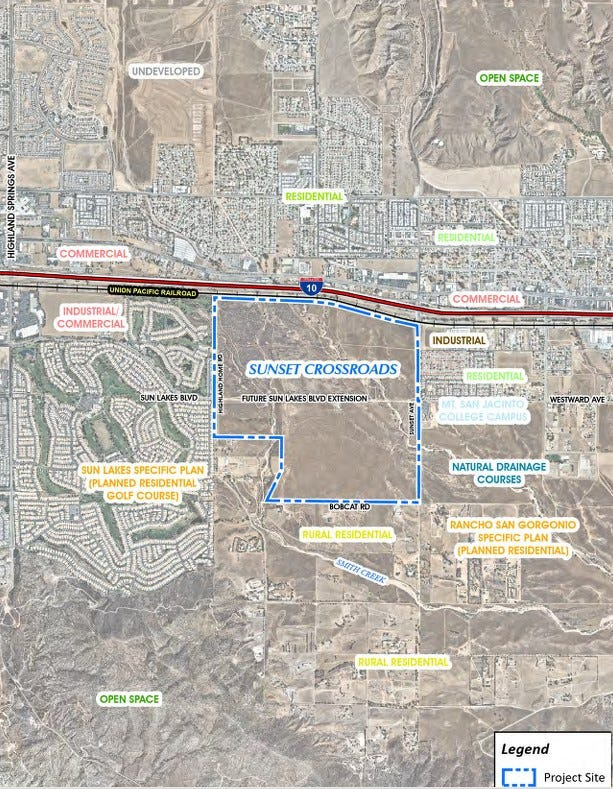
Sunset Crossroads is the name for a proposed plan that would allow Missouri-based NP Banning Industrial LLC to develop over 500 acres of land just south of Interstate 10, between the Sunset Avenue and Highland Springs Avenue exits, near the Farm’s House restaurant, a red barn-like building visible from the freeway.
The 533.8-acre site is bounded to the east by Sunset Avenue and to the west by the Lakes Country Club community. The Union Pacific railroad tracks that run along Interstate 10 form the northern border of the site
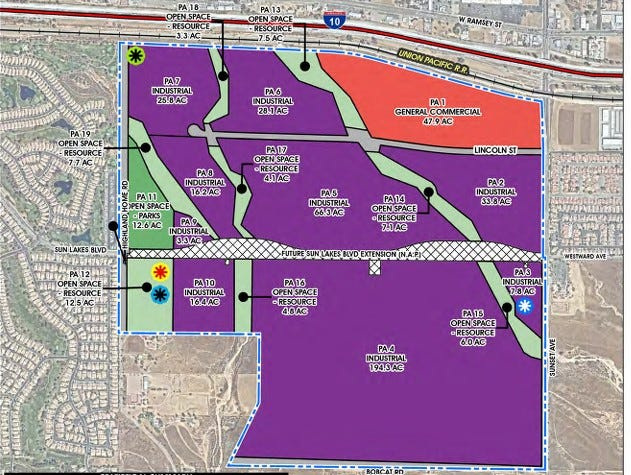
Under the plan, the company would be able to develop the bulk of the land – up to about 392 acres – with industrial uses, such as facilities that could be used for warehousing, manufacturing and distribution.
Another 47.9 acres is designated for commercial development that could entail a variety of retail, entertainment, dining and medical uses, including everything from a grocery store to a food court to an indoor skydiving facility.
An agreement between the city and the company laying out the terms under which the land will be developed states that the project can include up to 223,753 square feet of commercial uses and is also intended to include a 125-room hotel, although the latter is not a requirement.
Five acres would be turned into a park while another 24 acres would be used for less developed “passive open space” that could be traversed with trails. Another 41.5 acres would be left as is to preserve three existing waterways.
Under the agreement, NP Banning Industrial would have three years to start construction of at least 100,000 square feet of commercial space and would face fines of half a million dollars every six months for not doing so. It is also required to ultimately build at least two 100,000-square-foot commercial buildings. The agreement does not otherwise stipulate what must specifically be built and when, with the exception of certain infrastructure improvements laid out in the agreement.
The contract also lays out how the company would be obligated to pay the city around $35 million in various public benefit payments and provide land at the project for the construction of a new fire station, electrical substation and water tank that it would also cover much of the cost of, with the company able to apply up to $2 million in sales tax generated by the industrial property toward those payments.
The project’s lengthy Environmental Impact Report states that the project would have “significant and unavoidable impacts” on air quality and greenhouse gas emissions that there is no known way to fully mitigate. It imposes requirements that the company implement measures that mitigate them to “the extent feasible.”
Why is Sunset Crossroads proposal going to Banning’s voters?
The city made a series of votes in April greenlighting the development, including approving the 30-year development agreement between the city and the company.
Those votes came less than six months after the city’s planning commission voted 3-2 to recommend that the council deny the project.
A group of residents opposed to the project, however, responded to the council’s vote by forming a group called San Gorgonio Pass Alliance. The aim of that group was to collect signatures from at least 10% of the city’s registered voters to trigger a law forcing the council to either overturn its own approval or put the issue to the voters.In May, the group delivered over 2,500 collected signatures to the city clerk. About a month later, the clerk confirmed that 2,379 valid signatures from registered Banning voters had been submitted, about 400 than the threshold needed.
What are Banning residents saying about Sunset Crossroads?
The degree to which the proposal has caused tension and division in the community was on full display at an emotional council meeting earlier in July.
Many cited a need to bring new jobs, commerce and investment to Banning, which they said they hoped the project would do. Several of those speakers bemoaned the loss of businesses from Banning, saying that residents are now often going to neighboring Beaumont for shopping and entertainment to Banning’s own economic and quality-of-life detriment.
One speaker argued that many of the project’s opponents were old and at or near retirement and that the council had been rightfully trying to look out for the interests of the next generation by supporting the project.
Opponents, meanwhile, said they were concerned that hundreds of trucks coming and going from potential warehouses would damage air quality and the environment while also creating traffic congestion. Some also described warehouses as ugly and said that the Inland Empire has too many of them.
There was also questioning of what kind — and how many — jobs warehouses or similar uses would create given that many think warehouse jobs are ripe for automation from artificial intelligence.
A few speakers said they felt the development would be too close to homes and is better suited elsewhere. Still others said there are better uses for the land. One speaker questioned how much Banning residents would really benefit from a project that was 95% industrial and 5% commercial.
Could data centers be part of Sunset Crossroads?
Councilmember Sheri Flynn, who opposes the project, said she is concerned that data centers had apparently been made a “use-by-right” in zoning documents the council OK’d as part of the approval process. She argued that would give the city little recourse to stop data centers from being built there provided the company did what was necessary to alleviate their environmental impacts.
Banning Mayor Richard Royce said the developer had committed to removing that language from the planning documents and that the city is also considering its own moratorium halting data center development, as multiple cities in the Coachella Valley have done. Flynn countered that the city attorneys had instructed a moratorium could not be applied retroactively to the Sunset Crossroads project.
That discussion ended without an apparent resolution when a city attorney urged the council to return to the topic at hand, which he said was the decision of whether to send the question to the voters.
Flynn then tried to make a motion but to overturn the decisions. But when she was not joined by any other councilmembers, she made a second motion to send the matter to the voters that passed unanimously, without any of the councilmembers making any comments explaining their vote and why they opted to send the question to the voters.
Paul Albani-Burgio covers growth, development and business in the Coachella Valley. Email him at paul.albani-burgio@desertsun.com.
This article originally appeared on Palm Springs Desert Sun: Should 4.7 million square feet of warehouses be built in Banning?
Reporting by Paul Albani-Burgio, Palm Springs Desert Sun / Palm Springs Desert Sun
USA TODAY Network via Reuters Connect
By Paul Albani-Burgio, Palm Springs Desert Sun | USA TODAY Network