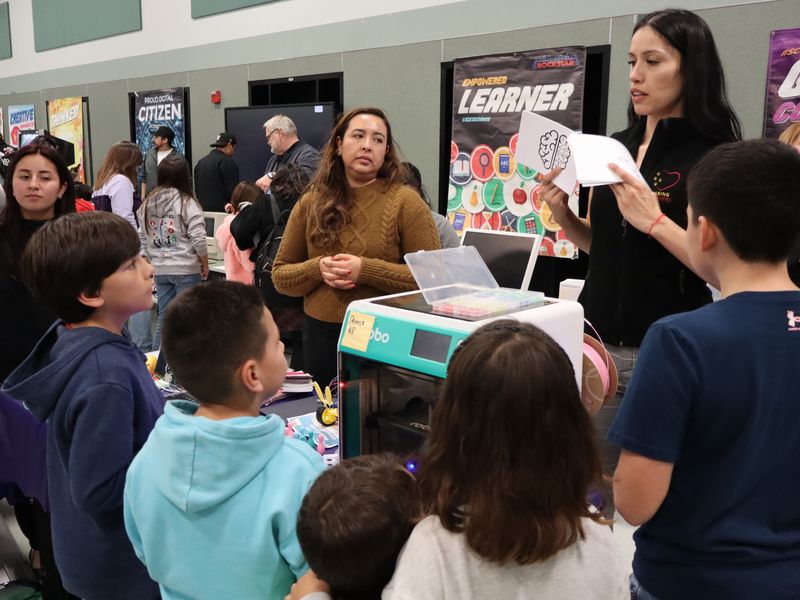
Robots made out of Lego bricks and a tech-centric fashion show with pieces created by students marked the first ever Computer Science Showcase on Wednesday at the Salinas City Elementary School District.
Held on Dec. 10 at Boronda Meadows Elementary School, the evening event was for students and their families and coincided with Computer Science in Education Week, an initiative that aims to inspire K-12 students to learn computer science.

“One of the biggest things I notice is that our children not only come to school ready to learn, but also with an amazing sense of curiosity, initiative and motivation and these types of events make that learning so much more fun,” Superintendent Rebeca Andrade said.
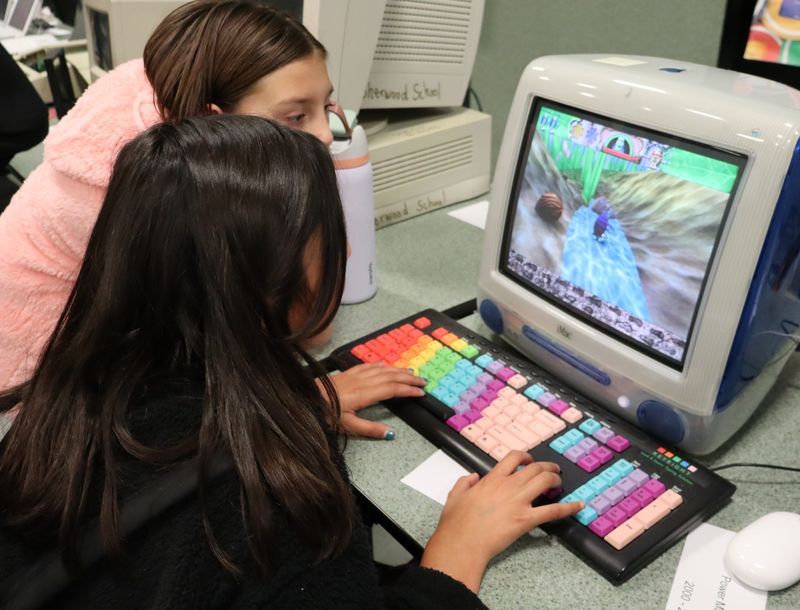
The school’s multipurpose room was filled with student-produced work, demonstrations and a history of the computer mini-museum where parents got to explain to their children what a floppy disk is, and students experienced the primordial frustration of playing video games from the 1980’s and 1990’s.
An old projector from the 1940s that staff found in a district warehouse also made an appearance.
The showcase included a number of partner agencies such as Lego Education, Hartnell’s K-12 STEAM Foundation, Hartnell Planetarium’s Robotics Team as well as the district’s own Salinas City STEAM academy and El Gabilan student-run TV and videography team.
Embedding critical skills in all subjects
“In the past we had something called a STEAM showcase where we do something similar, but this year we really wanted to highlight computer science as part of Computer Science in Education Week,” said Krysta Bradley, district coordinator for innovation. “It’s a national movement to make kids familiar with computer science and computational thinking to prepare them for the future.”
Bradley said introducing computer science concepts to young students can be done in fun, innovative ways.
“Me and my team worked with a group of fourth-graders over the last few weeks, and they coded micro bits, but the catch was they had to attach the micro bits to an article of clothing and whatever they designed or encoded had to be a part of their identity,” Bradley said. “We really highlight in our district computational thinking, which can be applied to all subjects, from writing, to math and when you are doing science.”
Bradley said the exercises, which can be creative and artistic, are important to build awareness.
“Computer science is the future, and we have to give our kids a foundation, otherwise I worry that girls especially are not going to choose these sorts of electives when they get to middle and high school,” Bradley said. “If we do not expose them to these concepts now, they may not go into these careers, and we are just furthering the gender gap.”
Activities do not mean students are in front of a device, either.
“If a student is under third grade I don’t think they should necessarily be on a device coding, they should be doing unplugged activities, and we have so many of those happening inside right now,” Bradley said.
Andrade, who was at the local Joby Aviation facility earlier in the day said the visit highlighted the need to build critical skills necessary for these nascent industries now.
“We cannot wait until they are in high school,” Andrade said. “We need to be able to embed these skills in science, technology and the arts and make sure they are being done in a collaborative way that solves problems and builds critical thinking.”
This article originally appeared on Salinas Californian: Salinas elementary students showcase computer science skills
Reporting by Roseann Cattani, Salinas Californian / Salinas Californian
USA TODAY Network via Reuters Connect