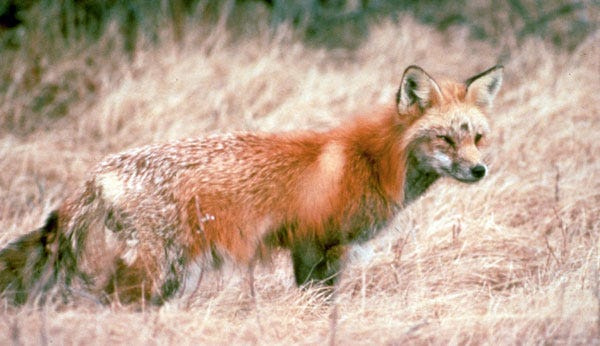
One of California’s rarest mammals has been collared for the first time in the Sierra Nevada, making a potentially historic moment for the species.
By collaring a Sierra Nevada red fox (Vulpes vulpes necator), wildlife officials can now closely study its behavioral patterns in a “significant goal in conservation science,” the California Department of Fish and Wildlife said in a Feb. 9 news release.

“With fewer than 50 individuals believed to remain in the Sierra Nevada, and a lifestyle that keeps them far from human contact, encounters like this are incredibly rare and provide invaluable insight for conservation efforts,” the CDFW said in a Feb. 10 Facebook post.
An ‘exceedingly rare and elusive’ species
Though red foxes are common in North America and Eurasia, wildlife officials consider the Sierra Nevada red fox to be a distinct lineage found only in the high elevation regions of California and Oregon.”
The species has “always been exceedingly rare and elusive,” per historical records, according to officials.
Sierra Nevada red foxes were once thought to have disappeared, but then “an automatic trail camera detected one near Sonora Pass in 2010,” wildlife officials said.
“Since then, researchers have documented Sierra Nevada red foxes as far south as Cottonwood Pass, west of Lone Pine,” officials said.
Species listed as endangered in 2021
Sierra Nevada red foxes were listed as an endangered species in 2021, according to the U.S. Fish and Wildlife Service.
While the factors behind the Sierra Nevada red fox’s population decline are not fully known, wildlife officials said, “Unregulated hunting and trapping in the early 20th century likely played a major role, and low genetic diversity has continued to weaken the subspecies over time.”
The population’s vulnerability continues to be driven by unpredictable events, such as wildfires and drought; competition with coyotes; and widespread hybridization with nonnative species, according to the USFWS.
Historically, the species “ranged from the Oregon-Washington border to the southern end of the Sierra Nevada,” the agency said.
Today, however, the fox has only two distinct population segments: One that lives in California’s Sierra Nevada and the other that resides in the southern Cascade Range of California and Oregon, the agency said.
“The species is typically extremely wary of humans and inhabits barren, rugged terrain at high elevations,” wildlife officials said. “Cautious behavior, remote habitat, and low-density populations make them extremely difficult to find and capture.”
Separate collaring in 2018
In 2018, a team of CDFW scientists “attached GPS satellite collars to several Sierra Nevada red foxes in the Lassen Peak region of northern California,” wildlife officials said.
Those efforts helped biologists find several dens, offering a “much better understanding of the patterns of reproduction, movement, and habitat use in this little-studied species,” officials said.
January capture offers hope for species
January’s capture of a Sierra Nevada red fox near Mammoth Lakes was the “culmination of 10 years of remote camera and scat surveys to determine the range of the fox in the southern Sierra, and three years of intensive trapping efforts,” CDFW Environmental Scientist Julia Lawson said in the release.
“Everyone on the team was thrilled to see our hard work pay off,” Lawson said.
It was the first time the species had been fitted with a GPS-tracking collar and released in the Sierra Nevada, according to wildlife officials.
In an interview with SF Gate, Noah Greenwald, the endangered species co-director for the nonprofit Center for Biological Diversity, called the animal’s capture “significant.”
“It expands our knowledge of where they occur and what habitat they are currently using,” Greenwald told SFGATE. “(Wildlife officials) found this fox considerably south of where the animals are known to survive currently. If they are spreading out, it indicates that they have a better chance of survival.”
Data from the collar and DNA samples gathered during the fox’s capture will offer wildlife officials a better understanding of its species, which will “directly support its protection and aid in increasing the efficiency of future capture and survey efforts,” according to the department.
“Our goal is to use what we learn from this collared animal to work toward recovering the population in the long term,” Lawson said.
This article originally appeared on Palm Springs Desert Sun: One of California’s rarest mammals collared for first time in Sierra
Reporting by Daniella Segura, Palm Springs Desert Sun / Palm Springs Desert Sun
USA TODAY Network via Reuters Connect