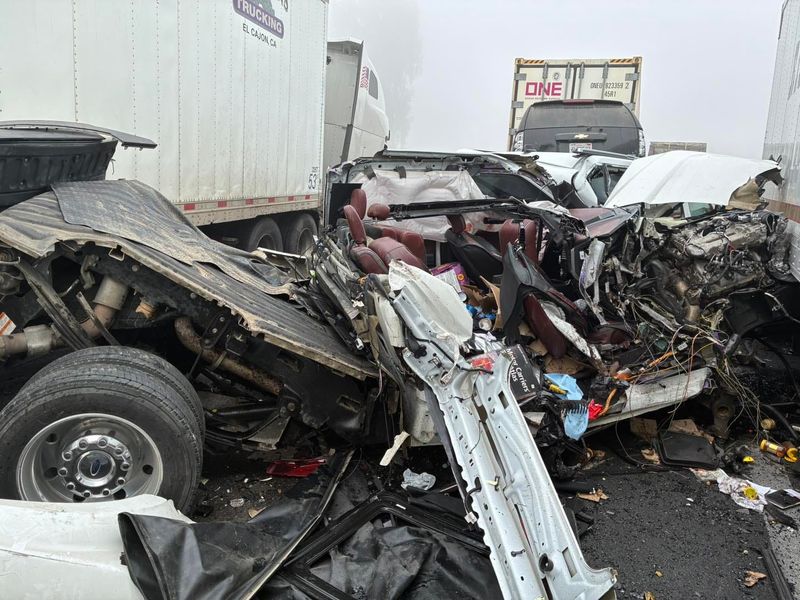
Hours after a massive vehicle pileup shut down Highway 99 near Earlimart in dense tule fog, southbound lanes fully reopened, and Caltrans began guiding northbound traffic at Cecil Avenue as of 2:30 p.m. Saturday.
The crash, which unfolded in near‑zero visibility shortly after 8:15 a.m., sent at least 10 people to local hospitals and left many drivers stranded as crews worked to untangle wreckage stretching across both sides of the highway.

The California Highway Patrol began receiving calls shortly after 8:15 a.m., reporting multiple collisions on both the northbound and southbound lanes near Avenue 24. Officials say visibility at the time of the crash was 100 to 200 feet — the type of conditions CHP frequently describes as “sudden wall of white” events.
Initial reports suggested the pileup involved 150 vehicles, but authorities later revised the count to 59 after a close examination of the wreckage. As of 3 p.m. Saturday, there were no reports of deaths and only moderate injuries.
“Drivers were hitting fog so thick they couldn’t see brake lights until it was too late,” authorities said.
Tow trucks, investigators, and Caltrans crews spent much of the morning and early afternoon clearing wreckage from both sides of the freeway. While traffic has begun moving again, CHP warns of significant delays, especially northbound, where escorts remain in place, and cleanup is ongoing.
Here’s what to know about the tule fog blanketing California’s Central Valley and the rash of accidents that fog has caused this season.
This is a breaking news story. Check back for more details.
A season defined by fog: Valley communities shrouded since November
Saturday’s disaster comes during one of the longest and most stubborn tule fog seasons the Central Valley has seen in years. Since just before Thanksgiving, millions of Californians from Redding to Bakersfield have woken up under a milky, unmoving blanket of mist and fog, with the National Weather Service issuing near‑daily advisories.
Dense Fog Advisories remained in effect across wide swaths of the San Joaquin Valley on Friday and into Saturday morning, including communities around Fresno, Visalia, Porterville, Delano and Bakersfield, where visibility repeatedly dropped below a quarter‑mile — and in some cases to mere feet.
NASA satellite imagery captured Dec. 9 shows the Valley covered by a continuous cloud of tule fog stretching more than 300 miles, the result of “perfect” atmospheric conditions that began forming around Nov. 24 and have persisted through late January.
Residents say this year’s fog stands apart.
“Never lasted this long in my 57 years here,” Greg Clark of Redding told the Record Searchlight.
Meteorologists attribute the unusually persistent layer to a stagnant high‑pressure system that has trapped cold, moisture‑rich air close to the ground, preventing the daily “burn‑off” that often clears the fog by mid‑morning.
Other recent fog‑related crashes across Central Valley
Saturday’s pileup is the largest so far this winter — but not the only one.
Law enforcement agencies say they’ve responded to dozens of fog‑related collisions in January alone, especially during the early‑morning commute.
Notable incidents this month include:
CHP officials say the pattern is clear: sudden, severe visibility drops, drivers traveling too fast for conditions, and people exiting their vehicles on fog‑cloaked roadways — an extremely dangerous combination.
Why Tule Fog is so dangerous
Tule fog is a form of radiation fog, forming when moist ground, cool nights, clear skies, and calm winds combine — conditions common in the Central Valley from November through February.
What made today’s fog particularly hazardous, according to forecasters:
“It’s the classic tule fog setup,” said NWS meteorologist Eric Kurth. “A big bowl of mist.”
Safety tips: How to drive in Tule Fog
For millions of Valley residents, avoiding fog entirely isn’t always an option. But safety agencies say the right habits can save lives.
If you must drive:
Slow down — way down. Expect travel times to double or triple in heavy fog.
Use low‑beam headlights. High beams reflect off water droplets and make visibility worse.
Follow lane lines, not taillights. Looking at roadway markings helps maintain orientation.
Increase following distance dramatically. Give yourself several seconds of reaction time.
If the driving becomes too unsafe:
When will the fog lift?
Unfortunately, forecasters say the Central Valley’s fog cycle isn’t done.
Conditions may improve slightly by late next week as temperatures warm into the upper 60s — but unless a stronger storm system disrupts the stagnant air mass, tule fog is likely to continue forming overnight and during early‑morning hours.
This article originally appeared on Visalia Times-Delta: Massive car pileup shuts Highway 99 near Earlimart amid dense tule fog
Reporting by James Ward, USA TODAY NETWORK / Visalia Times-Delta
USA TODAY Network via Reuters Connect