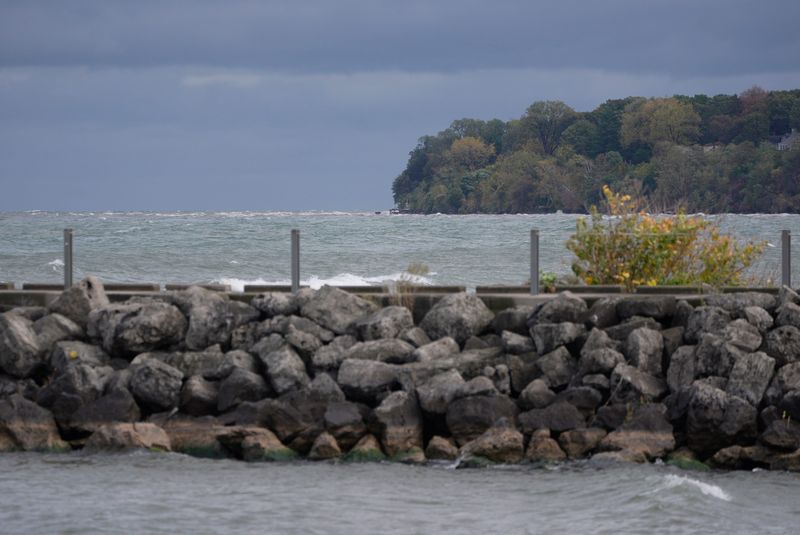
A trip east this summer will bring you to Lake Ontario, the only Great Lake that doesn’t touch Michigan, but one of the deepest and the most eastward of the quintet.
The smallest of the Great Lakes in surface area, Lake Ontario straddles the U.S.-Canada international border between Ontario, Canada, and New York. Niagara Falls, near the lake’s southwest corner, is a major tourist attraction in the region, and the lake boasts historic lighthouses, along with vacation destinations such as Toronto and Rochester, New York.

“The drainage basin covers parts of Ontario and New York, and a small portion of Pennsylvania. Major urban industrial centers, such as Hamilton and Toronto, are located on its shore. The U.S. shore is less urbanized and is not intensively farmed,” the Great Lakes Commission says.
The Niagara River links Lake Ontario with Lake Erie to the west, part of the five Great Lakes.
Here’s what to know about Lake Ontario.
Where is Lake Ontario located?
Lake Ontario borders Canada’s Ontario province to the north and west and New York in the U.S. to the south and east.
How deep is Lake Ontario?
Lake Ontario has an average depth of about 283 feet, and a maximum depth of 802 feet, according to the National Museum of the Great Lakes.
How wide is Lake Ontario? How long?
Lake Ontario is 53 miles wide and 193 miles long, Michigan Sea Grant says.
How warm does Lake Ontario get?
Lake Ontario’s temperatures begins rising in early spring, climbing to a peak in late summer and early fall, according to GLISA, a collaborative between Michigan State University and University of Michigan supported by NOAA.
Seatemperature.org says the average temperature of Lake Ontario is 41.9 degrees Fahrenheit in May. It rises in June to 58.8, and 70.5 in July, before topping out at nearly 73 degrees in August. In February and March, lake temperatures average in the upper 30s.
Does it get warm enough to swim in Lake Ontario?
In July and August, the lakes waters will be comfortable enough to swim. Swimming is typically comfortable in lake waters at about 70 degrees, Swimoutlet.com says.
Your body can enter “cold shock” in water between 50 and 60 degrees, the National Weather Service says. The dangerous condition brings a sudden spike in heart rate and blood pressure, accompanied by involuntary gasping, rapid breathing or hyperventilating in the first two to three minutes, and immediate panic, fear or stress.
How many lighthouses are on Lake Ontario?
Lake Ontario boasts more than 50 lighthouses along the Canadian and U.S. shores, many along the St. Lawrence River to the northeast, Great Lakes Proud says.
How many shipwrecks are there in Lake Ontario?
There have been an estimated 550 shipwrecks on Lake Ontario, the Niagara Falls National Heritage Area says. The lake’s eastern basin is particularly disastrous, having seen some 270-500 shipwrecks, mainly in the “Marysburgh Vortex,” an area where magnetic rock from an ancient meteorite impact throws off compass readings, Nature Canada says.
What is Niagara Falls?
Niagara Falls, three cascades on the Niagara River between Lake Ontario and Lake Erie, is a popular tourist destination, Niagara Falls USA notes. The falls are made up of Canada’s Horseshoe Falls, American Falls and Bridal Veil Falls. Visitors can enjoy walking tours near the top of the falls and boat tours on the river below.
The Niagara region draws in 14 million visitors annually, including 12 million to the city of Niagara Falls, according to Niagara Falls Tourism. On The New York side, Niagara Falls State Park is the oldest state park in the U.S., open 365 days a year and brings in over 8 million visitors annually.
What is the Welland Canal?
The Welland Canal is part of the St. Lawrence Seaway, a system of rivers, lakes, canals and locks that allows ocean-going ships to travel from the Gulf of St. Lawrence on Canada’s east coast all the way to Duluth, Minnesota, on western Lake Superior.
The Welland Canal includes eight locks from Lake Ontario to lake Erie. It traverses Canada west of Niagara Falls.
What is the lake’s Indigenous name?
The name Lake Ontario comes from the Huron word Ontari’io, meaning great lake or beautiful water.
Contact Jenna Prestininzi: jprestininzi@freepress.com.
This article originally appeared on Detroit Free Press: This Great Lake doesn’t border Michigan. 10 facts about Lake Ontario
Reporting by Jenna Prestininzi, USA TODAY NETWORK / Detroit Free Press
USA TODAY Network via Reuters Connect