Mackinac Island — DTE Energy is in the thick of the country’s data center boom with two recent deals inked to provide electricity to Google’s planned data center in Van Buren Township and the data center being built in Saline Township for Oracle and OpenAI, the maker of ChatGPT.
The special contracts the Detroit-based utility company has secured with Google and Oracle/OpenAI will provide 4.1 gigawatts of electricity for two sprawling data centers, the equivalent of powering nearly 3 million homes in Michigan.

This comes as a ballot campaign committee turned in signatures this week seeking to prohibit DTE Energy, other state-regulated utility companies and state contractors with contracts exceeding $250,000, as well as their employees, from giving campaign cash to Michigan politicians.
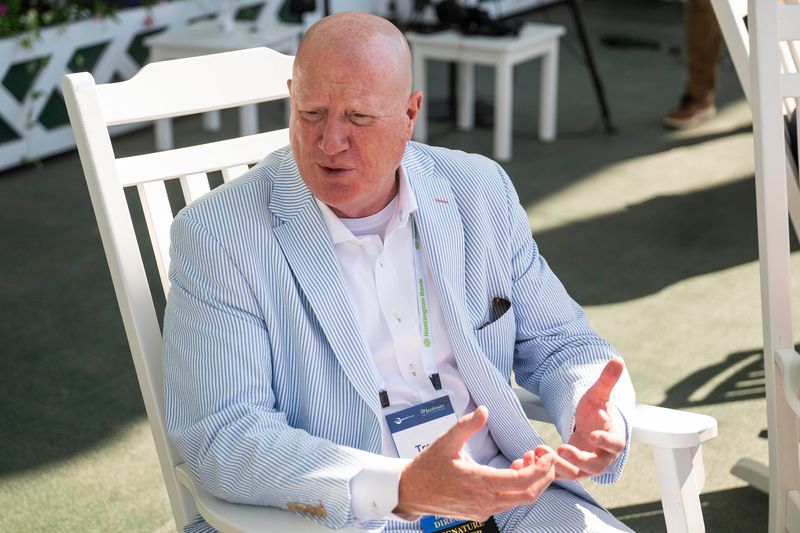
Trevor Lauer, vice chairman and group president for DTE Energy, spoke with Detroit News Politics Editor Chad Livengood at the Detroit Regional Chamber’s Mackinac Policy Conference about DTE’s political giving and how the company is responding to an influx of data centers that will require enormous amounts of energy to power them.
The following partial transcript has been edited for clarity.
Question: There’s a ballot initiative that’s filing petitions today … Michiganders for Money Out of Politics, or the ‘MOP Up’ campaign, that would prohibit the employees of state-regulated utilities from making campaign donations. This looks like a declaration of war against DTE and Consumers Energy, Blue Cross Blue Shield of Michigan and state contractors at large, but in particular the utilities going after your prolific giving to politicians in this state through all the various different channels, and I wanted to get your response to what they’re doing here.
Answer: Our political activities go through our political action committee. It’s hard for me to imagine that a company’s employees can’t be active politically in the issues that matter to them, to their families, to their livelihoods. I think it’s important that all organizations, including DTE, have the ability to have a strong, active political action committee. The other thing I’d say is it’s one half of the equation, right? You’re not restricting the dollars that are coming in from California (to fund the ballot campaign.) You’re really allowing out-of-state voices to come in and dictate state policy. I don’t understand how that’s good for our state. I think you want people who care dearly about the issues, who are actively involved in the issues every day, to be involved in the legislative discussions that are happening.
Q: You have your PAC. We also have the affiliated 501(c)4 that gives money in different ways to other 501(c)4s. That is sort of a separate system that doesn’t have disclosure because of federal laws. That seems to be the biggest criticism of the system, that the money that flows in Michigan politics, half of it is disclosed and half of it is secret. And their solution here is just to ban all the money that ends up in the secret accounts.
A: I take offense to the word secret. We publish every dollar that we give and who they go to. So I don’t think there’s anything that DTE does not disclose. I think it really goes back to our political action committee is the main voice that speaks for DTE, and that is supported by 70% of our employees inside of the company. These issues matter a lot to us. Energy policy matters a lot to our state, and it’s hard for me to imagine not having a strong voice inside of that and allowing out-of-state interests to be the ones that pile money in the way you’re describing it to influence issues.
Q: In state energy policy, data centers are front and center. What is the path forward to supply the power for the Van Buren Township project? How are you going to come up with that power in such a short period of time? What are the sources that you will primarily turn to?
A: Your question’s a complicated one that I need to unpack a little. The first thing I try to describe to people is we have an obligation to serve customers. If you show up on our electric system and you say want service, I don’t get to say I don’t want to serve you, but I’ll serve you. As long as you can pay the bills and you will not harm the other customers on our system, we have an obligation to serve. In the case of Van Buren Township project for Google, we worked extensively with Google to build the assets and to develop the assets that will support them.
How do we do it in a short period of time? All electric systems are built for the hottest single day of the year, which means on the average day, about 50% of the energy we’re using in our system is actually getting used. We have a lot of excess energy on 98% of the days, so to bring on a large load, what you’re really trying to solve for is that 2% of the days when the system’s under stress. So in the case of what we’re doing with Google, we’re adding a series of energy storage facilities. With energy storage, when the system’s got a lot of excess power, we charge batteries, and then when the batteries need to export that, we can cover those new peaks that have been created. On every other day, we’re just using the same system we have, and we’re spreading the fixed costs of that system across a lot more customers, so we’re able to take pressure off of everybody’s rates and bills. We designed it in a way to benefit our customers and to benefit the new customer that’s coming into the state.
Q: So with this contract DTE just locked into with Google for 20 years, if they pull up and leave in five years, what happens with all the new generation and the battery investments that you had to make in order to fulfill that? Who pays for that?
A: Great question. When we negotiate these contracts, the first thing we try to do is make sure that we’re protecting our existing customers. In these contracts, unlike any other industrial customer we serve, they have termination fees. If they terminate before 20 years, there are payments that are dictated in the terms and conditions that they have to make. Those payments cover the cost of any infrastructure that we’ve had to build for them. Secondly, they pay directly for all the infrastructure on our distribution system and transmission system to bring them online, so they’re making direct payments to us. They’re not going through the regulated rate process, and they’re covering all their costs. Third, they’re paying directly to us for all of the assets we’re building for them. So again, we’re not asking the other customers to subsidize any assets or to push any cost to them. We’ve contracted directly for them, and they’re covering the entire cost of the assets. We’ve structured agreements that have termination fees, minimum contract links, minimum billing demands. These are the things that protect our other customers and make sure that everybody else actually gets an affordability benefit from these data centers.
Q: In layman’s terms, how will people see that affordability? How will that come down?
A: What these two contracts with Oracle, OpenAI and Google have done … it’s $9 billion of positive affordability. Or said another way, they’re paying above the cost to serve them. They have voluntarily agreed to pay $9 billion more than what is needed to serve them. That will reduce cost pressures elsewhere on our system.
Q: DTE has had some 5-7% rate increase requests in the last couple of years.
A: We have, but I’d like to point out our rates and bills are below the national average and the regional average. I think it’s important to keep reminding people where we actually sit relative to others. The national average for electricity has been up almost 30%. We’re up about 4% over those years. So it may feel like a lot, and it is a lot if you’re on the other end, but relative to the rest of the country, our bills have gone up very little over the last five years.
Q: So you got the Oracle and Google deals. Is there a deal in the works for a data center in South Lyon?
A: We have a process where we understand all the data center customers that are trying to interconnect to the grid. So I think the most important thing right now is for the data centers to find communities that are willing to host them. That’s probably the most difficult piece of the transaction right now. They have to continue to bring a level of transparency and community benefits and try to explain to people what they’re doing. Google did an excellent job in Van Buren Township of managing that process. Saline was a little rougher.
Q: I think everybody would accept that. … You’re not the developer. But do you think that some of the tech companies might have misstepped in how they went about presenting these proposed projects?
A: I think the tech companies have been surprised by how quickly the anti-data center movement has shown up, not only here in Michigan, but across the United States. There’s a series of them that are regrouping and trying to get their public messages refined. But, largely, people were welcoming the data centers into their communities up until about six months, nine months ago. People understood the tax benefits that were coming, the jobs. So I think they were just caught a little flat-footed by how quickly everything changed.
Q: To feed this AI data center revolution, does burning natural gas remain the most efficient baseload generation for electricity?
A: We’re big believers in a little bit of everything. We’re fortunate; we have everything from nuclear to pump storage to natural gas to a huge renewable fleet. That’s the way we have to keep doing it, but there’s no, there’s no way. Set data centers aside, this state can’t operate on renewals. We need to have a baseload (power source) that also feeds the electric grid. The sun doesn’t always shine, the wind doesn’t always blow, and battery technology is good for four hours. You need longer transitions than four hours to get through it. That technology is going to show up at some point, but it does not exist today.
clivengood@detroitnews.com
This article originally appeared on The Detroit News: Q&A: DTE exec Trevor Lauer on who pays if Google data center in Wayne Co. fizzles
Reporting by Chad Livengood, The Detroit News / The Detroit News
USA TODAY Network via Reuters Connect