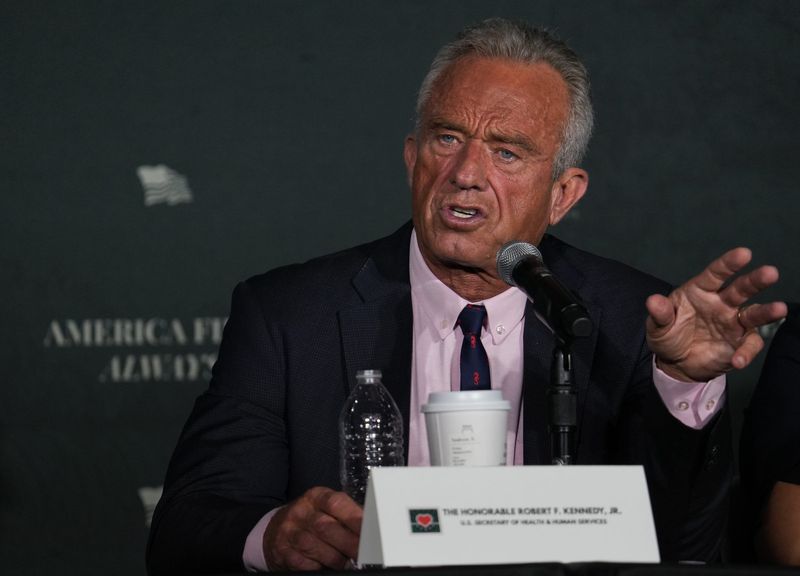
U.S. Health Secretary Robert F. Kennedy questioned a Wayne State University professor’s decision to take down an article about a proposed relationship between infant deaths and vaccines in a social media post.
The June 15 X post included a June 11 letter that Kennedy, a longtime vaccine skeptic, sent to Lawrence Lash, the editor-in-chief of the science journal Toxicology Reports and a professor of pharmacology at WSU. In the letter, Kennedy said he was concerned about the explanation Lash provided when the article was removed and called it “woefully insufficient.”

“Retraction, and even removal, of seriously flawed publications is appropriate in certain cases,” Kennedy wrote. “However, it should be accompanied by a transparent and full explanation of why such an action was carried out. … The notice of removal you issued had only two sentences explaining retraction.”
Kennedy said that high levels of public interest in vaccine safety and a history of both “overt and obscure pressure” against the study of vaccine safety necessitated a longer explanation. Kennedy asked Lash to respond by June 25.
The letter was sent to Lash at the WSU Department of Pharmacology address.
Lash did not respond to requests to comment.
The article, titled “Vaccines and sudden infant death: An analysis of the VAERS database 1990–2019 and review of the medical literature,” was written solely by Neil Z. Miller and published in 2021. The notice of removal was published online in April 2026 and in the print version of the journal in June 2026.
In the notice of removal, Lash said readers raised concerns about “potential research errors” and “methodological flaws” in the article. Toxicology Reports then did an investigation, he said, and determined that the author’s response did not “satisfactorily address” the concerns.
Lash’s response added “serious methodological flaws” were found in the data used to “infer a correlation between vaccination and sudden infant death syndrome.”
“Given the inherent limitations of passive reporting systems, including the expected temporal clustering of events independent of causality, the conclusions presented in the article are not supported by the methodology employed,” Lash wrote.
What Kennedy is asking for
Under Kennedy, who has called for tighter restrictions on vaccines for children, the Centers for Disease Control and Prevention made significant changes to the childhood vaccine schedule in January, a move experts warned could result in fewer children receiving a full suite of vaccines.
The CDC removed universal recommendations for childhood vaccines that protect against rotavirus, influenza (flu), meningococcal disease, COVID-19, and hepatitis A and B, instead suggesting only children at “high risk” of serious illness receive them. Kennedy has said the administration is “not taking vaccines away from anybody” and that they would still be available to all.
To determine whether Toxicology Reports’ removal of the article was appropriate, Kennedy requested that Lash send him five additional pieces of information to determine whether the decision to remove the article was appropriate.
The requested information included the “full internal written analysis” that determined Miller’s conclusions were unsupported, which experts were consulted and whether corroborating evidence cited by Miller was examined.
Kennedy also asked Lash to explain what he meant by the “potential implications for medical practice” he cited as a reason for removal and why he removed the article entirely versus writing an “expression of concern or retraction.”
“To rebuild the American public’s trust in public health and medical science, full transparency regarding these decisions is essential,” Kennedy wrote. “The public deserves to know how and if the scientific publishing industry is taking its duty to ensure research integrity seriously and ethically.”
In 2011, Salon withdrew an article by Kennedy that claimed to tie autism to vaccines, a move that Kennedy called censorship, according to Retraction Watch, a publication that tracks scientific retractions.
satwood@detroitnews.com
This article originally appeared on The Detroit News: RFK Jr. questions Wayne State professor’s decision to pull vaccine article
Reporting by Sarah Atwood, The Detroit News / The Detroit News
USA TODAY Network via Reuters Connect
By Sarah Atwood, The Detroit News | USA TODAY Network