Detroit is perhaps the best place to celebrate Juneteenth.
That’s according to visitors and residents alike in the city who on Friday, June 19, marked the anniversary of when enslaved people in Galveston, Texas, were finally informed of their freedom more than two years after President Abraham Lincoln signed the Emancipation Proclamation.

Detroit is one of the largest majority-Black cities in the country. It’s given the world all types of music, and it’s acclaimed for putting the world on wheels.
To 34-year-old resident Silver Moore, it’s the “capital of Blackness in America.”
“As a Black person in Detroit, you get to see the beauty in Blackness all the time,” she said. “We get Juneteenth every day.”
Marking the day itself is a chance to amplify what Detroiters experience, and for those across the country to join in, Moore said.
Juneteenth across Detroit
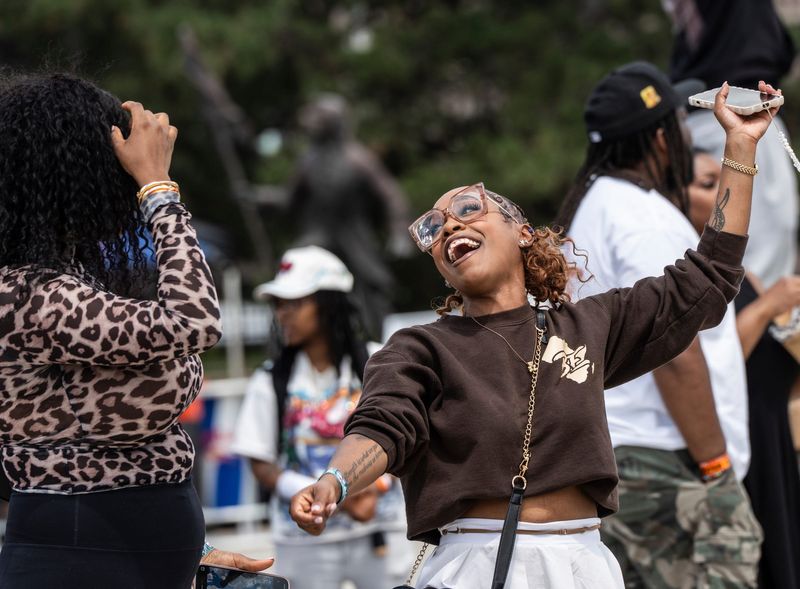
Moore was among those who took to Hart Plaza on Juneteenth for the second “Hart of Detroit Summer Festival,” which promised a multi-hour set of gospel music ahead of an evening featuring rap stars including Fetty Wap and Detroit natives Kash Doll, BabyTron and Tone Tone.
Elsewhere in the city, a Juneteenth gathering was planned in Rouge Park, Detroit People’s Food Co-op was set for a Juneteenth Cookout, Avalon Village had its 16th annual Juneteenth Family Day Freedom Festival, and the Charles H. Wright Museum of African American History offered a full day of free programming, among other events.
Founder of the ticketed Hart Plaza gathering, Chanel Domonique, said those different options along with the various types of music at her own event were important to have.
It’s “the dynamic of freedom,” she said. “Everyone has their own vision and their version of what freedom is, so there’s different pockets of what that looks like.”
Hers is her own sort of theme park, filled with food trucks and music at a staple location for Detroiters.
It’s a location that happens to include a strong reminder of the city’s history with the Underground Railroad: the Gateway to Freedom Underground Railroad Monument by the sculptor Ed Dwight, who was also the first African American trained to be a NASA astronaut.
Tameka Brooks, 53, of Philadelphia, came to visit her boyfriend but also to mark the day specifically in Detroit with her 15-year-old granddaughter and two 12-year-old grandsons.
As a nurse, it’s the first time she’s had the day off to celebrate Juneteenth, and the city has the “true essence of Black culture, Black unity and Black history,” she said.
She wants her grandchildren to know the history of music from here. To understand why Detroit is called the “Motor City.” And Juneteenth is a chance to recognize all that Black Americans have contributed.
An Independence Day before Independence Day
It’s no disrespect to the Fourth of July, a holiday Brooks also celebrates and for which her town of residence is going all out this year. But Brooks said, “Juneteenth is our independence day.”
Darnell Davis, 36, of Rochester Hills, views the Fourth of July as excluding Blackness. Juneteenth is about “celebrating our Blackness.”
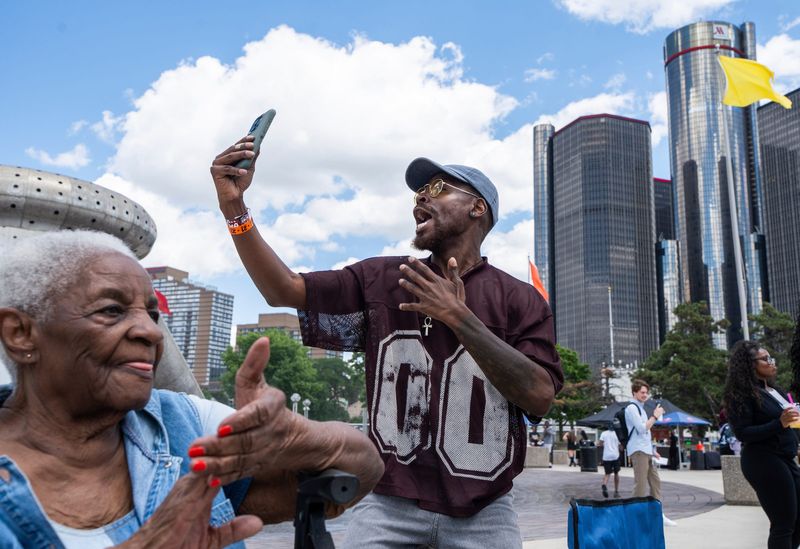
It’s important for his family to mark the occasion yearly, especially for the generations to come. This year, that meant dancing vigorously to gospel music while his grandmother, Pamelia Martin, 93, sat in her walker mouthing the words and moving a finger to the beat.
Moore recalled at the event the words once spoken by abolitionist and statesman Frederick Douglas: “What, to the American slave, is your Fourth of July?”
The Fourth of July only meant freedom for certain people, and there are those trying to erase Juneteenth, Moore said. There’s been the gutting of the Voting Rights Act and affirmative action.
True liberation isn’t possible without truly recognizing what has happened and the ongoing impacts of slavery, she said.
“Juneteenth – it was another step, it wasn’t a final step,” Moore said.
The upcoming Fourth of July holiday, being called America 250 as the country marks a milestone anniversary, is an opportunity to correct the record about those who contributed to the creation of the country, by the telling of John Taylor, 48, of Atlanta, founding co-chair of the Black Male Initiative.
The initiative was in Hart Plaza to help with civic engagement efforts like voter registration, and works to reshape the narrative about Black men. Taylor also claims Detroit among the locations he’s from and said he has family in the area.
“Every day is Juneteenth in America. … We’re still finding out and realizing what that freedom looks like.”
For many attendees in Hart Plaza, the day was one of enjoying music, food and unity.
Black people, and especially Detroiters, “resist with a level of joy and love,” Moore said.
“In order to keep ourselves fighting, we need to fill ourselves up,” she said.
She came to the gathering at Hart Plaza for just that reason, to take in all the different types of music and enjoy the “cookout day” feeling in the city.
This article originally appeared on Detroit Free Press: Detroit marks Juneteenth as independence day before America 250
Reporting by Darcie Moran, Detroit Free Press / Detroit Free Press
USA TODAY Network via Reuters Connect
By Darcie Moran, Detroit Free Press | USA TODAY Network