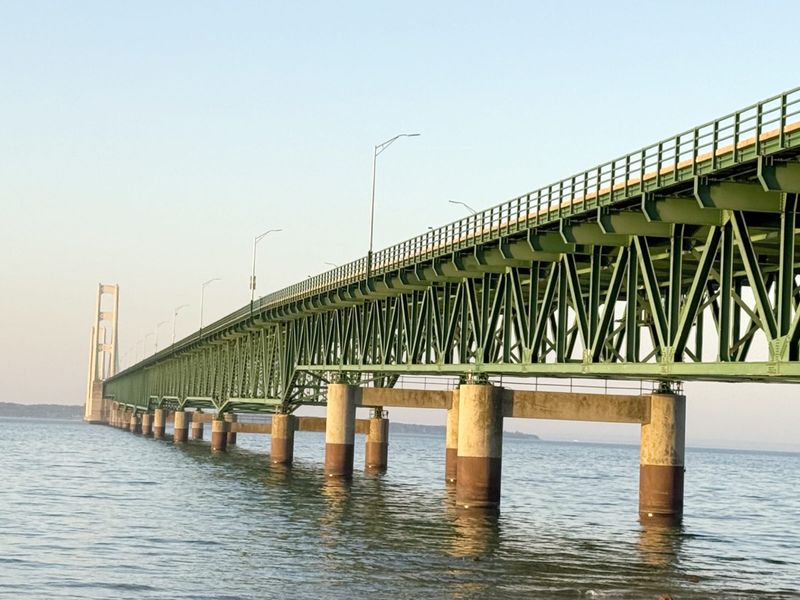
The Mackinac Bridge Authority confirmed the bridge is at a lower risk of collapse due to a vessel collision than nationally established thresholds, the bridge authority announced on Wednesday, July 8.
The assessment, conducted by a consulting engineering firm Parsons, was made after the Mackinac Bridge was selected by the National Transportation Safety Board (NTSB) to be evaluated for risk of bridge collapse in March 2025.

The Mackinac Bridge is the only one in Michigan on the list. Others — Zilwaukee, Blue Water, International and Gordie Howe bridges — were left off the list because they have piers on land (and are protected from strikes), aren’t high enough for ocean-going vessels to travel under or were built recently enough to meet current protection standards.
“This report confirms what we’ve long believed to be true, that the risk of the Mackinac Bridge collapsing due to being struck by a vessel is extremely low,” said Bridge Director Kim Nowack. “We hope this gives greater assurance to everyone who crosses the bridge that there is very little danger of such a tragedy here.”
The report is in response to a request from the NTSB to 30 owners of 68 spans in the U.S., recommending that each conduct a vulnerability assessment.
The recommendations by the NTSB were issued to bridge owners using the American Association of State Highway and Transportation Officials (AASHTO) Guide Specifications and Commentary for Vessel Collision Design of Highway Bridges.
The analysis determined a total annual frequency of collapse of 0.000097, corresponding to a return period of approximately 10,350 years, which is below the AASHTO limit of 0.0001 for critical bridges, officials said.
For one-way vessel traffic, the calculated annual frequency was 0.000045.
The assessment took into account the bridge design and structural capacity, the characteristics of the Straits of Mackinac, and the size, type and frequency of vessels navigating near the bridge.
Why did the NTSB recommend the study?
The MV Dali, a 984-foot container ship headed for Sri Lanka, struck a pier of the Key Bridge in Baltimore, after losing power early on the morning of March 26, 2024, causing the structure to collapse into the Patapsco River, killing six road workers and forcing temporary closure of the Port of Baltimore.
The bridge was built in 1977 and did not have collision protection in place that was robust enough to absorb an impact from a vessel as large as the Dali, the report said.
Bridge guidelines
In 1991, AASHTO developed and published a vulnerability assessment calculation for new bridges in the National Highway System, in response to the NTSB’s investigation of the Sunshine Skyway Bridge collapse in Florida, a news release says.
At the time, AASHTO also recommended that all bridge owners conduct the vulnerability assessments on existing bridges to evaluate their risk of catastrophic collapse in the event of a vessel collision.
Since 1994, the Federal Highway Administration, or FHWA, has required new bridges be designed to minimize the risk of a bridge collapse from a vessel collision, given the size, speed and other characteristics of vessels.
Have any vessels ever crashed into the Mackinac Bridge?
At least two vessels have struck the bridge, and most recently a crane struck the bridge while being moved by barge in 2021. In 1968, a Greek ship, the Castalia, struck a pier, causing minor damage.
(Editor’s note: This story has been updated to properly reflect the name of the consulting engineering firm.)
Jalen Williams is a trending reporter at the Detroit Free Press. Contact him at jawilliams1@freepress.com.
This article originally appeared on Detroit Free Press: New study finds Mackinac Bridge at low collapse risk
Reporting by Jalen Williams, Detroit Free Press / Detroit Free Press
USA TODAY Network via Reuters Connect
By Jalen Williams, Detroit Free Press | USA TODAY Network