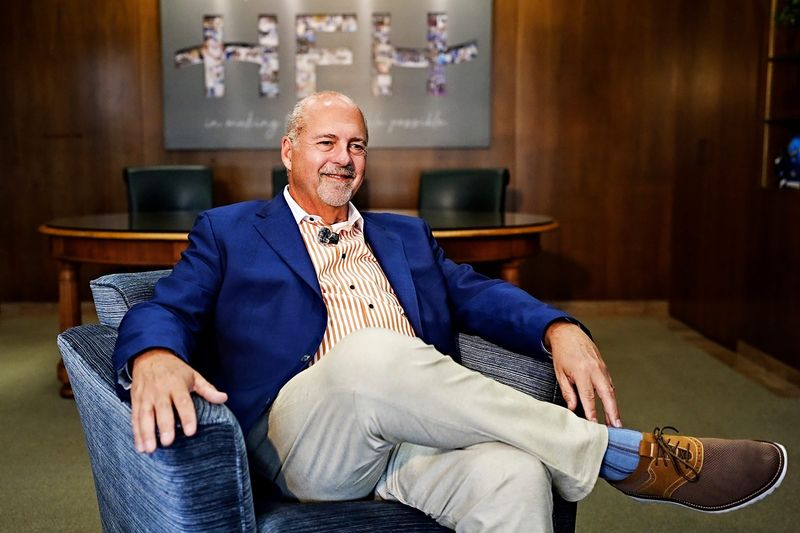
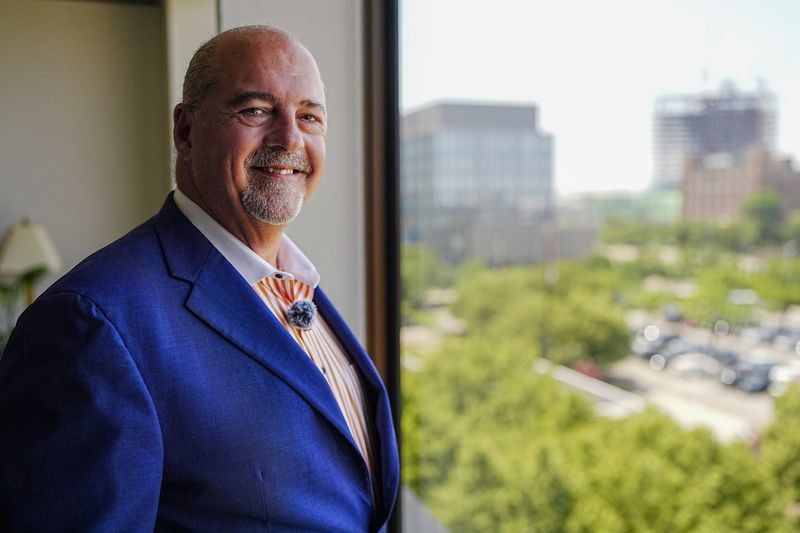
Robert G. Riney didn’t take a conventional path to the executive suite.
He started out as a security guard when he was a student at Wayne State University in the late 1970s, and never left.

Riney worked his way up − and even chose what some considered a backward step later in his career − before going on to be named president and CEO of Detroit-based Henry Ford Health, one of Michigan’s largest health systems with more than 50,000 employees across 13 hospitals.
Growing up Downriver, Riney said he fondly remembers boisterous family dinners around a tightly packed kitchen table.
“When my grandma moved in, there were eight of us in a 900-square-foot, one-bathroom home,” Riney said.
It was at that table where his parents taught him the importance of a strong work ethic and other core values that he has never abandoned.
“Those conversations were about how the playing field is not level for everybody, and it’s all of our collective jobs in community to help raise it for all,” Riney said.
“My dad was so far ahead of his time in embracing diversity. … I look back now and think, what a gift we got – a gift we didn’t even know at the time we were being given.”
Riney’s mother was a licensed practical nurse who rode her bike to work each day – even in winter – “because of economics” and often talked about the patients she cared for and the struggles they faced in their daily lives.
That experience embedded the idea in Riney’s mind that the word “health” should have a very broad definition.
To him, the term health “means that we have a region that is economically strong,” Riney said. “It means we have academic systems that are producing the best talent for the future.
“It means that we have amenities for people to live their best lives, such as access to great food, and then, of course, we have great health care delivery.”
For all he has done in his more than five decades of work at Henry Ford Health to bring his broad vision of health to Detroit and to the region, Riney was awarded the Neal Shine Award for Exemplary Regional Leadership, part of the Shining Light Awards presented by the Metropolitan Affairs Coalition and the Detroit Free Press. The lifetime achievement award recognizes a person whose career has prominently encouraged regional cooperation and understanding. It was created to honor the legacy of former Detroit Free Press editor and publisher Neal Shine.
“I was raised to think holistically [about] just elevating people up,” Riney said. “And I think that in many ways, that’s what Neal Shine called us to do.”
We asked Riney about his path and challenges ahead for the region.
Question: Can you share a story about a time when you had to make a difficult decision to serve the greater good … putting that ahead of your own benefit?
Answer: I remember a time when things were much tougher in the city of Detroit than they are today, when I had to meet with our Board of Trustees and talk about wanting to make further investments in the city, and they asked the right questions: ‘Is that the right thing to do, given the population shift?’ … And I said, ‘It’s the right thing to do from a mission standpoint, and here’s our obligation to make the math work. I didn’t know how it would go because it was a time when it was very popular for people to be exiting the city, but … we got the board’s support. … I think we led the way.
What’s one thing you wish everybody understood about where we live and this region?
I have the pleasure of overseeing an organization that has been recruiting talent from all over the world for decades, and it turns into its own kind of research. … We’re not the perfect region. We’re not the prettiest region. We don’t have big mountains and waterfalls. But we have something else. We have just an incredible array of people that are just nice. And at the end of the day, I think that matters more to people in their daily lives than a bunch of bells and whistles. … I don’t think that the world that hasn’t visited our region and immersed themselves in it fully appreciates that.
What was one of the biggest risks that you took in your career that led you to where you are today?
One of the biggest risks I took in my career was when I was in a corporate role here. I wanted to transition from … chief human resource officer into operations. … Some of my colleagues at the time said: “You can’t leave corporate and go to an operations role in one of the hospitals. You’re like two levels from the CEO. You shouldn’t do that.” And I found them to be well intended, but it was very wrong advice. I said, “But if I want to play the long game, then I want to learn operations.” So, I took a lateral move. It was a smaller title, a longer drive, and I went into operations, and it was the best decision I ever made because it allowed me to round out my experience in a different way.
And what it taught me was a couple things: Steer your own ship. Take advice but steer your own ship and have the courage to take risks. … I tell the young people, especially now, there is no straight line to progress. There is no straight line to success. It’s a winding, curvy trip and sometimes you even go a little back in order to go forward.
What gets you up in the mornings, and what keeps you up at night?
“Well, the truth of the matter is what gets me up in the mornings is usually a backache. (Laughs) No, in all seriousness … I’m a naturally curious person. And so, I wake up every day really looking forward to what I’m going to learn that day, what I’m going to be challenged by. What am I going to have to rethink? And it’s really a very motivating part of me. That, along with a good cup of coffee, because I have to start my day with a good cup of coffee.
What keeps me up at night is the political discourse that is no longer about topics, but about character. It’s so ugly these days, and it seems to be a battle of how we can out-insult one another. And that really saddens me for a couple of reasons. One, it’s just not the kind of behavior that certainly Neal Shine would have ever, ever emulated. But it’s also a distraction from really hearing different sides of a real issue that we need to solve. It’s like it has become entertainment versus a discussion on issues that really affect everyday people in a meaningful way. And so, that keeps me up at night because we’ve got to course correct.
What do you see as the biggest challenges facing Henry Ford Health and the region?
We can’t get a true affordability of health care, which is important to all of us, if we don’t keep growing as a state. Because if you think about any kind of population, you want a bell-shaped curve, right? You want a decent amount of young people, a good bowl of middle-aged people and then a decent percentage of older people. But we all know that older people are the ones that consume the vast, vast majority of health care, for all the obvious reasons.
So, we need a population balance here that’s got to come from growth. So, Michigan is an enormously great state for all sorts of reasons, but we have to align all of our efforts and really tell people: “This is the place you want to be.” Tell corporations: “This is the place you want to build.” Tell young people: “Detroit, Grand Rapids, these are the places you want to start up because you can make a real difference.” … And we have to compete. We can’t sit back and just think, “Oh, we’re doing fine.” No, we’re not. We are not doing fine unless we are growing.
Shining Light Awards ceremony
The 2026 Shining Light honorees will be recognized at a luncheon ceremony in October. Here are the details.
When: 10:30 a.m. Wednesday, Oct. 7Where: Motor City Casino Hotel Tickets: $85 available at bit.ly/shininglight2026
This article originally appeared on Detroit Free Press: Henry Ford Health’s Bob Riney took unconventional route to CEO seat
Reporting by Kristen Jordan Shamus, Detroit Free Press / Detroit Free Press
USA TODAY Network via Reuters Connect
By Kristen Jordan Shamus, Detroit Free Press | USA TODAY Network