President Donald Trump should have sat Michigan’s Republican gubernatorial primary out.
Without Trump’s endorsement, the race was shaping up to be a competitive contest through Aug. 4, forcing candidates to build broader coalitions and make their case directly before Republican voters.

For their part, Michigan Republican voters have shown they are willing to prioritize candidates they believe can win statewide. Their selections for attorney general and secretary of state in March suggested a preference for qualifications and broad appeal after two election cycles in which the party struggled to win statewide.
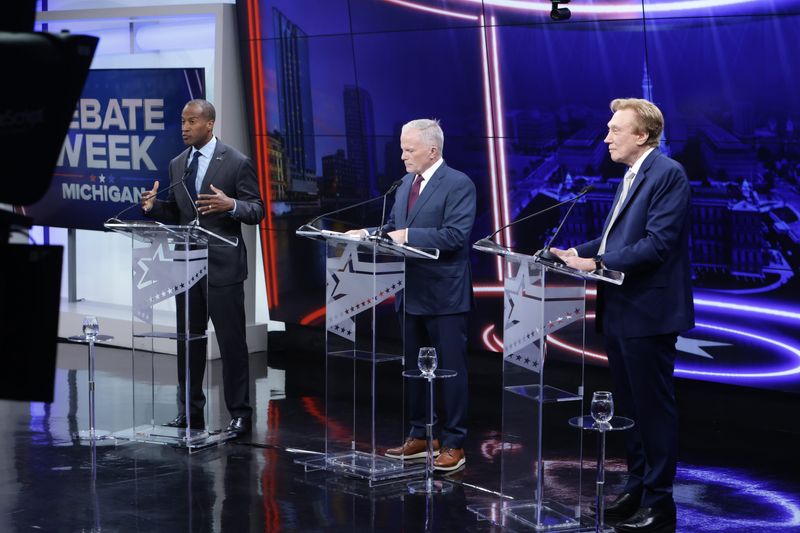
But former Attorney General Mike Cox dropped his bid for GOP gubernatorial nominee Friday afternoon, backing U.S. Rep. John James, who secured Trump’s endorsement earlier this month. Cox had been gaining in the polls.
Once the Trump endorsement came out, Cox argued, the die was cast for James to become the Republican nominee. But was it?
Republicans should be in great standing going into this election. Traditional political wisdom would say a Republican governor would be elected after eight years of Democrat Gov. Gretchen Whitmer.
But Trump’s endorsement didn’t increase the likelihood of that would-be inevitability.
It’s not that Trump’s agenda is necessarily unpopular in Michigan. But his personal political preferences don’t carry the kind of weight he might expect. Sometimes, they push people away from candidates who would otherwise be appealing.
The endorsement also did not eliminate divisions within the Republican coalition. Some activists and party leaders remain aligned behind businessman Perry Johnson, suggesting Trump’s support has not fully consolidated the field.
GOP activists and leaders at the party’s state convention in Feb. 2025, just four months after Trump won, bypassed his pick for state party chair. Trump-era MAGA leaders are also notably helping to lead Johnson’s campaign regardless of Trump’s endorsement, including in Oakland County, where some party leadership has openly endorsed Johnson.
Consider Iowa. Trump backed U.S. Rep Randy Feenstra in Iowa’s June 2 primary to be the GOP nominee for governor. GOP gubernatorial candidate Zach Lahn upset the race and won — and now Trump has endorsed Lahn.
“Had I been given the proper information, which I don’t think I was, I probably would have endorsed the other person,” Trump said following the election. “But — or not endorsed at all. But I would have endorsed the other person. The other person was much more Trump, as you know, than Randy.”
Trump puts it in a way only he can. But the broader point is that he doesn’t always receive the best advice.
But once that is finally settled, if the nominee is James, he will need a plan to walk the tightrope in the general election with Trump’s explicit backing against formidable Democratic opponent Jocelyn Benson, where the outcome will likely be decided by independent-leaning voters.
Michigan is not a state where a Republican can rely solely on the party base to win statewide office. Trump’s endorsement doesn’t translate very effectively in the general election in a purple state where, uniquely, the outgoing Democratic governor has roughly a 60% approval rating.
Just 37% of Americans approve of Trump’s job performance, a near-record low, according to a recent Economist/YouGov poll.In May, Trump had a roughly 37% approval rating among Michigan voters, the lowest point in a year.
The presidential approval rating is the number one determinant of midterm election outcomes.
Cox may be right. Trump’s endorsement may ultimately secure James the nomination in August. But there is a long road ahead to November.
kbuss@detroitnews.com
This article originally appeared on The Detroit News: Did Donald Trump’s endorsement seal up GOP gov primary? | Buss
Reporting by Kaitlyn Buss, The Detroit News / The Detroit News
USA TODAY Network via Reuters Connect
By Kaitlyn Buss, The Detroit News | USA TODAY Network