Last week, an anniversary came and went and almost nobody noticed. But if the history of the world is to be written just before humankind destroys itself, this should be the reddest letter date of them all.
On July 16, 1945, a man named Donald Hornig, an explosives expert, sat atop a 100-foot tower in the wee hours of the morning in a remote desert location in southeastern New Mexico. As a heavy rain fell, violent thunder and lightning shook the sky.

A more religious type might have taken that as a divine sign. Stop. Go back. Do not allow what is about to happen. Hornig himself, years later at a symposium, admitted “it was a deeply philosophical experience” as he sat there contemplating “the monster beside me and what it was about to do to the world if it worked.”
The monster was an atomic bomb.
It worked.
Horing was the last man who could have stopped the test. He had a finger near “the chicken switch.” He didn’t. At 5:29 a.m., from inside a control bunker, he recalled “the needles dropped to zero and the red lights went out. There was a brilliant light swirling around outside.”
And the world changed forever.
Before that moment, nuclear warfare was a theory. After, it became reality. And here we are, more than three-quarters of a century later, still seeing our politics, our economy, our military and our civilian lives spinning on the axis of the bomb to end all bombs, who gets to have it and who might use it.
Countless times, President Donald Trump has said, “Iran cannot have a nuclear weapon.” We are in this off-on-off-on war are because of that belief. Countless smaller missiles and bombs have been fired, countless structures destroyed and many lives lost in service to it. A memo of understanding has all but crumbled, and the world hangs on the brink, wondering how far off the cliff we are all willing to dangle in this struggle.
Today, as it was 81 years ago, the thinking is the same. The bad guys can’t have the bomb, because they might use it.
An accidental date with destruction
Did you know that the atom bomb was basically discovered by accident? Two German scientists, in 1938 — nine months before the start of World War II — were experimenting with various elements, shooting subatomic particles called neutrons into them. When they tried this on uranium, they were stunned to see that it didn’t work the way they thought.
They were trying to create a new, heavier element. Instead, in consultation with a female Jewish physicist who had fled Germany, they realized they had just split the atom in two.
They called their discovery “nuclear fission.” And, as happens within the scientific community, in a blink, other countries were trying to replicate the process.
But because the original scientists were German, and by 1939, the Nazis were on the march, American officials feared that the technology would be rapidly developed by Hitler to create a bomb that no one could match.
So we set out to do it first.
It was called the Manhattan Project and those of you who watched “Oppenheimer” know the rest. Our scientists surged ahead of other countries. The French, British, Soviets, Japanese and Germans all tried, but we succeeded first.
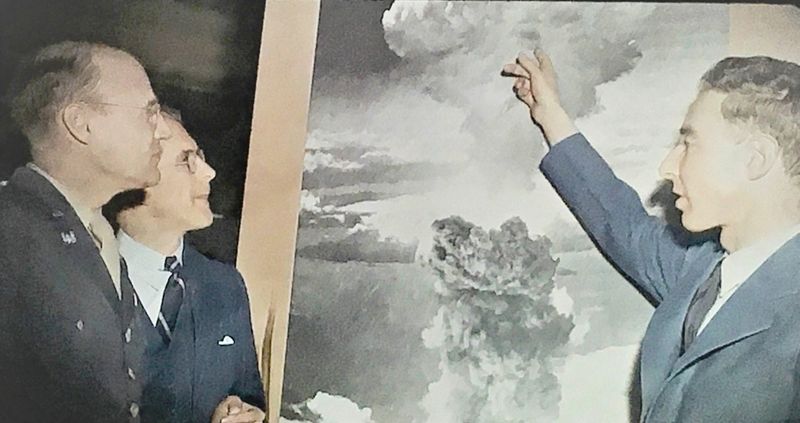
When that initial fireball, the equivalent of 18,000 tons of TNT, lit up the New Mexico sky, humankind moved into a new phase of existence. For the first time in history, we were capable of wiping ourselves out on a mass scale.
You might think such power would lead to a long period of meditation, a deep, serious contemplation of what it all meant. J. Robert Oppenheimer himself said the moment reminded him of a quote from Hindu scripture, “Now I am become Death, the destroyer of worlds.” A number of scientists immediately drafted a letter to President Harry S. Truman beseeching him to warn Japan before actually using this weapon.
The letter never got to the president. And a mere 21 days after testing it, we dropped the first atomic bomb, nicknamed “Fat Boy” on Hiroshima. Days later, “Little Boy” fell on Nagasaki.
Shortly thereafter, the war was over.
But something else had begun.
A moment to remember
Today there are nine countries believed to have a nuclear weapon: Russia, China, France, Great Britain, Israel, India, Pakistan, North Korea and the U.S. Since those two fateful days over Japan, no one has ever used one. The theory is that multiple countries possessing this horrendous capability assures mutual deterrence, because the alternative is mutual destruction.
But in Iran, the world sees an unstable actor, one who might launch a weapon at Israel or elsewhere, consequences be damned. Which is why, in 2024, 2025 and 2026 there have been repeated attempts by Israel and the U.S. to cripple Iran’s nuclear capabilities.
Yet just last week, reports surfaced of Iran again trying to rebuild its damaged nuclear sites.
Now, as it was 80-plus years ago, nations race to gain the ability to wipe out the enemy. Iran’s leaders no doubt think if they gain the atomic bomb, they can twist the world to their will in a way that dwarfs what they’re currently doing with the Strait of Hormuz.
And we are hellbent to stop that.
On it goes. In centuries past, victory in war meant the other side surrendered, certain leaders were taken prisoner and the victor ruled the conquered land. Today, the ante is upped. And the victor may be the last one breathing.
It is an immeasurable turn of events in human history, and one at least worthy of some solemn contemplation on its July 16th anniversary.
Instead, we blew through it with barely a thought. We can only hope that the world’s potential use of “the monster” that Hornig sat beside that thunderous night gets far more serious consideration.
Contact Mitch Albom: malbom@freepress.com. Check out the latest updates on his charities, books and events at MitchAlbom.com. Follow @mitchalbom on x.com.
This article originally appeared on Detroit Free Press: Mitch Albom: 81 years later, a solemn mark in history goes unnoticed
Reporting by Mitch Albom, Detroit Free Press / Detroit Free Press
USA TODAY Network via Reuters Connect
By Mitch Albom, Detroit Free Press | USA TODAY Network