Detroit’s police oversight board has lost its direct access to officers’ body-worn camera footage and police investigative reports, a move its chief investigator is calling a “structural attack” on civilian oversight.
The FBI stripped the Board of Police Commissioners of that access on May 15 over compliance issues with the FBI’s Criminal Justice Information Services division, which enforces strict rules for handling the law enforcement databases behind nearly every background check and criminal-record lookup.

The board must now rely on the Detroit Police Department to hand over evidence that has first been redacted to protect CJIS data — including footage of the officers its investigators are scrutinizing.
“That’s a major step, in my humble opinion, in the wrong direction,” said Chief Investigator Jerome Warfield, who leads the office that investigates citizen complaints and works in tandem with the BOPC. “Because now we’re dependent on police to give us evidence.”
The FBI did not respond to the Free Press’ request for comment.
Exactly why the feds chose to pull the board’s access now is unclear. Warfield said the issue of Detroit’s oversight board losing direct access to footage has been under discussion since he became chief investigator three years ago.
One theory is political. Warfield said civilian oversight boards are under attack nationwide, and that the pressure appears to have accelerated under President Donald Trump’s administration. Commissioner Scott Boman spoke to the Free Press about political pressures as well, like the national debate over whether local law enforcement should be collaborating with federal immigration agents.
The FBI’s directive came nearly three months after leaked body camera footage of a controversial downtown traffic stop of a Venezuelan man revealed a sergeant’s repeated references to a supervisor’s directive that she contact federal immigration agents to identify him — and the sergeant’s remark that such checks are worthwhile because someone could turn out to be “Pablo Escobar Jr.”
Commissioner Darious Morris also thinks the move is political. He told the Free Press: “I truly believe this was not accidental. In my heart, I believe this was intentionally done in a way that weakens civilian oversight and further damages democratic accountability within policing.”
Another theory points to an administrative shift: At some point, the board had moved out of the Detroit Police Department’s human resources and into the city of Detroit’s. “So we were no longer considered a criminal justice agency” with direct access to investigative materials, Warfield said.
Warfield told the Free Press that when Detroit established its Board of Police Commissioners in 1974, it was the first fully independent civilian oversight board in the country — and one that actually had teeth. The combination of charter independence, subpoena power and final disciplinary authority over police set it apart.
That, he says, is exactly why the federal government’s decision to cut off the board’s direct access to body-worn camera footage and investigative reports is so alarming.
In a May 21 letter to the board affirming his concern, Warfield said it not only violates a city charter that grants the board direct access, he warned, but will also hamper investigations — because officers will now decide which materials are relevant — and lengthen the time it takes to resolve complaints, creating yet another backlog.
And by filtering evidence that his investigators see, “the damage is not just operational. It is a loss of transparency, accountability, and public trust that civilian oversight was created to deliver,” he wrote.
“The investigation is no longer truly independent.”
Detroit Police said in a statement provided to the Free Press that the department joined the BOPC in advocating for Warfield’s office to keep its access, but their hands are tied by the federal government’s directive.
The department has been working with Warfield on new procedures, it said, and Warfield credited Detroit Police for its willingness to cooperate. But told the Free Press that the arrangement “should not be the permanent fix, at all.”
Warfield is not alone in his concern that those tasked to investigate citizen complaints against police will lose access to critical investigative materials from the very department it is supposed to oversee.
Morris called it a “dangerous blow to transparency, accountability, and the public’s right to independent oversight” at time when trust between police and communities in Detroit is already fragile.
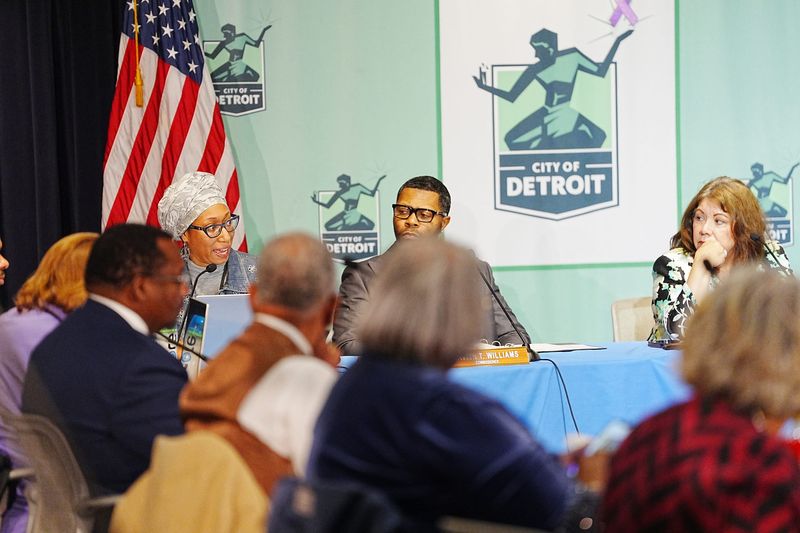
And the issue has come up repeatedly at the BOPC’s weekly Thursday meetings — as recently as May 28, when Commissioner Victoria Camille emphasized the need for the public to know and understand what is happening — its overreach, she says “preempts the will of the people of Detroit” to have oversight over their local police.
Boman added after the meeting: “The board of police commissioners is not subordinate to the Detroit Police Department, if anything, it’s the other way around.”
He brought up a hypothetical to a Free Press reporter: What if body camera footage is available, but police tell them it wasn’t turned on?
“We wouldn’t know anything,” he said. “Do we trust that the top brass of the DPD is telling us the truth, or also making sure that people under them are telling them the truth?”
“I don’t want to sound like I’m being mistrustful or conspiratorial about the members of the DPD, because as far as I know, I have no reason to believe, and in my heart I don’t really believe, that they are doing anything to mislead us,” Boman continued. “But the fact of the matter is, rather than just trust, trust, trust, I do prefer trust, but verify.”
Andrea Sahouri covers criminal justice for the Detroit Free Press. Contact her at asahouri@freepress.com.
This article originally appeared on Detroit Free Press: Detroit police oversight board stripped of direct access to bodycam footage
Reporting by Andrea May Sahouri, Detroit Free Press / Detroit Free Press
USA TODAY Network via Reuters Connect
By Andrea May Sahouri, Detroit Free Press | USA TODAY Network