Michigan’s signature landmarks tell a layered story about how people shaped the Great Lake state — and how this state shaped them.
From stone city halls and marble lighthouses to suspension bridges, aquariums and skybridges, each site captures a different moment when Michigan decided to build and think big.

Taken together, these Michigan Marvels show how transportation corridors, industrial power and cultural ambition play out in steel, glass, timber and marble.
Whether it’s a mill that fed a frontier fort, a bridge that stitched two peninsulas together or lighthouses guarding a fog‑bound point, they reveal the ingenuity and anxiety that come with living at the edge of deep water and deep change.
Historic Mill Creek: Little mill with a big job
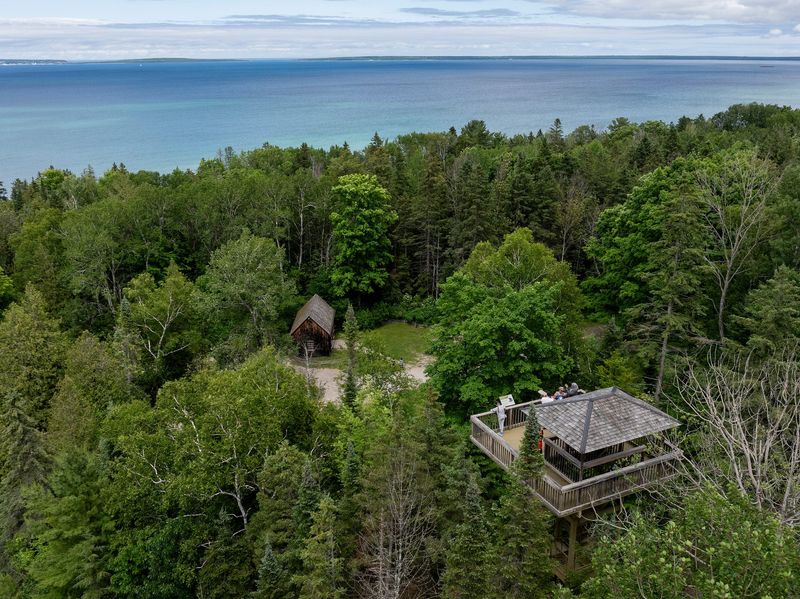
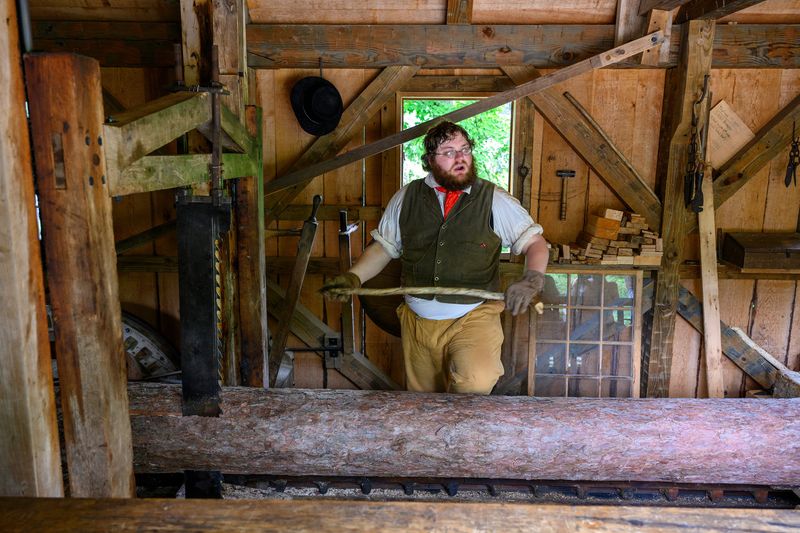
About four miles south of Mackinaw City near the Lake Huron shoreline, a small sawmill tucked into the North Woods once had a big impact on Mackinac Island. Robert Campbell built the Mill Creek operation around 1790 specifically to produce lumber and farm crops for sale to the island, replacing laborious hand‑sawing as demand exploded after the British moved Fort Michilimackinac there in 1781.
Historic Mill Creek is now part of the Mackinac Island State Park system. It opened to the public in 1984 with a reconstructed mill dam and sawmill, British workshop and American millwright’s house spread over 625 acres. The site also features three miles of nature trails and a Treetop Discovery Tower with views of Lake Huron, the Straits of Mackinac and Mackinac Island, along with interpretive programming that explains how sawn lumber was rafted across behind sailing ships.
Rediscovered in the 1970s after decades as a quarry and forgotten property, the mill is now presented as a place where water power and timber made settlement possible and as a site that “ties all of Mackinac State Historic Park sites together.”
Bay City City Hall: 20‑year plan, 128‑year reality
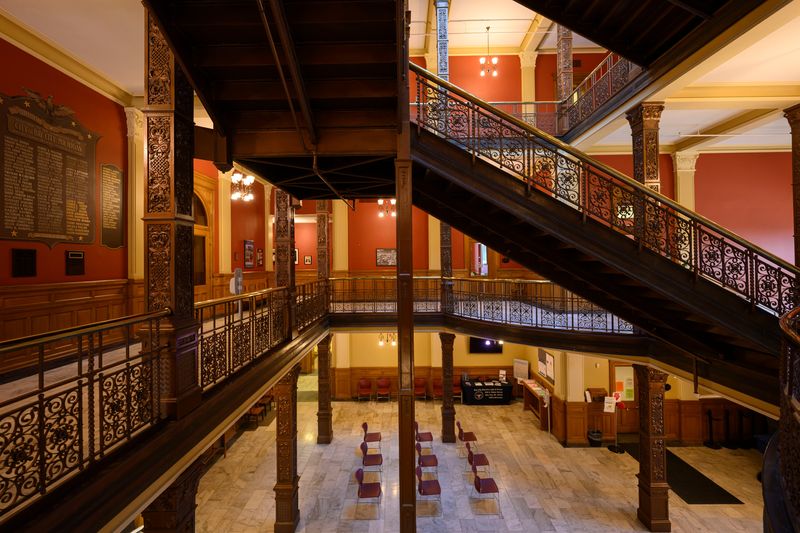
Bay City City Hall was built in the 1890s with the idea it would last 20 years, yet 128 years later, the four‑story Richardsonian Romanesque Revival building remains in use as the city’s municipal hub. Constructed of Michigan and Indiana limestone, sandstone, and granite, with a 180‑foot clock tower above the city, it opened with the first City Commission meeting on March 22, 1897, and originally housed the commission, police station, water works, and library.
In a booming 19th‑century economy driven by crane building, shipbuilding and lumber, local leaders approved the project in 1889, then weathered delays and the 1893 financial panic by treating construction as a stimulus effort that hired Bay City workers and bought from local businesses. The building blended new and old technologies — telephone service, electricity, fireplaces, central steam heat, ventilation, gas lights, skylights and a glass atrium ceiling — and its basement once contained the police station and jail, with horse‑drawn wagons bringing detainees through the rotunda.
Threatened with demolition by the 1960s, City Hall instead went through a series of renovations, including a major 1977 upgrade and a $10 million post‑fire restoration completed around 2013, and today the Bay City Historical Society leads regular tours that showcase its restored chambers, tower views and enduring civic role.
Zug Island: Steel, smoke and the Rust Belt story
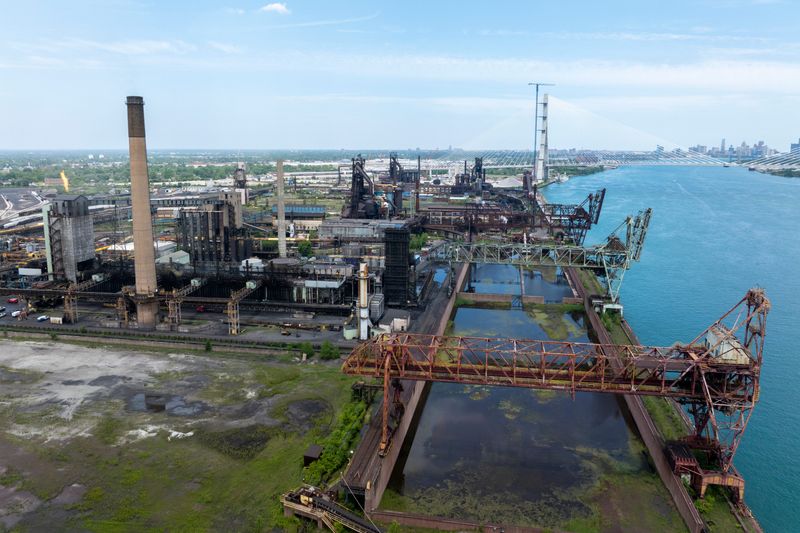
Zug Island, a man‑made island at the confluence of the Rouge and Detroit rivers in Detroit, evolved from marshy estate land bought by furniture maker Samuel Zug in 1876 into one of the world’s major steel‑making sites after industrial buyers acquired it in the 1890s.
A first blast furnace opened in 1902, followed by more and larger furnaces under companies such as M.A. Hanna, Great Lakes Steel and National Steel, helping power U.S. industrial growth in vehicles, machinery and infrastructure and employing more than 16,000 workers at its 1940s peak. Over time, the operation consolidated under U.S. Steel’s Great Lakes Works, while coking plants, iron works and other heavy industries layered on to the dense landscape of pipes, coal piles, rail lines and smokestacks. By 2020, U.S. Steel idled the mill, leaving fewer than 500 workers and a reduced set of finishing operations, even as EES Coke Battery continues to turn coal into metallurgical coke.
Decades of activity left a legacy of severe air and water pollution, and today Zug Island stands as a Rust Belt symbol that encapsulates both the height of American steel production and the environmental and economic fallout of industrial decline.
Marble lighthouse: Tribute to a Great Lakes shipping pioneer
On the eastern end of Belle Isle stands the 58‑foot William Livingstone Memorial Lighthouse, honoring a towering figure in Great Lakes shipping who also ran a bank and served in elected office.
Born in 1844 in Dundas, Ontario, Livingstone moved to Detroit as a child, launched the Michigan Navigation Co. in 1880, bought the Detroit Evening Journal in 1885 and, as president of Dime Bank, loaned money to a young Henry Ford. He became a major force in navigation improvements, credited with securing the Davis and Sabin locks at the Soo, deepening channels in the St. Mary’s River and Lake St. Clair, and championing the Livingstone Channel in the lower Detroit River, which opened Oct. 19, 1912.
Livingstone helped found the Lake Carriers’ Association (a trade association for Great Lakes shippers) and was its president when he died in 1925, after 61 years of marriage and eight children. Completed in 1930, the Art Deco‑styled lighthouse designed by Albert Kahn with ornamentation by Hungarian sculptor Geza Maroti is built of Georgia marble and, according to the Detroit Historical Society, is the only marble lighthouse in North America, still guiding mariners along the route Livingstone helped create.
Colonial Michilimackinac: 18th‑century fort life under the bridge
At the south end of the Mackinac Bridge, Colonial Michilimackinac recreates an 18th‑century fortified fur‑trading community that once anchored life at the Straits.
The reconstructed post represents a mixed civilian and military settlement, initially French and later British, that operated from about 1715 to 1781 as a center of the Great Lakes fur trade and a gathering place for travelers, settlers, and Indigenous peoples for whom the waters were a highway, a food source, and a spiritual resource. Historical interpreters portraying British soldiers and French‑Canadian families bring daily life during the American Revolution to life on the two‑acre site, even as archaeologists continue one of North America’s longest‑running digs to uncover artifacts that flesh out residents’ work, culture and economics.
After the British deemed the original fort too hard to defend and moved to Mackinac Island in 1779–1781, local leaders ultimately preserved the shoreline as a park, which became Michigan’s second state park in 1909 and the focus of ongoing reconstruction work begun in 1959. Today, visitors can walk inside the palisade walls, watch a film in the King’s Storehouse, hear cannon and musket firings, and explore barracks, houses, a church and other structures that interpret a year‑round community of roughly 200–300 people and a much larger seasonal population.
Mackinac Bridge: Architectural link between peninsulas
In a state full of marvels, the Mackinac Bridge stands out as a key anchor, connecting Michigan’s two peninsulas across the Straits of Mackinac and representing a major architectural achievement. Decades of talk and stop‑and‑go efforts preceded its 1957 opening, from late‑1800s dreams and a state‑ordered ferry service in 1923 to a first bridge authority in 1934 that stalled for lack of funding, even as ferries carried up to 9,000 vehicles a day and traffic backups stretched 16 miles and 24 hours.
A new Mackinac Bridge Authority was formed in 1950 under chairman Prentiss Brown. Engineer David B. Steinman was hired in 1953, and construction began on May 7, 1954, ultimately drawing on 4,000 engineering drawings, 85,000 blueprints, and more than 11,000 workers on and off-site. The finished bridge incorporates 4,851,700 rivets, 1,016,600 steel bolts, 931,000 tons of concrete and cables made from 42,000 miles of wire, with 552‑foot‑tall main towers, 199 feet of ship clearance at midspan, a five‑mile total length and an opening price tag of $100 million.
When it opened on Nov. 1, 1957, it was the world’s longest suspension bridge between anchorages, and today it’s one of the longest suspension bridges in the Western Hemisphere by total suspended length, carrying more than 4 million vehicles a year and bearing the memory of six men who died in its construction and later maintenance.
Belle Isle Aquarium: Albert Kahn’s underwater art gallery
Opened on Aug. 18, 1904, the Belle Isle Aquarium debuted as the third-largest in the world, and is the ninth-oldest globally, according to worldatlas.com.
Its Albert Kahn–designed building was conceived as an “underwater art gallery,” with curved ceilings and green tiles meant to evoke being below the surface and tanks originally framed like paintings, a vision staff say still impresses visitors who often audibly gasp when they walk in. Inside, about 2,000 people visit each Friday through Sunday to follow an educational path that links major rivers such as the Congo, Amazon and Detroit with the world’s great lakes, including the African Great Lakes and the Great Lakes of North America, before flowing into a marine section that underscores how all waterways connect. The collection features giant gouramis that greet guests at the entrance, a giant Pacific octopus, piranhas, an electric eel, garden eels, Mbu pufferfish and a rare lineup of all seven freshwater gar species, along with crowd‑pleasing axolotls that remain aquatic as adults and have a following among Minecraft‑playing kids.
Closed to the public by city budget cuts in 2005, the aquarium was reopened by the Belle Isle Conservancy in 2012 and has since seen about $6 million in renovations, including $1.2 million during a 16‑month pandemic closure, and still offers free admission to experience Kahn’s blend of art and nature.
Boyne Falls SkyBridge: Glass‑floored thrill over fall color
At Boyne Mountain Resort’s SkyBridge Michigan in Boyne Falls, visitors like Gina and Brian Bourdon pose and inch across a 36‑foot glass section suspended 118 feet above the valley floor, the highlight of a span that has become catnip for Instagrammers and influencers.
The bridge offers elevated views over surrounding hills and valleys, pairing especially well with northern Michigan’s fall colors, and was added after Boyne, founded in 1947, decided this valley between the summit of McLouth and Disciples Ridge was the perfect place to mirror its Gatlinburg SkyPark bridge. Open year‑round but most popular in autumn, SkyBridge opened Oct. 15, 2022, and stretches 1,200 feet, making it the world’s longest timber‑towered suspension bridge. Its grated approaches, glass center, and constant swaying and tilting create a mix of awe and anxiety, with mesh fencing and handrails on both sides and a steady soundtrack of self‑doubt, encouragement and “I did it!” as people cross.
Marketing Director Kari Roder calls it “equal parts stunning and thrilling,” noting that many visitors conquer their fears in the middle while kids often dash ahead, making it, in her words, “really kind of a bridge for everybody” with a definite thrill factor.
Presque Isle lighthouses: Twin beacons on a fog‑bound point
On Presque Isle, about 35 minutes north of Alpena, visitors find a bucket‑list maritime stop where two historic lighthouses and the Keeper’s House Museum complement better‑known Great Lakes institutions like Whitefish Point and the Dossin Museum.
On foggy fall mornings, the Old Presque Isle Lighthouse and New Presque Isle Lighthouse emerge from Lake Huron mist as classic 19th‑century conical towers, the older “Old Light” having served from 1840 to 1870 at the bay entrance with a 30‑foot‑tall white stone‑and‑brick tower, visitor center, museum and climbable steps to harbor views. Nearby stand a statue of longtime keeper Patrick Garrity Sr., a set of old‑style stocks and even the bell from Lansing’s demolished Old City Hall clock tower.
A mile north at the tip of the peninsula, the 113‑foot New Presque Isle Lighthouse, built in 1870 for $35,500 and designed by Army engineers Orlando Poe and William Raynolds, remains an active aid to navigation, is the tallest lighthouse tower open to the public on the Great Lakes, and includes a keeper’s house that now serves as a visitor center, museum and gift shop. Both lights and the 1905 Keeper’s House are recognized with listings on state and national historic registers, are owned by Presque Isle Township and operated by the township museum society, with the museums closed in winter, but New Lighthouse Park and nearby trails are open year‑round.
Edsel and Eleanor Ford House: An English village on the lake
When Edsel and Eleanor Ford went looking for a site to build a new home, they chose a 125‑acre Grosse Pointe Shores property called Gaukler Pointe that already belonged to Edsel’s father, Henry Ford.
Henry sold the land to his only son, and construction on the estate began in 1926. By 1928, the couple and their four children had moved into an Albert Kahn–designed, 30,000‑square‑foot English Tudor Revival house inspired by Cotswold homes, with 60 rooms arranged to feel like a cluster of houses or a small village.
Beyond the main residence, the property included a recreation building, power house, gate lodge and a striking Tudor Revival playhouse built in the 1930s for daughter Josephine as a gift from Edsel’s mother, Clara Ford. That one‑third‑scale cottage was fully functional, with running water, electricity and refrigeration, the kind of place Heppner notes you “could live in and never need anything else.”
Today, the estate spans 87 acres after Eleanor donated part of the land for a park, which was opened for public tours and community programs after her death in 1978, was designated a National Historic Landmark in 2016, and added a new visitor center with a restaurant in 2021.
Greenfield Village: Henry Ford’s collection of American life
Greenfield Village grew out of Henry Ford’s instinct to collect buildings instead of stamps, a project that began in 1919 when a road project threatened his Springwells Township birthplace and he chose to move and painstakingly restore it to its 1876 condition, right down to excavating for dish shards so replicas could be made. He went on to preserve other historic structures and formally founded Greenfield Village in Dearborn on Oct. 21, 1929.
Today, the 80‑plus‑acre site contains 83 authentic historic buildings, four living history farms, historic rides like authentic Model Ts, and working artisans producing 19th‑ and 20th‑century pottery, tinware and glass, with marquee attractions such as Thomas Edison’s Menlo Park complex; the Firestone farmhouse; Sir John Bennett’s London clock and jewelry shop; the Wright brothers’ Dayton home and cycle shop; the Henry J. Heinz home; the Robert Frost home; and a courthouse where Abraham Lincoln practiced law.
The working farms feature livestock, vegetable fields and period farm equipment that demonstrate 19th‑century American agriculture. Visitors can also ride the Weiser Railroad, horse‑drawn Omnibus Shuttle, a 1931 Ford Model AA bus, or a Model T.
This article originally appeared on The Detroit News: 10 Michigan landmarks that reveal the state’s past and future
Reporting by David Guralnick and Andy Morrison, The Detroit News / The Detroit News
USA TODAY Network via Reuters Connect