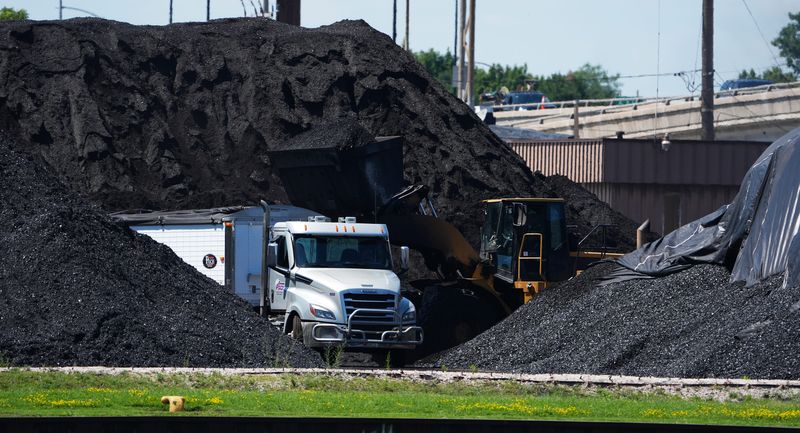
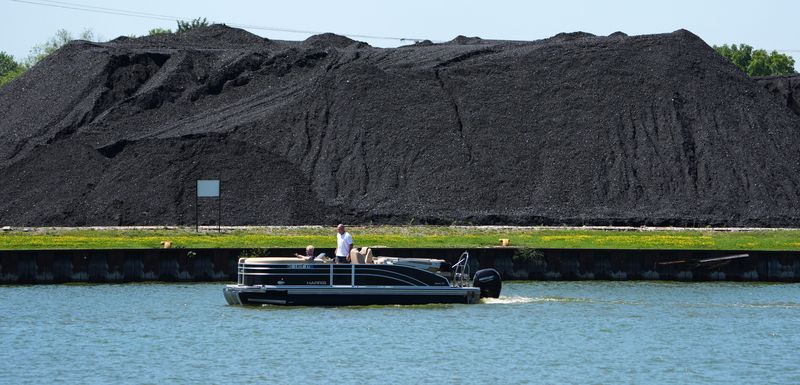
The C. Reiss Co. coal piles, those black mounds almost as tall as the Mason Street bridge, will move out of downtown Green Bay. Forever.
Take a moment to let it sink in, Brown County: It’s really happening.

The countdown to the end of nearly a century of on-and-off complaints, decades of fruitless talks, years of local jokes and wistful “what-ifs” formally began July 7, 2026. C. Reiss and Brown County formally signed the lease that will see the company relocate coal storage from its 126-year home south of West Mason Street.
“People have been trying to move the coal piles for 100 years and we’re going to get it done. We’re definitely excited to do something that’s been the community’s goal for some time,” said C. Reiss Co. CEO Keith Haselhoff.
The event brought together members of the Kroh family that owns C. Reiss Co., Gov. Tony Evers, state officials, county officials, city officials, state legislators from both sides of the aisle and countless people who worked collaboratively for years to make this historic deal happen. Many of those who spoke used words like “historic” and “transformational” to describe the moment.
Evers called the effort a “defining moment” for Brown County and the City of Green Bay that was no small feat to execute. He said the state was proud to provide about $41 million in grants and direct support for the $55 million project. Wisconsin Department of Administration Secretary Kathy Blumenfeld said the project will have a long-term impact on the community.
“The coal piles have dominated the downtown Green Bay area for well over a century,” Blumenfeld said. “We can all agree that after all these years, Green Bay deserves a better symbol of its future.”
It’s a complicated effort that still will take years to become a reality. Yet while the signatories may beg to differ on some of the finer points, it is hard to argue the agreement is anything but a win-win-win-win for the region.
C. Reiss’ coal storage will continue to help fuel the regional economy. The Port of Green Bay will add new terminal spaces. A prime property on the Fox River will be redeveloped, generating more property value for the city, local schools and county tax bases. And a decades-long nuisance, perceived or actual, will no longer impact neighborhoods on both sides of the river.
“This is an amazing achievement for this community,” Green Bay Mayor Eric Genrich told the Press-Gazette.
A total of 600,000 tons of bulk coal and salt won’t relocate overnight
The deal is done and construction is well underway on the new $44.1 million Port of Green Bay development site key to the whole effort to move coal storage out of the central city to a Fox River Terminals site currently used for salt storage.
In an exclusive interview with the Press-Gazette, Haselhoff said construction of the new port site is only the beginning. Once it’s done, estimated for the end of 2027, C. Reiss and Fox River Terminals, both subsidiaries of Robindale Energy, will need to use the 600,000 tons of existing coal and salt already before the relocation process shows visible progress.
“It’s all a big undertaking,” Haselhoff said. He later added: “There’s new infrastructure you’re commissioning to make sure is working efficiently. You’ve got other operational things that are going to add complexity to the entire move.”
The Port of Green Bay’s new site at the mouth of the Fox River, formerly home to the J.P. Pulliam power plant, involves site improvements, filling in slips on the property, constructing an access road, a stormwater pond, dredging tons of material from the Fox River, asphalt paving and construction of a new dock wall.
Once the port site is done, C. Reiss can begin to draw down the existing salt piles at the Fox River Terminals site and direct new ship deliveries of salt to the port development site. The soonest this might start would be in 2028.
As the Fox River Terminal salt piles deplete, C. Reiss will look at how to reconfigure the Fox River Terminals site to store the variety of coal products it stocks for customers. It’s not just uniform, large lumps of black rock, but varieties of coal based on sulfur content, size and intended use. At the same time, it will also begin the slow process of depleting the coal stores on the West Mason Street site.
As new coal deliveries arrive, C. Reiss will begin to unload them at the Fox River Terminals site.
Once the coal piles are drawn down, C. Reiss will perform a final cleanup of the longtime coal storage site and move its equipment up to the Fox River Terminals site.
Green Bay residents have long found the coal piles ‘a just cause for complaining’
Former Green Bay Mayor Jim Schmitt traces concerns and calls to move the coal piles back to Mayor Roman Denissen (1959-65), but Press-Gazette archives indicates residents found reasons to grouse about coal storage, and C. Reiss’ site in particular, as early as 1931.
Women who lived on both sides of the Fox River in February 1931 told city leaders they routinely scooped up piles of coal dust from their homes and laundry hung out to dry would be coated in coal dust, requiring another wash. Local residents and railroad switch workers joined the chorus.
“We don’t want to put the coal company out of business, we are pleased to see them do well. We have bought our coal from them. We have a just cause for complaining especially in the summer when you cannot raise your windows or set out on your porch or your yard, everything you touch is coal dust,” wrote J.B. McDermott in a Feb. 3, 1931, letter to the editor.
In the July 22, 1952, Press-Gazette, a letter only signed “Yours for a cleaner city, Disgusted” complained of the coal dust and excess smoke from ship traffic through downtown.
“What became of all the talk about doing something? All Green Bay housewives should holler so loud and make so much ado they would have to get busy and clean up the mess,” they wrote.
By the 1970s, Donald Stein, an east-side resident, had had enough and wrote to the Press-Gazette.
“We hear talk of being or becoming an ultra-modern city; so let’s be one. The only way this can be possible is to once and for all eliminate coal piles and railroad switching in the dead center of town,” Stein wrote in a letter published on March 9, 1971.
In the early 2000s, the Press-Gazette’s Vision for Green Bay series looked at planning and developing the community over the next 20 years. And of course the coal piles came up as the community debated how to balance the aesthetic and economic issues the site, and use, presented.
A particularly warm, dry start to the 2002-03 winter left the coal piles dry. By late January 2003, strong winds out of the west blew coal dust off the piles and turned part of the Fox River black. Reports indicated the dust reached St. James Park, and then-Mayor Paul Jadin said the city was talking with C. Reiss about the issue.
Community leaders spent decades trying to relocate the coal piles; residents grew skepitcal it woud ever happen
Genrich, Schmitt and Jadin have served as mayor of Green Bay for the last 31 years and all have spent time trying to talk with C. Reiss’ various owners about moving the coal piles and it probably goes back decades earlier.
Schmitt remembered in the early 2000s, after he first was elected mayor, calling Denissen to talk about priorities and the job. Denissen told Schmitt to move the coal piles.
“He was dead serious” about it, Schmitt recalled.
Multiple people who worked on the effort said decades of talk and proposals that went nowhere engrained some cynicism in residents about whether the coal piles would ever move. Genrich said Brown County, C. Reiss, the city, the state and the community fought through it to seize the opportunity when one arose.
“We all experienced those points, but everybody involved here refused to accept defeat, including the community,” Genrich said, applauding the people who spoke out at meetings to support the effort.
Schmitt thinks the coal piles lodged themselves in the community’s collective consciousness for reasons beyond the on-again off-again nuisance complaints over the years.
“It’s visual. Everybody sees it whether they’re driving or boating or coming/going to a Packers game,” Schmitt said.
County executive puts the longtime ‘Ski Green Bay’ coal piles joke to bed
Nothing quite epitomizes the visual impact the coal piles had on the community and with visitors than the “Ski Green Bay” poster that showed a local man skiing down the coal piles.
Brown County Executive Troy Streckenbach used the joke to add a symbolic touch to the July 7 ceremony. He recently found a copy of the poster for sale on Facebook Marketplace, bought it and framed it for the occasion. Streckenbach and C. Reiss’ Zachary Kroh unveiled it to laughs before they asked the key partners involved to sign it, starting with Evers.
“It’s really fitting because at the end of the day we’re putting this to bed. This story is over,” Streckenbach said. “There will be a new story at some point that’s talking about the great future that we have coming forward.”
Downtown Green Bay Inc. Executive Director Jeff Mirkes said he’s heard plenty of jokes about it, but is glad the deal is done.
“When I drive home from work and I see the sun setting on coal piles, it’s a reminder to me that one day we’re going to see a beautiful sunset from downtown Green Bay that won’t be over coal piles,” Mirkes said.
Robindale Energy’s decision to buy C. Reiss Co., Brown County’s purchase of port site made historic day possible
The region’s prior efforts failed to materialize because they often ran into two major challenges:
The first challenge was addressed in 2021 when Wisconsin Public Service Corp. agreed to sell the former Pulliam power plant site to the county and then over successive years as they undertook the major task of securing enough local, state and federal funding to pay for the project, which could cost in excess of $50 million.
The community also caught a break when in 2016 Pennsylvania-based Robindale Energy bought C. Reiss Co. Schmitt said the region was “blessed” with willing participants when presented with the opportunity.
Haselhoff said the family-owned business is big on giving back and understood what this meant to Green Bay and Brown County. He said C. Reiss can maintain its existing bulk materials operations and the company is now looking forward to redeveloping the existing coal piles site in collaboration with the City of Green Bay.
Focus now shifts to redeveloping the current coal piles site, finding a tenant for southern part of port development site
And therein lies the final impact this lease and relocation will have on the entire community
The community will gain two new port terminal sites that expand opportunities for maritime commerce through the Port of Green Bay, plus a new chunk of riverfront property for commercial and residential uses.
Port of Green Bay Director Dean Haen said his focus will shift to recruiting a tenant for the southern half of the county’s new port development site. Haen said the port plans to develop a fresh request for proposals for the southern half of the new port site this summer and fall.
Haen said new port sites have been a goal since he joined the port staff in 1999. He said expansions, like ones undertaken by U.S. Venture and RGL Logistics, often fly under the radar, but remain vital to increasing the port’s estimated $217 million annual economic impact.
“These growth opportunities are long plays that can take five, 10, 15 years to mature,” Haen said.
C. Reiss and the City of Green Bay meanwhile will begin to look at how to redevelop the 36-acre coal piles site into a mix of light industrial on the southern end and more commercial and residential uses on the north end, closer to West Mason Street.
“The big positive for us is Mason Street and what it becomes. That’s the excitement internally here,” Haselhoff said.
This is a developing story that will be updated.
Contact business reporter Jeff Bollier at (920) 431-8387 or jbollier@usatodayco.com. Follow him on X at @JeffBollier.
This article originally appeared on Green Bay Press-Gazette: ‘Amazing achievement’: Green Bay coal piles to move after decades trying
Reporting by Jeff Bollier, Green Bay Press-Gazette / Green Bay Press-Gazette
USA TODAY Network via Reuters Connect
By Jeff Bollier, Green Bay Press-Gazette | USA TODAY Network