In February – in the wake of federal agents shooting and killing two Minneapolis residents – Milwaukee council members were defiant.
Members introduced ICE Out, a package of legislation aimed to curtail the federal agency’s work in the city. Within months, Milwaukee Common Council members unanimously passed one of the key pieces of that package, an ordinance that prohibited ICE agents from wearing masks while working in the city

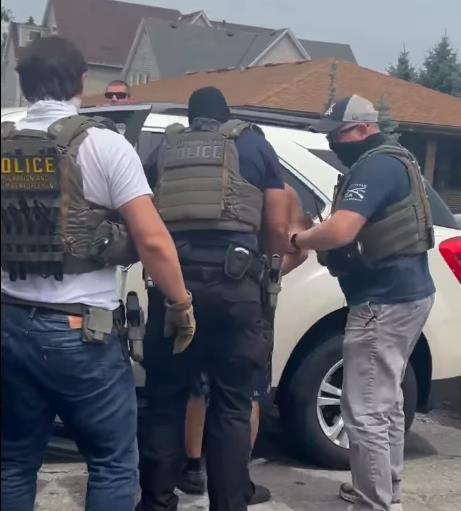
Four months after the package was introduced, a small group of ICE agents from Illinois arrived − many wearing masks − and arrested 39 people during the agency’s nationwide push to increase detentions from late June to early July. A federal spokesperson said its agents would not follow Milwaukee’s law, describing council members as “sanctuary politicians.”
It pitted the legal strength of the city ordinance against the federal government, which argues it is exempt from these laws.
Milwaukee police officers have yet to issue a citation. The department is waiting for City Attorney Evan Goyke to provide further legal guidance, a spokesperson said in an email. Goyke declined comment for this story and has not shared his legal opinion publicly since the masking ban’s passage.
One legal expert said he has yet to hear of any municipality issuing a federal agent a citation for masking, meaning it remains an open question of what might play out. In other states, the federal government has challenged ordinances like Milwaukee’s with some success.
“The law on this is kind of unsettled,” said Robert Yablon, professor of law and co-director of the University of Wisconsin-Madison’s State Democracy Research Initiative, adding that “states and localities that have put these measures in place, they certainly have reasonable arguments.”
What remains to be seen is what happens if local authorities cite ICE agents and elected officials to try and push this fight into the courtroom. Some like County Executive David Crowley and council member Alex Brower have directly stated their desire to build a case against ICE agents’ activities in the city for a prosecution.
Yablon’s organization State Democracy Research Initiative has researched masking laws and other legislations that have been enacted since President Donald Trump’s harsh immigration approach has overhauled how ICE conducts its operations.
The Trump administration argues local mask bans for federal law enforcement violate the Supremacy Clause of the U.S. Constitution, which generally establishes that federal law overrides local laws.
But a 2025 report from the State Democracy Research Initiative concluded the constitutionality of masking bans remains unclear. The organization found laws that prohibit use of public property more likely to withstand a court battle, which Milwaukee city and county officials also passed.
“Under existing precedent, mask bans are neither clearly prohibited nor clearly permissible,” report author Bridget Lavender found. “Because the legal doctrine is murky, it is difficult to predict how legal challenges to mask bans might ultimately play out.”
California suffered a legal loss for its own masking law that specifically targeted federal law enforcement agents, Yablon said.
However, Milwaukee officials crafted a neutrally worded ordinance, specifying any law enforcement officer must comply.
That phrasing, paired with a lack of a direct requirement that agents mask, offers a possible legal defense, Yablon said.
Some local and state lawyers have compared the masking law to speeding laws, he said. If an agent has no need to speed, then they could be subject to a speeding ticket. The same logic towards masking bans has been used, he said.
“There’s no legitimate reason for, in their view, these agents to be masked,” he said.
Milwaukee officials launched their anti-ICE legislation in February, acknowledging they were attempting to sidestep the U.S. Constitution’s Supremacy Clause. The push, and ultimate passage of the legislations, came as part of a balancing act, council member Jo Casta Zammaripa told the Journal Sentinel in February.
“[We’re] trying not to put that target on our back, but also not sitting on our hands,” she said.
But the legal questions were apparent throughout the lawmaking process. In March, city attorney Goyke forced council member to postpone a vote on the masking ordinance, citing the need for more legal review. That drew the ire of council members, who later passed it with Goyke’s support.
Elected officials continue to view masked ICE agents as a troubling issue, citing its impact on community trust with law enforcement.
State Rep. Sylvia Ortiz-Velez, D-Milwaukee, represents a portion of the city’s south side, which has a longstanding human trafficking issue, she said. Masked agents complicate addressing that problem.
She worries that traffickers, who often wear masks, could exploit the presence of masked federal agents to target victims. She fears that people who encounter masked agents arriving in unmarked vehicles could mistake them for traffickers or other criminals and try to flee.
Ortiz-Velez also pointed to an incident last year in San Bernardino, California, in which federal agents shot at a family after the family fled from several masked agents who arrived in an unmarked vehicle. The family’s attorney reported the family feared they were being targeted for a robbery because the agents did not immediately identify themselves.
Ortiz-Velez said she supports law enforcement but believes clear identification by agents is important to avoid confusion and prevent harm to the community.
“Masks aren’t routine,” she said.
Reporters Gina Castro and Zachary Suri of the Milwaukee Journal Sentinel contributed to this article.
This article originally appeared on Milwaukee Journal Sentinel: Is it legal for ICE agents to ignore Milwaukee’s no-mask ordinance?
Reporting by David Clarey, Milwaukee Journal Sentinel / Milwaukee Journal Sentinel
USA TODAY Network via Reuters Connect
By David Clarey, Milwaukee Journal Sentinel | USA TODAY Network