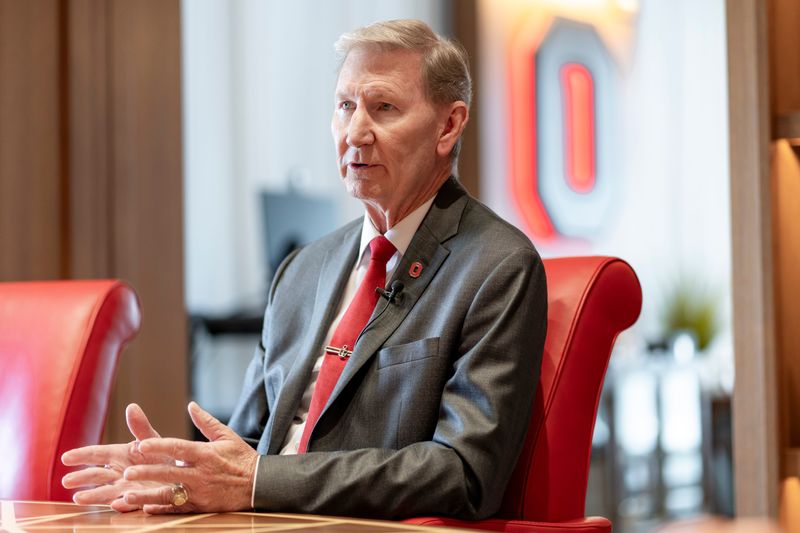
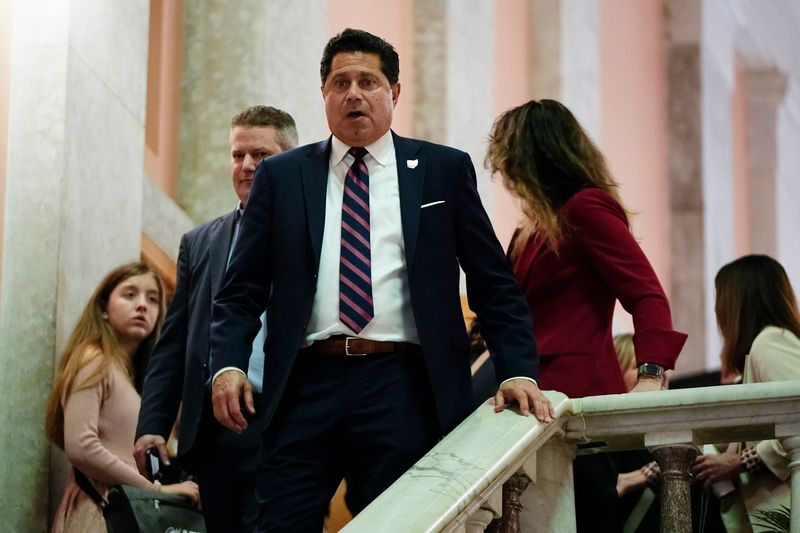
An app developer named in Ohio State’s investigation of former president Ted Carter called the university’s report misleading, saying the report damaged his company’s reputation and inaccurately described his relationship with Carter and Krisanthe Vlachos.
“They lied in their report,” said Paul Hylenski, a Marine Corps veteran who founded an app that would eventually get caught in the middle of Carter and Vlachos’ misconduct.

In fact, Hylenski claimed that Carter and Vlachos tried to steal the intellectual property of that app.
Hylenski founded Vet Mentor AI, a tech company that developed an app to help streamline the disability benefits application process for veterans, in December 2024.
Vet Mentor AI would wind up at the center of a university controversy that ended in Carter’s sudden resignation on March 7. Carter resigned after admitting to having an “inappropriate relationship” with “someone seeking public resources to support her personal business,” according to a university statement.
Ohio State released a nearly 50-page report about a month later detailing the internal investigation into Carter’s downturn. The university interviewed 60 people, including Hylenski, and reviewed thousands of documents as part of its report.
Ohio State’s investigative report made numerous mentions of an app that Vlachos was pitching. The app, which she called “Connect to Power,” would link veterans transitioning out of the military with training programs for employment and government funding to pay for those programs, according to the report.
The report found that Carter leveraged his role within Ohio State and his external relationships with university partners to help Vlachos and her app.
But Hylenski said the app was never Vlachos’ intellectual property and that he was blackballed from business relationships because of Carter after cutting ties with Vlachos. This happened after Vlachos attempted to make herself CEO of his company, according to emails obtained by The Dispatch.
Hylenski said Ohio State’s report misrepresented his app as “not viable,” a statement he said can’t be true because it is currently live and successfully operating under a different name. Hylenski said Carter and Vlachos also attempted to co-op his intellectual property and develop an app on their own after he cut ties.
“They tried to use our IP after we didn’t agree to their terms,” he said.
Hylenski also questioned if his interview with Ohio State’s compliance investigators was kept private because Vlachos reached out to him for the first time in months shortly after he was interviewed.
In a statement, Ohio State spokesperson Ben Johnson said that Hylenski’s claims are “simply not true.”
“The report does not say his software was not viable and does not credit others with his intellectual property. In fact, it links to Vet Mentor AI’s website on page 4 and includes the following description on page 19, ‘has successfully developed an app that assists veterans in obtaining VA benefits,'” Johnson said.
“I can assure you that university investigators kept all interviews confidential,” he continued. “As the report states, investigators did not speak with Vlachos. Keep in mind that numerous individuals were being interviewed during that time.”
Meeting with the “Godfather”
About five months after he incorporated his company, Hylenski was introduced to Vlachos in May 2025. Hylenski’s friend told him Vlachos was interested in collaborating on a platform to help veterans.
Within two weeks of meeting, Vlachos introduced Hylenski to Carter over email on June 4, 2025. Vlachos described Vet Mentor AI as the software that would be the “engine” of her app.
Hylenski met with Carter and other state government officials over the next several months, including representatives from JobsOhio and the Ohio Department of Veterans Services.
During those meetings, Hylenski gave multiple demos of his app to stakeholders, like Carter and ODVS Director Maj. Gen. John C. Harris Jr., who Hylenski said both showed interest in partnering.
A Dec. 4, 2025, Zoom call between Carter, Vlachos and Hylenski, the former Ohio State president laid out a plan for the app’s future that included multiple funding streams and connections to his personal network.
JobsOhio hosted a large meeting at Vlachos’ request on Dec. 10, 2025, focused on the app. The meeting included Vlachos; Hylenski and Matt Poch with Vet Mentor AI; Ohio State’s Carter and former Senior Vice President for Administration and Planning Chris Kabourek; several JobsOhio representatives including J.P. Nauseef, Phil Greenberg, and others; Harris and others from the Ohio Department of Veterans Services.
Hylenski said Carter entered the room “like the Godfather” and made direct, authoritative statements about Vlachos’ app idea.
Hylenski demonstrated a nearly completed app at the meeting and said Carter would put his name and Ohio State’s name on the project. Carter told Nauseef, “You need to get this done,” and told Harris, “We need to do this,” before leaving the meeting, according to the OSU report.
Vet Mentor AI team members left the meeting feeling confident about the app’s future. But Hylenski said things rapidly changed over the next two weeks.
JobsOhio backs out without Vlachos
The relationship between Vlachos and Vet Mentor AI began to deteriorate shortly after the JobsOhio meeting.
On Dec. 20, 2025, according to Hylenski, Vlachos demanded that he give her 25% equity in their venture and demanded to be CEO. Hylenski said Vlachos threatened that if she was not an owner and CEO, Vet Mentor AI “would lose Ohio.”
Hylenski told Vlachos that though they discussed a business relationship, nothing had been agreed upon. That would’ve only happened had retail billionaire Les Wexner purchased the technology, Hylenski said, something that was discussed briefly in September 2025. Hylenski said he and Vlachos had multiple conversations about getting funding, and “she stated that she could get Carter to introduce them to Wexner,” according to the report.
According to Ohio State’s report, Wexner’s attorney was contacted as part of the investigation process and confirmed that at no time did Wexner ever discuss or meet with anyone regarding Vlachos or her app idea.
Hylenski and Poch told Vlachos that she did not own the technology and declined her request.
A few days later, JobsOhio Chief of Staff Phil Greenberg told Poch that “JobsOhio leadership and Carter said that they could not move forward unless Vlachos was involved,” according to the report. Poch said Vet Mentor AI wasn’t able to come to a business arrangement with Vlachos but were prepared to keep going with JobsOhio.
Hylenski emailed Vlachos the next day on Christmas Eve to tell her Vet Mentor AI would be moving forward without her.
“Demo access has been removed, we have funding in place, and we are actively moving forward,” he wrote.
Hylenski and Poch tried to schedule meetings with JobsOhio and ODVS after they parted with Vlachos in the weeks that followed but received no response.
According to the university’s report, Greenberg said it “was clearcut after that meeting that JobsOhio was not going to go forward supporting the App.”
But Hylenski said that characterization isn’t accurate. He noted that JobsOhio reached out after the Dec. 10 meeting with a nondisclosure agreement, which he said was pointed to further interest. JobsOhio also reached out to Hylenski on Dec. 20 to set up a meeting “sooner than later” to discuss the app.
Hylenski told Ohio State investigators he believes his company was “extorted” by Carter and Vlachos because neither JobsOhio nor Ohio Department of Veterans Service continued to work with Vet Mentor AI.
A tale of two apps
Hylenski said he is bothered by Ohio State’s characterization that Vet Mentor AI’s technology was Vlachos’ idea and own product.
“Readers of that report should be aware of an important distinction the report does not clearly draw: at the time those references were made, VMAI had a fully developed, functioning platform. Ms. Vlachos did not,” Hylenski said.
Hylenski also takes issue with Carter and Vlachos trying to produce an app of their own after cutting ties with Vet Mentor AI.
In January, Carter introduced Ohio State’s Center for Software Innovation Director Shereen Agrawal to Vlachos and Rob Lowden, the university’s chief information officer, for the purpose of developing a platform to serve veterans, according to the university’s report.
While Vlachos did not have her own experience developing apps, what she did have, according to Hylenski, “was extensive access to VMAI’s proprietary technology, platform demonstrations, and internal discussions about how our system was built and how it functioned.”
Hylenski said he plans to pursue legal action soon. Although he is disappointed by his experience, Hylsenski said he feels most for the veterans who will miss out on the services that Ohio State could’ve provided through Vet Mentor AI’s app.
“We got screwed in this,” Hylenski said, “but the ones who really got screwed were the veterans of Ohio.”
Higher education reporter Sheridan Hendrix can be reached at shendrix@dispatch.com and on Signal at @sheridan.120. You can follow her on Instagram at @sheridanwrites.
This article originally appeared on The Columbus Dispatch: Veterans app founder slams Ohio State’s Carter report. ‘They lied.’
Reporting by Sheridan Hendrix, Columbus Dispatch / The Columbus Dispatch
USA TODAY Network via Reuters Connect