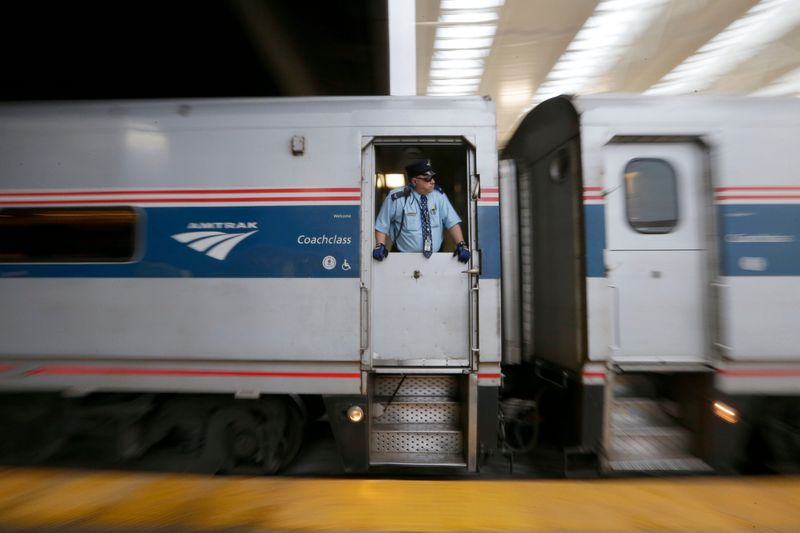
MADISON – All but three candidates for governor are pledging to dedicate $2.5 million of state taxpayer money in the next state budget to help pay for a federal plan to connect Milwaukee and Madison with passenger rail service.
Democratic candidate Mandela Barnes did not make the same promise as his primary opponents when queried by the Milwaukee Journal Sentinel, instead pledging to “work with unions and stakeholders to explore every funding option to expand transit across Wisconsin without increasing costs for middle-class families.”

After the Journal Sentinel published candidates’ answers, Barnes added that he would “certainly sign a budget with the rail expansion in it as long as the federal government upholds their commitment to covering 80% of the construction costs.”
Joel Brennan, a Democratic candidate for governor who worked as Department of Administration Secretary under Gov. Tony Evers, said he would consider the idea but did not commit to enacting it.
“The numbers here make sense: the federal government covers 80% of construction, and a $2.5 million annual operating subsidy that generates $46 million in economic impact is worth a serious look,” he said. “As governor, I’d approach this practically and make sure Wisconsin doesn’t leave that federal money on the table.”
Republican candidate Tom Tiffany rejected the idea outright, saying the funding allocation would be irresponsible.
“Committing millions to a rail project that serves a limited number of riders, while costing at least $2.5 million a year and likely more over time, is not a responsible use of taxpayer dollars, especially when we have seen projects in California waste billions of tax dollars,” Tiffany said in a statement.
“Families in Wisconsin who will never use this line shouldn’t be forced to pay for it.”
The Journal Sentinel polled candidates for governor on whether they would support including funding in the next state budget after Arun Rao, Amtrak’s senior director for network development, told business owners and development officials a planned project to expand Amtrak service in Wisconsin would need an increased operating subsidy from state taxpayers in the 2027-29 state budget.
Amtrak has been working on plans for the possible extension of its Hiawatha service, which runs between Milwaukee and Chicago. That new service, dubbed Hiawatha West, could start as soon as 2030.
The project would cost more than $200 million to build, with Wisconsin taxpayers providing a share of that amount and the annual operating subsidy.
The Amtrak service would initially run two round trips daily, with additional stops in Pewaukee and Watertown – bringing passenger service to Wisconsin’s second- and third-most populous counties. That could increase to four trips daily.
Amtrak expects around 260,000 annual passenger trips, Rao said. The Milwaukee-Chicago Hiawatha service has around 681,600 annual passenger trips. Hiawatha West would use existing tracks and bridges – which Rao said would need upgrades. The new service also would need stations or platforms in Madison, Watertown, and Pewaukee.
The estimated capital improvements budget would be $215 million to $275 million, Rao said. The federal government would cover 80% of that tab, with Wisconsin paying the remaining share.
Also, Wisconsin would need to provide a $2.5 million annual operating subsidy, he said. The state now pays $5.6 million annually for the Hiawatha’s Milwaukee-Chicago service.
A critical step to move the project forward is for the Legislature to include the increased operating subsidy in the 2027-29 budget, Rao said.
Scott Walker campaigned against, killed high-speed train
The question of whether to subsidize could reignite a still-simmering political debate that raged in Wisconsin about 15 years ago when former Republican Gov. Scott Walker canceled a federally-funded project to build a high-speed rail line between Milwaukee and Madison. Democrats still criticize Walker for the move.
“Scott Walker was handed $810 million in free federal grant funding to build this rail line and gave it away to California — one of his many fumbles that left lasting damage on Wisconsin,” Barnes told the Journal Sentinel.
Five Democratic candidates for governor told the Journal Sentinel they would seek or sign a state spending plan that included the state funding sought by Amtrak.
“Yes. Rail is necessary infrastructure and I predict both environmental and economic demand to cause ridership to increase steadily,” State Rep. Francesca Hong, who is leading the Democratic primary in polling, said. “I would rather build rail than Data Centers or invest in repeated highway expansion.”
Hong later added after the Journal Sentinel published candidates’ answers that she would rather build rail than data centers or highway expansions “because rail is a long-term benefit to our state that delivers decades of union work to build, operate, and maintain.”
“That means real careers for the skilled workers who build it. That’s the kind of investment I want to make in our future,” she said.
Lt. Gov. Sara Rodriguez said she “absolutely” would sign a state budget with the funding included.
“Wisconsinites have been voting with their feet since we launched the Borealis line to the Twin Cities in 2024 — those trains are full every day,” she said. “This Milwaukee-Madison expansion will create 200 jobs, bring in $46 million for our economy, and position Wisconsin for long-term economic growth.”
Milwaukee County Executive David Crowley said the project would link “some of the state’s fastest-growing counties to its economic cores and decrease congestion on I-94.”
“Scott Walker rejected $810 million in federal funds in 2010 that would have covered 100% of the capital costs to build this,” he said. “Trains would have been running to Madison by 2012. All Walker actually did was guarantee that Wisconsin taxpayers would pay more, later, for less.”
State Sen. Kelda Roys said “Walker throwing away $1 billion for high speed passenger rail was a catastrophic error, harming Wisconsin’s connectivity and economic growth for 15 years.”
“As governor, I will connect Madison and Milwaukee with Minneapolis and Chicago by passenger rail, increasing mobility and opportunity for workers, businesses, and tourism throughout the state,” she said.
Former Wisconsin Economic Development Corp. CEO and Secretary Missy Hughes also said she supported including the funding in a state spending plan, if elected.
“Expanding train service deeper across Wisconsin will generate enough economic activity and job creation to cover the costs in less than two years, and I’d certainly support including this funding in my first budget as governor,” she said in a statement.
“Republicans in the state starting with Scott Walker have shortsightedly killed investment in rail expansion over the years, and as a result Wisconsin is falling behind in providing more and better transit options to our people. Let’s get this done.”
In response, Walker said the “Democrats running for Governor must have failed their math classes.”
“The ‘high speed rail’ boondoggle in California already cost the state taxpayers billions of dollars,” he told the Journal Sentinel in a statement. “The mess there shows that I saved the hard-working taxpayers in Wisconsin from a scam that would have cost us billions and taken funds away from fixing our roads.”
Whether the funding makes it into the state budget could depend on the outcome of the midterm elections this fall, when Democrats are seeking to flip control of at least one house of the GOP-controlled Legislature.
In 2022, Republican Assembly Speaker Robin Vos said he would not agree to include any state funding for the project. Vos is retiring this year but Republican lawmakers have largely been on the same page on whether to subsidize rail service.
Molly Beck and Tom Daykin can be reached at molly.beck@jrn.com and tom.daykin@jrn.com.
This article originally appeared on Milwaukee Journal Sentinel: Amtrak debate could return to Wisconsin in this year’s governor’s race
Reporting by Molly Beck and Tom Daykin, Milwaukee Journal Sentinel / Milwaukee Journal Sentinel
USA TODAY Network via Reuters Connect