MADISON – In a ruling that gave the governor more power over how state laws are enacted, the Wisconsin Supreme Court cleared the way for the state to institute a ban on conversion therapy.
In a 4-3 ruling July 8, the liberal-controlled court ruled that the Republican-controlled legislative committee’s rejection of a state agency rule that would ban the practice of conversion therapy for LGBTQ+ people was unconstitutional.

Here’s what you need to know about conversion therapy and how this ruling impacts Wisconsinites.
What is conversion therapy?
Conversion therapy is a discredited practice in which counselors instruct gay patients to change their sexual orientation, using therapy to “convert” LGBTQ+ people to heterosexuality or into traditional gender expectations and roles.
In 1973, the American Psychiatric Association removed the diagnosis of homosexuality as a mental illness from its Diagnostic and Statistical Manual of Mental Disorders. Before the removal of the classification, LGBTQ+ individuals could be institutionalized against their will, fired from their jobs and denied a mortgage, among other things.
Many proponents of conversion therapy contend that sexual orientation is a mental health condition that can be healed through intervention from mental health professionals.
While this idea has since been discredited through scientific research, some religious communities and families still seek out the practice of conversion therapy.
Conversion therapy has been banned in 23 states and the District of Columbia, according to LGBTQ+ rights think tank Movement Advancement Project.
A 2023 report by The Trevor Project, a nonprofit organization focused on suicide prevention and crisis intervention for LGBTQ+ youth, found more than 1,300 active conversion therapists operating in all U.S. states except Vermont and Hawaii.
A national poll conducted in 2019 by Ipsos/Reuters found that 56% of U.S. adults support making conversion therapy on youth by mental health practitioners illegal, compared to 18% who think it should be legal.
A 2025 Data for Progress survey found that 60% of likely voters oppose the practice. The survey found that the stance on conversion therapy varies between political parties, with 72% of Democrats opposing the practice while only 46% of Republicans oppose it.
How does this ruling impact Wisconsinites?
The Wisconsin profession licensing board for therapists, counselors and social workers labeled conversion therapy as unprofessional conduct since April 2024.
This provision was blocked twice by the Legislature’s Joint Committee for the Review of Administrative Rules — a powerful Republican-controlled panel in charge of approving state agency regulations, which prompted the lawsuit brought by Democratic Gov. Tony Evers
In the July 8 decision, the Wisconsin Supreme Court ruled that the committee overstepped its authority in blocking the ban on conversion therapy, among other state regulations put forth during Evers’ administration, from being enacted.
The ruling could have sweeping implications for the interaction between the Legislature and the governor’s office, as it determines whether the legislative committee can continue to block rules created by the governor’s office, rather than going through the full Legislature to create policy.
In the majority opinion, Chief Justice Jill Karofsky disputed the notion that the ruling strips power from the Legislature, noting that the ruling does not prevent the Legislature from creating rules and laws through the legislative process.
“…the Legislature retains power over the administrative rulemaking process regardless of our determination here,” she said. “The Legislature created the current process. It alone maintains the ability to amend, expand, or limit the breadth of administrative rulemaking in the other branches — as long as it adheres to the constitution.”
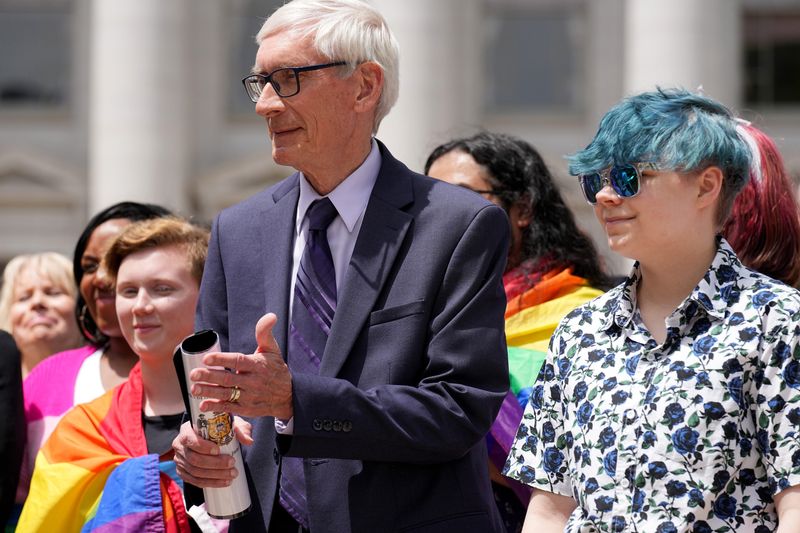
Evers, a staunch supporter of LGBTQ+ rights, has worked on trying to enact the conversion therapy ban since 2020, but the Legislature prevented it from going into effect.
What are lawmakers and advocates saying about this ruling?
Evers applauded the ruling and said Republicans have been allowed to overstep their power and cause gridlock by holding up administrative rules for years.
“It’s pretty simple — a handful of Republican lawmakers should not be able to single-handedly and indefinitely obstruct state agencies from doing the people’s work,” he said in a news release. “Wisconsinites want to protect our constitutional checks and balances. Today’s Wisconsin Supreme Court decision ensures that no small group of lawmakers has the sole power to stymie the work of state government and go unchecked.”
Republican lawmakers, however, saw the ruling as a way to give the executive branch more power while stripping the Legislature of its checks-and-balances role.
Assembly Speaker Robin Vos, R-Rochester, criticized the court for removing oversight.
“For decades, case law has upheld the constitutionality of the legislative rules committee to serve as a legitimate check on the powers of the Governor and the overreach of the bureaucracy. Today’s decision overrules those cases,” Vos said in a statement. “As Justice Rebecca Bradley said in her dissent, ‘Progressives like to protest against ‘kings’ – unless it is one of their own making.’”
Co-chair of the Joint Committee for the Review of Administrative Rules Sen. Steve Nass, R-Whitewater, echoed this.
“The liberal judicial junta on the state Supreme Court has in essence given Evers the powers of a king,” Nass said in a statement. “Today’s ruling is another devasting attack on the Wisconsin Constitution and on the authority of the Legislature, the only branch of government now controlled by Republicans.”
While Fair Wisconsin Executive Director Abigail Swetz celebrated the ruling as a “powerful step in the right direction,” she said there is “still have more work to do” to remove the harmful practice.
“A bill banning conversion therapy by all licensed professions passed through the legislature and signed by the governor would be an even more powerful step. Wisconsin State Senate Bill 324 would do exactly that, and I look forward to seeing it become Wisconsin law,” Swetz said in a press release.
The bill, introduced in June by Sen. Tim Carpenter, D-Milwaukee, and Rep. Lee Snodgrass, D-Appleton, would prohibit conversion therapy in Wisconsin. It has yet to receive a public hearing.
Will the U.S. Supreme Court take up a similar case?
The U.S. Supreme Court is expected to take up a case next term that challenges Colorado’s ban on conversion therapy.
The case would determine whether state and local governments can enforce laws banning conversion therapy for LGBTQ+ youth.
The conservative-led court will take up the case during a time in which transgender people are facing increasing attacks by President Donald Trump and his administration.
After taking office in January, Trump signed an executive order stating the United States would not “fund, sponsor, promote, assist, or support” gender-affirming care. In June, the U.S. Supreme Court upheld Tennessee’s ban on gender-affirming care for minors.
In 2023, the court had turned away a similar challenge related to conversion therapy bans, despite federal appeals courts coming to differing decisions when weighing state bans on the issue.
Anna Kleiber can be reached at akleiber@gannett.com.
This article originally appeared on Milwaukee Journal Sentinel: What is conversion therapy? A breakdown of the Wisconsin Supreme Court ruling on banning the practice
Reporting by Anna Kleiber, Milwaukee Journal Sentinel / Milwaukee Journal Sentinel
USA TODAY Network via Reuters Connect