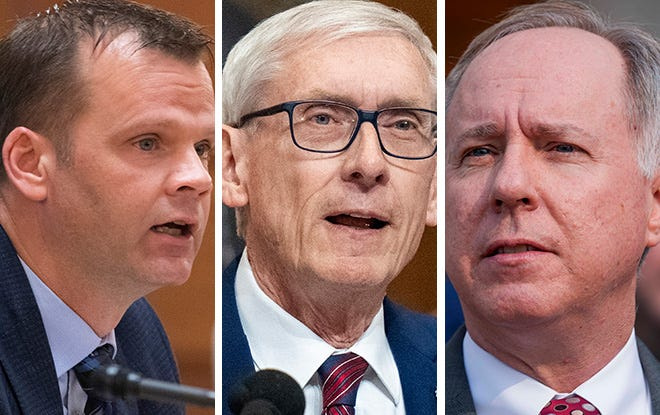
MADISON – Leaders in the state Capitol announced with hours to spare before the dawn of a new fiscal year that they had reached a tentative agreement on key elements of the state budget, including Medicaid funding, special education, childcare and the University of Wisconsin System.
The preliminary agreement, shared with reporters by members of Democratic Gov. Tony Evers’ staff and the Republican leaders of the Legislature’s Joint Finance Committee, assures the governor will not alter any items covered by it with his powerful veto authority. The governor remains free to exercise that option in other areas of the budget, according to Evers’ staff.

The budget committee is set to take votes on the remainder of the budget on Tuesday, July 1, with the full Legislature discussing a vote on the spending plan in its entirety the following day. Joint Finance Committee co-chair Rep. Mark Born, R-Beaver Dam, said in a statement that lawmakers will send the bill to Evers later this week.
“The people of Wisconsin expect their leaders to show up, work hard, and operate in good faith to get good things done. We’ve shown we’ve been able to get good things done for Wisconsin when people put politics aside and decide to work together to do the right thing,” Evers said in a statement.
Lawmakers have nearly five months to build a new state budget after the governor presents his proposed spending plan in February. But this year, Republican leaders were still negotiating with Evers on areas of the budget days before state law requires a new two-year budget to be in place. The new fiscal year begins July 1.
A state budget sets funding levels for hundreds of programs and services paid for by Wisconsin taxpayers. But a missed deadline does not immediately affect funding levels. When a two-year budget in Wisconsin expires, the state continues to operate under its old tax and spending provisions until a new one is passed.
Republicans hold a slim 18-15 majority in the state Senate, which means if more than one GOP senator decides to vote against the budget plan, Democratic votes will be needed to pass it. A spokeswoman for Senate Minority Leader Dianne Hesselbein, D-Middleton, said Hesselbein has been involved in negotiations and expects to have the votes needed from her party.
“This budget delivers on our two biggest priorities: tax relief for Wisconsin and reforms to make government more accountable,” Assembly Speaker Robin Vos, R-Rochester, said in a statement. “This deal brings those investments and reforms together and creates a Wisconsin that works for everyone.”
The agreement gives Republicans a win in that it includes a $1.3 billion tax cut plan that would expand the state’s second-lowest tax bracket, exempt some retirement income from taxation, eliminate the residential utilities sales tax and create a film tax credit capped at $5 million per year.
The tentative deal also delivers Evers’ goal of increasing funding for Medicaid. The agreement increases the amount hospitals pay to the state to help fund Medicaid payments, raising the percentage of their net patient revenue they send to the state Department Health Services from 1.8% to 6%, 30% of which would then go to funding the state’s Medicaid program under the deal. The remainder of those funds would go back to hospitals as provider payments.
Evers’ staff noted that policy changes to the state’s Medicaid program could be affected in the future by federal legislation that could seek to limit such provider taxes in states, arguing the urgency for including them in the state budget now.
The deal would also boost spending on child care by $300 million, with $110 million directed toward payments to child care providers as a pandemic-era program that did the same comes to an end — an Evers priority — while including some regulatory changes pitched by Republicans. Those include authorizing large family child care centers and allowing teens to work as assistant child care teachers.
The percentage of costs of educating students with disabilities covered by the state would grow under the tentative deal from 32% to 45% in the second year of the state budget, a compromise between Republicans who proposed 37.5% and the 60% Democrats have called for.
Deal marks a big turnaround in fortunes for the UW System
The UW System would see one of the biggest turnarounds in the budget if ultimately approved. Republicans in June threatened to cut universities by $87 million. Instead, the state’s public universities will receive a more than $256 million boost over the next two years, the largest increase in more than 20 years, according to the governor’s office.
More than $94 million of the UW money would go toward employee pay raises, another $7 million would support virtual mental health services for students, and $54 million would aid in the recruitment and retention of faculty with expertise in high-demand fields. More than $100 million would help “stabilize” campuses after decades of increasing financial pressure.
Included in the tentative deal is more than $840 million for UW campus building projects.
UW-Milwaukee will be able to consolidate its College of Health Sciences into one building instead of being spread across five. The state capital budget plan calls for UWM to receive $189 million to renovate portions of its Northwest Quadrant, formerly the old Columbia St. Mary’s Hospital complex. The project will allow UWM to graduate 300 more health sciences students annually, UWM Chancellor Mark Mone said.
The project list also includes:
Left off the list was a UW-Madison request for $293 million to demolish the Brutalist-style Humanities building. The architecturally infamous building has caused headaches for facilities staff since its 1969 opening. The plan calls for $5 million to spend on planning costs of the larger project.
Future of Green Bay Correctional remains unclear
The tentative agreement did not weigh in on whether to close or replace the aging Green Bay Correctional Institution or whether Republicans approve of Evers’ proposed plan to close or modify a series of prisons across the state.
The deal must first be approved by the Republican-controlled budget-writing committee and then by both houses of the state Legislature. Leaders of the budget committee said they planned in their meeting Tuesday, July 1, to move forward a plan to begin the process of closing the Green Bay prison by 2029.
At least three Republican state senators have expressed a willingness to keep a new budget from passing anytime soon: Sens. Chris Kapenga of Delafield, Rob Hutton of Brookfield and Steve Nass of Whitewater.
“The months ahead are a great opportunity to start pulling back the curtain on what’s actually happening with state spending,” Kapenga wrote in a post on X on June 30.
“Chances are high there’s some ridiculous waste. Either way, Wisconsinites deserve more accountability and transparency.”
This budget cycle is the first during which Republican legislative leaders have sought to negotiate multiple areas of the state budget plan with the Democratic governor, who was first elected seven years ago.
Typically, Republican lawmakers largely toss Evers’ spending plan and build their own without ensuring their measures will withstand Evers’ veto pen.
GOP leaders have passed measures that typically live in a state budget as individual bills this budget cycle, however, in an attempt to avoid Evers’ vetoes.
Lawmakers have scheduled a final meeting of the Legislature’s budget-writing committee for Tuesday, July 1, and floor sessions could take place as early as Wednesday, July 2.
Jessie Opoien, Molly Beck and Kelly Meyerhofer can be reached at jessie.opoien@jrn.com, molly.beck@jrn.com and kmeyerhofer@gannett.com.
(This story was updated to add new information.)
This article originally appeared on Milwaukee Journal Sentinel: Democratic Gov. Tony Evers, Republican leaders reach a deal on large elements of a state budget
Reporting by Jessie Opoien, Molly Beck and Kelly Meyerhofer, Milwaukee Journal Sentinel / Milwaukee Journal Sentinel
USA TODAY Network via Reuters Connect