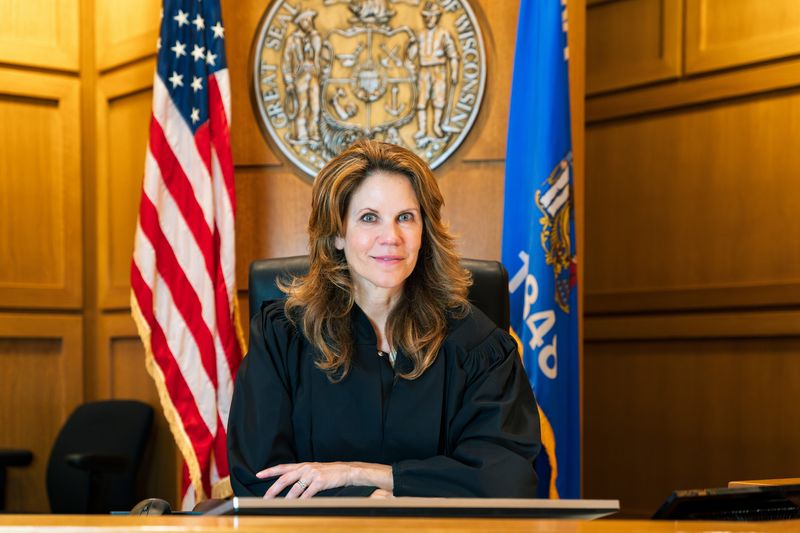
Appeals Court Judge Chris Taylor, who’s running in this year’s Wisconsin Supreme Court race, has something other candidates for the state’s highest court haven’t had in more than a decade – a legislative record.
Taylor, the liberal candidate in the race, is the first state Supreme Court hopeful on the ballot who previously served as a lawmaker since conservative former Justice David Prosser, who last ran for reelection in 2011. Prosser retired in 2016 after nearly 18 years on the court, and before that spent 18 years as a Republican representative in the state Assembly. Prosser died in 2024.

Taylor will be on the ballot on April 7, when voters can choose between her and Appeals Court Judge Maria Lazar, the conservative candidate in the race. Early voting starts March 24. The winner will be elected to a 10-year term on the Supreme Court, which is now controlled 4-3 by liberals.
A Democratic state representative from Madison between 2011 and 2020, Taylor had hundreds of bill sponsorships, floor votes and committee votes during the nine years she spent in the Assembly.
Taylor was the lead author of 243 bills during that time, but only six of them became law, according to information provided by the state Legislative Reference Bureau. Legislation authored by Taylor and other Democratic lawmakers typically faced strong opposition from the Republican-controlled Legislature and GOP former Gov. Scott Walker, who swept into power after the November 2010 elections.
Lazar campaign spokesman Nathan Conrad said Taylor’s legislative record is “one of extreme positions and minimal results.”
“While she touts a bipartisan brand, her tenure in the Assembly was marked by partisanship that saw fewer than 3% of her bills signed into law,” Conrad said in an emailed statement. “Unable to find success through the will of the people, she is now seeking a seat on the Supreme Court to bypass the legislative process.”
Taylor left the Legislature to become a Dane County Circuit Judge in 2020, and was elected to the be a District IV Court of Appeals judge in 2023. Asked about conservatives portraying her as a liberal activist, Taylor said, “I have heard thousands of cases. I have never been reversed.”
She added, “I don’t hide anything. I am who I am, but my gosh, I am absolutely committed to being an independent judge.”
Taylor: ‘I’m really proud of my legislative record’
Taylor was elected to the Assembly in August 2011 at an especially partisan time in Wisconsin, just months after Walker’s Act 10 measure sharply limiting collective bargaining for most of the state’s public workers drew tens of thousands of protesters to the state Capitol. It triggered recall elections against Walker and senators from both parties.
But Taylor frequently highlights her work on bipartisan bills on the campaign trail.
“I worked really hard in the Legislature to make sure that I was working across the aisle,” Taylor said on March 18 following an event at Marquette University Law School.
She noted that she worked on some “really significant” bills that passed, specifically citing a measure she co-sponsored making Wisconsin the first state in the nation to require outside investigations when people die in police custody. The 2013 bill set policies for investigating such deaths, and included a provision requiring at least two outside investigators in all officer-involved death investigations.
Its sponsors in the Assembly included Taylor and then-GOP Rep. Garey Bies, a former deputy sheriff from Sister Bay. The bill was signed into law by Walker in 2014.
“I’m really proud of my legislative record,” Taylor said.
Taylor contrasted her work in the Legislature to that of her opponent, who served as assistant attorney general at the state Department of Justice under Republican leadership from 2010-2015.
Lazar’s work included cases over Act 10 and the gerrymandered 2011 electoral maps, which all but guaranteed years of large Republican majorities in both chambers. She also represented the state in a case filed by Planned Parenthood of Wisconsin over a law that required physicians performing abortions to have admitting privileges at nearby hospitals.
“While my opponent was defending gerrymandered legislative maps, I was trying to establish a fair, nonpartisan redistricting process. When my opponent was defending harmful abortion restrictions, I was working to protect access to reproductive healthcare,” Taylor said. “And when my opponent was rolling back the rights of working people and defending those laws, I was working to make sure that working people were fairly compensating and earned a fair wage.”
Republicans criticize Taylor over criminal justice issues
Republicans have also criticized Taylor over her views on criminal justice issues, including her past opposition to Marsy’s Law, a constitutional amendment aimed at expanding and strengthening the rights of crime victims.
While she was in the Assembly, Taylor voted against Marsy’s Law in 2017 and 2019.
Republicans have also criticized Taylor’s stances on other criminal justice bills.
Republican Party of Wisconsin spokesperson Anika Rickard accused Taylor of “pushing the agendas of far-left groups over the needs of Wisconsinites demonstrates her blatant disregard for the people she claims to serve.”
Taylor said that she has been committed to helping crime victims and domestic abuse survivors throughout her career. She added that some advocates and community groups at the time had expressed concerns about the Marsy’s Law proposal delaying justice for victims. But she said that she’s implemented Marsy’s Law as a judge.
Taylor also pointed to her work introducing the bipartisan “Safe at Home” law, which allows victims of domestic abuse, sexual assault or stalking to keep their addresses confidential. The law created the Wisconsin Department of Justice address confidentiality program aimed at improving safety for survivors and their families.
Taylor worked on the bill with Republican lawmakers, including former Rep. Joel Kleefisch and U.S. Rep. Scott Fitzgerald, as well as Democratic former Sen. Jennifer Shilling.
“While the four of us don’t always agree, there is one thing we can all get behind: the safety of survivors of domestic abuse, stalking, and human trafficking,” they wrote in a 2016 editorial in The Cap Times.
Walker signed the bill into law in 2016.
Ashley Franz, Taylor’s campaign manager, accused Lazar and her supporters of “getting desperate.
“Highlighting Judge Taylor’s ability to bring Democrats and Republicans, including Governor Scott Walker, together to solve problems and improve protections for survivors of domestic violence and stalking only reinforces the fact that she will put people and the law first as a member of the Wisconsin Supreme Court,” Franz said.
“Maria Lazar is the only candidate with a record of using her courtroom to push a political agenda that puts right-wing special interests and big corporations first.”
This article originally appeared on Milwaukee Journal Sentinel: Wisconsin Supreme Court candidate Chris Taylor’s legislative record is a focus in her race
Reporting by Mary Spicuzza, Milwaukee Journal Sentinel / Milwaukee Journal Sentinel
USA TODAY Network via Reuters Connect