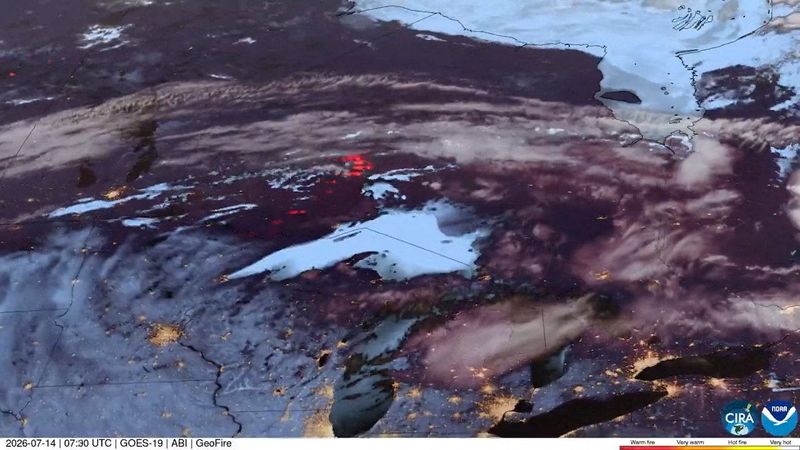
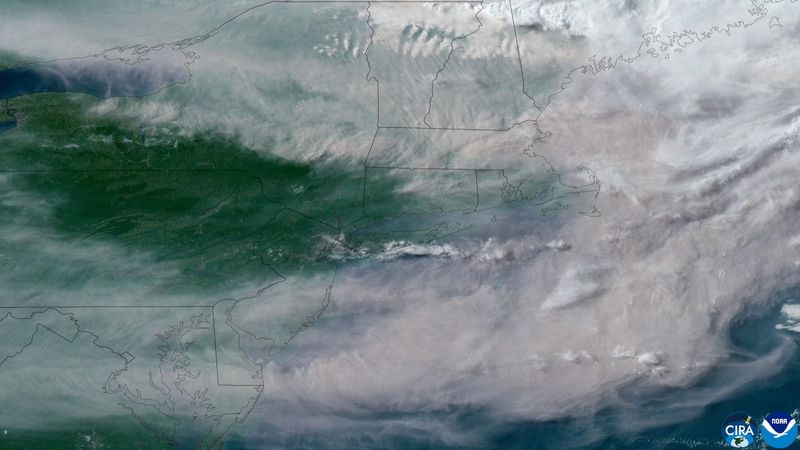
Smoke from various wildfires began drifting across Wisconsin on Tuesday, July 14, with experts predicting air quality impacts through at least Thursday, July 16.
As of Wednesday, July 15, Canada had 830 ongoing wildfires, including 100 considered out of control, according to the Canadian Wildland Fire Information System. There were 26 new wildfires reported Wednesday afternoon alone.

Most of Canada’s wildfires are active in northwest Ontario and in the border regions along the Great Lakes and northeastern United States. The Western Fire Chiefs Association also reported 14 active wildfires along Minnesota’s northern border with Canada. The association estimates 43,000 acres were burning in Minnesota as of Wednesday afternoon.
How does Canadian wildfire smoke get into Wisconsin?
Canada’s wildfires have been blazing since the middle of May, but the air quality impacts haven’t hit the United States until this week.
The wildfires are reaching a peak mass in July. While Canada had wildfires earlier this year, they weren’t on a level that could carry smoke far enough to impact the United States.
Smoke also needs the right weather pattern to come down to a level where humans can breathe it in. National Weather Service meteorologists say wildfire smoke usually affects Wisconsin residents when a high-pressure air mass comes before it.
This weather pattern creates sinking, dry air that pulls smoke to a lower altitude without getting absorbed by moisture.
Wisconsin has had those conditions in the past few days. On Tuesday, July 14, the National Weather Service reported northwest winds brought smoke to the state and a high-pressure system helped bring that smoke to the surface.
When will Canadian wildfire smoke leave Wisconsin?
The National Weather Service and Wisconsin Department of Natural Resources will reevaluate the ongoing air quality alert Thursday afternoon. Both agencies have said they expect the alert will be extended.
The high-pressure system pulling smoke to the surface could stick around through Friday, according to National Weather Service forecast discussions.
A low-pressure system could arrive by the morning of Saturday. July 18. If that happens, rain could have a chance to replace the incoming smoke. If the low-pressure does not heavily affect Wisconsin, colder air is still expected by Sunday, July 19.
This article originally appeared on Milwaukee Journal Sentinel: Why is Wisconsin seeing wildfire smoke from Canada this week?
Reporting by Caden Perry, Milwaukee Journal Sentinel / Milwaukee Journal Sentinel
USA TODAY Network via Reuters Connect
By Caden Perry, Milwaukee Journal Sentinel | USA TODAY Network