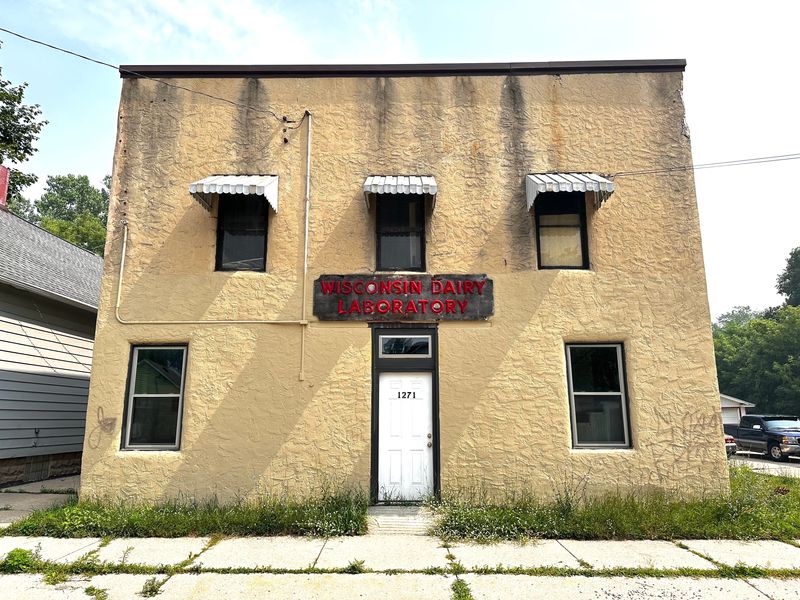
Reader question: In the 1200 block of St. Clair Street … is the old yellow Dairy Lab building., with a new door and new front windows but which still has cracks in the outside walls and looks as dilapidated as ever. Could you research this building sometime?
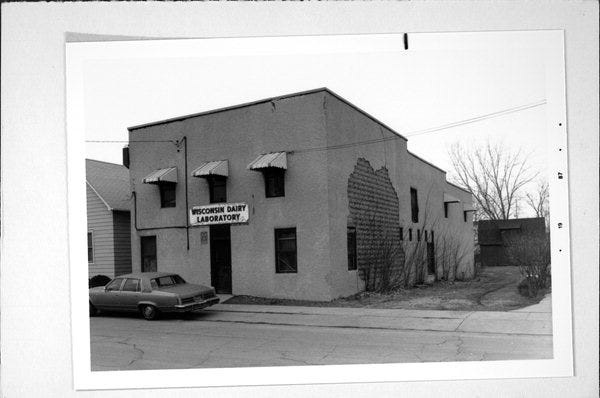
Answer: The two stories of stucco and concrete at 1271 St. Clair St. no longer house the Wisconsin Dairy Laboratory, as is emblazoned above the front door, what remains of a boom-and-bust business that sold cheese bandages and rennet.

Bandages to wrap hard dairy and rennet to separate curd from whey, these were the supplies in demand when Iva and John B. Linzmeyer incorporated their Wisconsin Cheese Bandage and Supply Company in 1921. The state’s milk supply was soaring. The number of cheese plants was rising to use that output. Green Bay became the center of the cheddar cheese market, according to a Brown County industrial survey.
To keep pace, the company needed to grow.
Not yet moved to St. Clair St., the company made 15,000 bandages a day in 1921. It was not enough to satisfy demand, the Green Bay Press-Gazette reported. Linzmeyer said at the time that he would soon double production to become one of the state’s largest cheese bandage factories.
It got into rennet-making two years later. The company, which had changed its name that year to the Wisconsin Dairy Laboratory, was prepared to sell 200 gallons of rennet a day, enough for 640,000 pounds of cheese, the Press-Gazette reported.
Then the building at St. Clair St., first built as a stable in 1916 then sold to the Bank of Oakfield, was bought in 1925 for the dairy lab’s use, according to the Wisconsin Historical Society.
“The building was loud, dark and smelly and overall depressing, not unlike many workplaces in the 1960s,” wrote Paul Linzmeyer, grandson of Iva and John Linzmeyer, in an email to the Press-Gazette. He worked in the St. Clair St. building for eight years, starting in fifth grade. “But I remember the long-term employees (about six) as being (except one of them) some of the kindest, hardworking, reputable people that I knew.”
Rennet was made downstairs, between the downstairs office and warehouse. Calf stomachs packed in 55-gallon barrels full of salt brine were brushed off, then put on drying racks before being ground into rennet. The stomachs from South America were especially putrid, Linzmeyer recalled. The dryer room was noisy and hot.
Upstairs, bandages were stitched together with foot-powered sewing machines from bales of cheesecloth delivered by a rope elevator. Packed by type and size, the bandages went back down to the warehouse.
The products shipped across the country and internationally, to France, Greece, Mexico and South America, the Press-Gazette reported in 1957. A salesman went around the state, cheese factory to cheese factory, in a large panel truck, and Linzmeyer personally drove a smaller truck for other large orders.
The business was sold in the mid-1960s to a mid-state cheese company, according to Linzmeyer.
“Like the small family farms of today, the small cheese factories mostly went out of business,” Linzmeyer said. “My dad (Sylvester Linzmeyer) tried to keep them going by extending credit, but the big corporate cheese companies ate them up like the corporate farms are eating up the family farm today.”
The Wisconsin Dairy Laboratory’s last year of operation in the stucco building was 1970, according to the Wisconsin Historical Society.
The building has sat vacant since 1971.
Do you have a question about Green Bay? Send them to Jesse Lin for an answer every week at 920-834-4250 or jlin@usatodayco.com.
This article originally appeared on Green Bay Press-Gazette: Reader asks about history of dairy laboratory building in Green Bay
Reporting by Jesse Lin, Green Bay Press-Gazette / Green Bay Press-Gazette
USA TODAY Network via Reuters Connect
By Jesse Lin, Green Bay Press-Gazette | USA TODAY Network