Large, grayish and solitary doesn’t sound like the description of a star.
But during the time when the Milwaukee County Zoo did not have a Diceros bicornis, Joan Stasica heard the same questions over and over:

Where are the rhinos? Where did they go? When are the rhinos coming back?
Visitors love to see the big animals – the hippos, rhinos and giraffes – said Stasica, who is the zoo’s supervisor for those large ungulates.
Rhinos returned to Milwaukee County Zoo shortly before the zoo opened its Ladish Co. Foundation Rhino Care Center and Robert Dohmen Hippo Indoor Haven in December, a $22.6 million project designed with best-care practices in mind.
In late April, the zoo opened its renovated outdoor space for the rhinos.
That’s a substantial investment for the zoo and its partner, the Zoological Society of Milwaukee. But it’s an important investment for several reasons, Stasica explained.
As a participant in the Association of Zoos and Aquariums’ species survival plan for rhinos (and similar plans for other species), the zoo wanted to create a good environment for breeding offspring and contributing to genetic variation.
Hosting rhinos also helps the zoo fulfill its mission of helping the public feel more connected with the natural world and environment, she said.
Where did Milwaukee County Zoo’s rhinos come from?
Zuri, a 16-year-old female, arrived in Milwaukee Oct. 23, 2025, from the Cincinnati Zoo & Botanical Garden, where she had lived since 2013. She was born in 2009 at the Baton Rouge Zoo.
Kianga, a 22-year-old male, arrived in Milwaukee Oct. 24, 2025, from the Racine Zoo, where he had lived for 18 years.
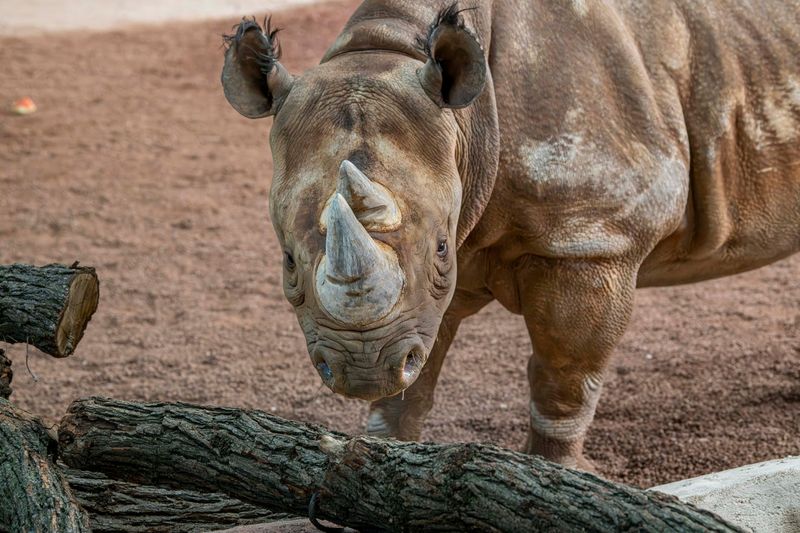
The two rhinos have been paired as potential breeding partners via the multi-zoo Eastern Black Rhino Species Survival Plan. Eastern black rhinos are classified as a critically endangered species by the International Union for the Conservation of Nature.
Zuri, who weighs about 2,550 pounds, and Kianga, 2,860 pounds, were matched because they are not closely related individuals genetically, Stasica said. So any offspring they create would add diversity to the pool of eastern black rhinos.
Zuri is an experienced mother who has birthed two calves, giving the zoo here hope for this union.
What do Milwaukee zoo staff know about their rhinos’ backgrounds?
They know plenty. Kianga and Zuri were both born in American zoos. Milwaukee zoo staff have talked with Zuri’s keepers in Cincinnati. Milwaukee even sent one of its keepers to Cincinnati to get to know Zuri before the rhino was brought here.
Kianga was born at the Brookfield Zoo outside Chicago. “We know some of his original keepers,” Stasica said.
“We have records on both these (rhinos) and their families,” she said.
Rhinos like solitude, so how does their mating work?
Apart from a mother and her calf staying together for few years until the calf reaches maturity, black rhinos in the wild are solitary animals, Stasica said. So at the zoo, Zuri and Kianga will be in separate areas of their habitat most of the time.
But when Zuri goes into estrus, signaling her availability to mate, zoo staff will bring her and Kianga together for a few days.
The keepers in Cincinnati told their Milwaukee counterparts that Zuri is very clear when she’s interested and when she’s not. “That’s helpful for us,” Stasica said.
What are Zuri and Kianga’s personalities like?
Both rhinos are friendly, and both seek out attention from keepers, Stasica said. She attributes that to the amount of training and keeper interaction they received at their prior zoos. “They’re actually very friendly,” Stasica said. “They want to be scratched.”
Describing differences that Stasica said could be somewhat gender-based, she characterized Zuri as a little cleaner, “a little more dainty,” and a bit higher strung. Male Kianga is more laid-back, but also has “a bull in a china shop” side. He’s tested the structure of his habitat and tried to move or break things. Zuri doesn’t test the environment the same way Kianga does, Stasica said.
Are black rhinos really black?
The black description is a misnomer, Stasica said. Both black rhinos and white rhinos, the other African species of rhinoceros, are a dull gray-brown color. But the mud where black rhinos live in the wild is black, and since they love to roll around in that mud, they often appear blackish in the wild, Stasica said.
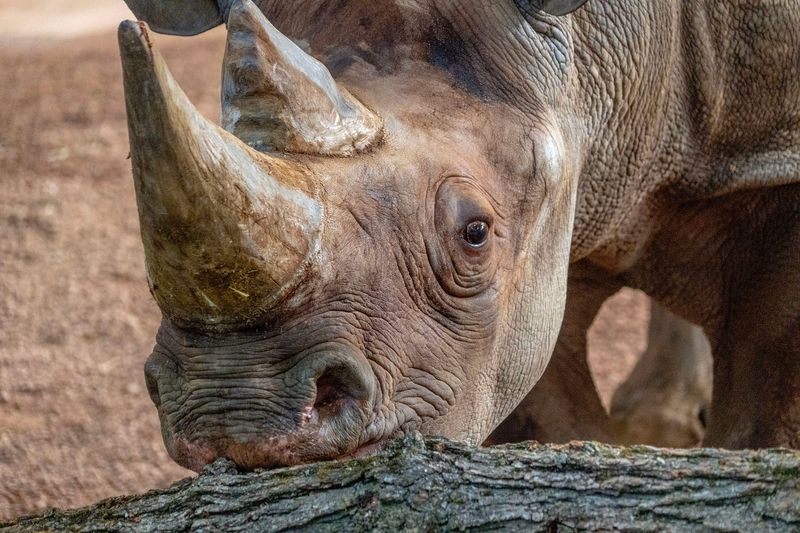
Black rhinos, which tend to be a little smaller than white rhinos, have a prehensile upper lip, which means it’s adapted for grabbing food to bring into their mouths. Contrast that with a white rhino, which Stasica said has “a big, flat, lawnmower lip,” suitable for grazing.
What do the zoo’s black rhinos eat?
Zuri and Kianga get a mixture of grass hay and alfalfa hay, Stasica said. They also receive pelleted chow specifically for rhinos with vitamins and minerals they need.
The zoo also provides them with browse – tree branches and shrubbery. Even in winter, they get bare tree branches to gnaw on.
The rhinos are also fed some produce daily, about a 1.5 kilograms of greens, plus a little fruit. Zuri has a sweet tooth and would eat all the fruit the zoo could give her, Stasica said. The rhino has enjoyed watermelon, banana, canteloupe, apples and pears.
What kinds of training are the black rhinos given?
It’s focused on behaviors that will help zoo staff take care of them, Stasica said. They learn how to step on a scale and stand still so they can be weighed. Standing still also helps keepers examine the rhinos’ feet and trim their nails. Rhinos also learn to cooperate with blood draws for medical tests. Among other considerations, rhinos are subject to iron overload, so drawing blood to test for that is important, Stasica said.
Are the rhinos aware of their neighbor, Happy the hippo?
Zuri and Kianga share their digs with the adjacent Robert Dohmen Hippo Indoor Haven, the new home for Happy, the zoo’s long-resident hippo. Are they aware of their neighbor?
“Definitely,” Stasica said. “They can smell him … he’s got a pretty strong odor, and they have a better sense of smell than we do.”
She also said that because Happy is a male hippo, he is a muck spreader. That means he helicopters his tail and spreads his manure. Occasionally he’s thrown a little bit of it into the rhino area, “which they’ve been really, really interested in,” she said.
Note: This story was updated to add photos.
This article originally appeared on Milwaukee Journal Sentinel: Meet Zuri and Kianga, two of Milwaukee County Zoo’s biggest stars
Reporting by Jim Higgins, Milwaukee Journal Sentinel / Milwaukee Journal Sentinel
USA TODAY Network via Reuters Connect
By Jim Higgins, Milwaukee Journal Sentinel | USA TODAY Network