More than most issues, conservation has the potential to transcend partisan politics.
And while many of the greatest successes in that arena – such as creating the Fish and Wildlife Restoration acts at the national level and establishing the Knowles Nelson Stewardship Program in Wisconsin – have had strong bipartisan support, I’m not surprised when things break down to party-line battles, either.

That’s been particularly true in the last couple decades, and perhaps never more evident than this year.
Last week Republicans in Congress added more reason for hunters, anglers and public land advocates to jump on the Democrats’ bandwagon.
It’s a matter of both substance and method.
On June 10 Sen. Mike Lee (R-Utah), chairman of the Republican-controlled Senate Committee on Energy and Natural Resources introduced an “Amendment in the Nature of a Substitute” to S.140–Wildfire Prevention Act of 2025.
While the original bill addressed commonsense wildfire issues and had bipartisan support, the last-minute amendment would repeal the Roadless Rule on national forests.
Further, if approved, the amendment would advance out of committee without any form of congressional hearing or chance for public input.
And it would prevent the U.S. Forest Service from ever issuing similar protections.
It’s the kind of rushed, underhanded process that earns politicians – and in this case, a political party – a bad name.
Lee is already vilified by many in the conservation world for his repeated attempts to sell public lands.
In this case, he argued the Roadless Rule has become an “environmental disaster” by restricting access for necessary wildfire prevention work, endangering communities and increasing wildfire.
The amendment passed out of committee on an 11-9 vote, with all Republicans in favor and all Democrats against.
The reaction has been strong, both because the Roadless Rule has been very popular among the public and for the process Republicans employed to try to undo it.
Over the last 25 years, the Roadless Rule has protected approximately 58 million acres of National Forest lands across the country, including about 70,000 acres in the Chequamegon-Nicolet National Forest in northern Wisconsin, from road construction and certain other developments.
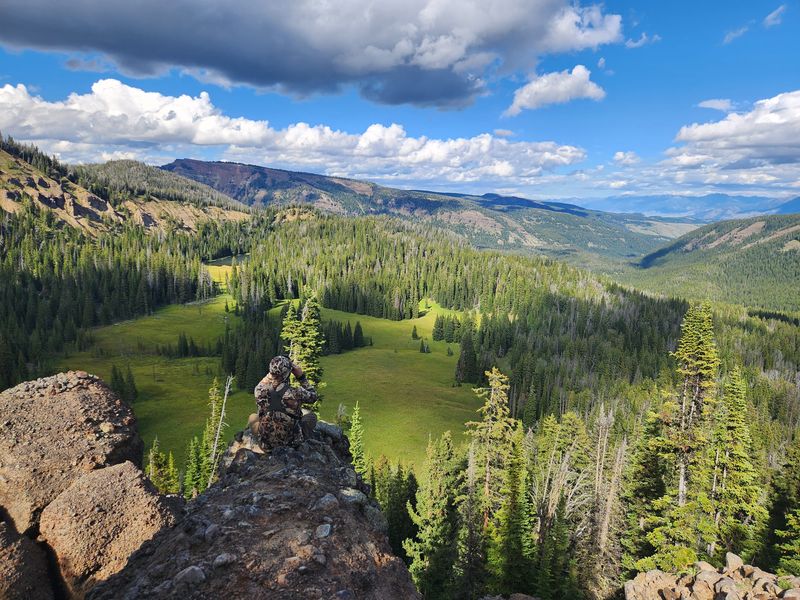
The areas contain some of the best remaining fish and wildlife habitat in the U.S. and support healthy watersheds and backcountry recreation.
In the realm of federal legislation, the rule has historic standing. It was established after one of the largest public participation efforts in federal land management history, including more than 600 public meetings and 1.6 million public comments. Ninety-five percent of those comments supported the rule.
In 2025, after the Trump administration announced a separate initiative to repeal the Roadless Rule, a public comment period delivered 99% opposition to the proposal, according to an analysis by the Center for Western Priorities, a non-partisan conservation and advocacy organization based in Denver, Colorado. The U.S. Department of Agriculture has yet to release its latest move on its efforts to rescind the rule.
The June 10 action by Republicans in the Senate Energy and Natural Resources Committee took most by surprise.
Sen. Martin Heinrich (D-New Mexico), the ranking member of the committee, called the amendment a “Trojan horse” that was never about wildfire.
“[The amendment is] about handing public lands to extractive industry while cutting the rest of us out,” Heinrich said. “Hunters and anglers alone generate $133 billion in annual economic output and 1.3 million jobs. The outdoor recreation economy tops $1 trillion a year. Fragment these places, and you don’t just lose the experience, you lose the economy.”
Wisconsin native and former chief of the U.S. Forest Service Mike Dombeck helped design the Roadless Rule in the late 1990s. In an appearance June 4 in Rhinelander, he called the rule “probably one of the most conservative policies you could have.”
“No. 1, it doesn’t cost taxpayers money; in fact, it saves taxpayers money,” Dombeck said. “No. 2, it doesn’t create a liability by building a road, then that year, after year, after year requires maintenance and costs money to keep up. And No. 3, it keeps options open for future generations.”
Conservation organizations have mostly spoken out against the committee vote.
“Lack of roads in inventoried roadless areas has neither prevented fuel treatment nor led to substantially more fire,” Chris Wood, president and CEO of Trout Unlimited, said at a June 11 press conference. “Today, 80% of all fires are started by people, and 80% of all fires are started within a half a mile of a road. The idea that we would overturn the roadless rule, it defies economic, ecological and common sense.”
The amended bill now goes to the full Senate. But rather than allowing an environmental analysis and a public comment period on the specific provisions, the Republicans embraced a shortcut in the legislative process.
It has done something else – it has shed more light on the priorities of the political parties.
“For the first time in my life, the Republican party no longer feels the need to be responsive to sportsmen,” said Sen. Heinrich, a hunter and angler.
Opponents to the amended bill are taking some solace in the fact it will – unless more political shenanigans are used – require 60 votes to pass the Senate.
Neither of Wisconsin’s senators are on the committee. But they would vote on the measure should it reach the Senate floor.
So you might want to let U.S. Sens. Ron Johnson (R) and Tammy Baldwin (D) know how you feel, both about the Roadless Rule and the political process.
This article originally appeared on Milwaukee Journal Sentinel: Latest attempt to rescind Roadless Rule reflects poorly on Republican party | Smith
Reporting by Paul A. Smith, Milwaukee Journal Sentinel / Milwaukee Journal Sentinel
USA TODAY Network via Reuters Connect
By Paul A. Smith, Milwaukee Journal Sentinel | USA TODAY Network