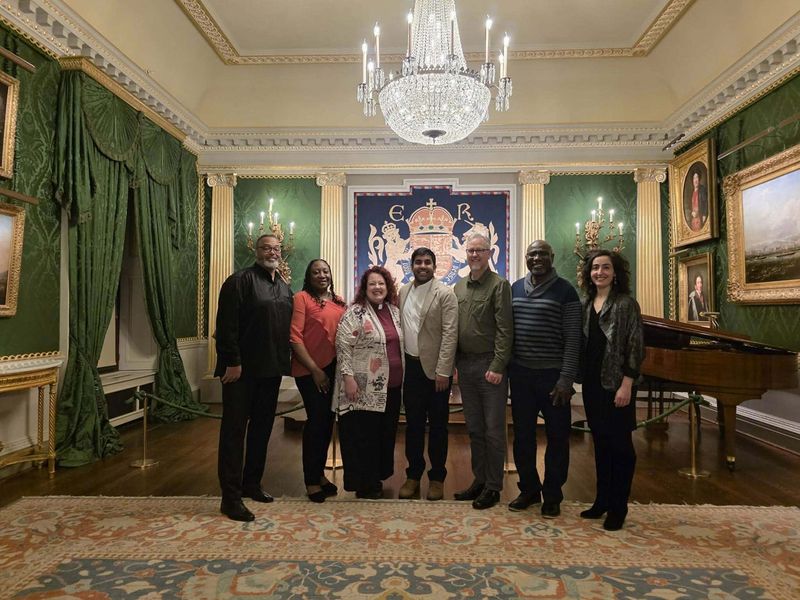
We recently traveled from Wisconsin to Belfast, Northern Ireland, representing the Wisconsin Alliance for Civic Trust at a retreat hosted by Rethinking Conflict and The Carter Center. We endeavored to learn from the history of “The Troubles” in Northern Ireland, and how we can apply the learnings from a decades-long, violent political conflict to our own situation in the U.S.
We spoke with civic and political leaders directly involved in both political violence and the peace process, including people who shared the heartbreaking experience of losing close family members during The Troubles, in which neighbors killed neighbors over political disagreements.

We brought back five key lessons that can be applied in Wisconsin and the United States.
Lesson 1: Face the truth about the health of democracy in the US
Leaders in Northern Ireland expressed worry that the US is sliding toward serious internal conflict. We believe we’re already there.
Rev. Dr. Gary Mason, director of Rethinking Conflict, noted that most global conflicts stem from disputes over land, identity, and toxic religion.
This rings true here today. From the vilification of immigrants to the mainstreaming of Christian nationalism to the killing of Charlie Kirk, the roots of conflict are taking hold. The violent attempt at the White House Correspondents’ Dinner April 25 is the most recent example of this. We must tell the truth about these dangers to address them.
Lesson 2: Linguistic violence is typically the precursor to violent conflict
Words matter, and political leaders need to condemn violence and violent language. Following the shooting attempt at the Correspondents’ Dinner, politicians from all sides condemned political violence. But we know that linguistic violence sows physical violence.
Dehumanizing language is commonplace across the spectrum. All too common is the demonization of the other side, employing a highly dangerous “us” versus “them” mentality. After all, as Gary noted, “It was words, not machines, that created Auschwitz.”
We can change this. Recent condemnations of antagonistic and hostile threats across the board may prove to be a watershed moment, encouraging a re-norming back toward civility.
Lesson 3: Be in dialogue with perceived political enemies before it’s too late
We must build relationships with those who hold different views. While many report they don’t trust the opposing party, our friends stressed that lack of trust is no excuse for avoiding the table.
People can find points of connection in the stories of others, even if they’re of a different political party, race, religion, or sexual orientation. Listening is the key to building relationships and understanding.
Gary recommended that, when confronted with someone saying something that clashes with what you believe, to reply, “You may well be right. Let’s talk about it.” If someone expresses support for violence, ask, “What’s your alternative?” Call people in rather than calling them out.
Lesson 4: Agree on what the problem is
In Northern Ireland, over 3,600 people were killed between 1969 and 1998 (proportionally equivalent to 800,000 Americans). From a peak of 482 political murders in 1972, they have now recorded zero such deaths for the first time in 2025.
The civic and political leaders we met stressed that peace is not an agreement on a particular date but a process that continues over time.
Gary stated that “humiliation is the root of all terrorism.” For many, political affiliation has become a “mega-identity,” driving social interactions more than race or class. To heal, we must dig into these wounds. This means working to understand the pain of others, even if it is expressed through perspectives that seem contrary to ours.
We need to try to reach a state of both peace and justice. That may involve letting some things go, with an eye on the bigger picture.
One man shared the story of how he dealt with the loss of his wife from a bomb. He recounted how helpful it was to hear an apology from someone from the other side; “Someone needed to have the courage to simply say ‘sorry’.” He doesn’t believe there can be justice in the case of his wife, but said, “My justice is the peaceful, tolerant, pluralistic society we can live in in the future.” The idea is to spend more time imagining the future than looking in the rear-view mirror.
Lesson 5: Focus on solutions, not taking sides
We can look to our own history, as the people of Northern Ireland have, for inspiration and strategy. Our constitutional democracy has been a model for the world and has withstood many challenges over the past 250 years. While we believe the current threat to our democracy is very serious, we also have faith that it will hold. This will, however, require all of us to defend it through peaceful engagement.
Our new friends pointed out that as long as there was a war movement in Northern Ireland, there was a peace movement, and that peace movement was inspired by the Civil Rights Movement in the US In Belfast, you’ll find murals of Frederick Douglass, Dr. King, and Rosa Parks alongside Irish heroes. Furthermore, the U.S. government — from Jimmy Carter to Bill Clinton and George Mitchell — was instrumental in the Good Friday Agreement and in providing billions of dollars of investment to help the country rebuild.
Civil society is the social glue that keeps peace together. We need to make our communities vibrant with interaction. To that end, we are launching Better Way Cafes throughout Wisconsin. To get involved, visit: uwosh.edu/whitburn-center/betterwaycafe.
The authors are members of the Wisconsin Alliance for Civic Trust who recently traveled to Northern Ireland with a team sponsored by The Carter Center.
This article originally appeared on Milwaukee Journal Sentinel: If we want peace in the US, we should learn from Ireland | Opinion
Reporting by Paul Van Auken, Arielle Goodman, Ellen Rasmussen, Mamadou Coulibaly, Ali Khaleel, and Joseph Butler, Special to Milwaukee Journal Sentinel / Milwaukee Journal Sentinel
USA TODAY Network via Reuters Connect