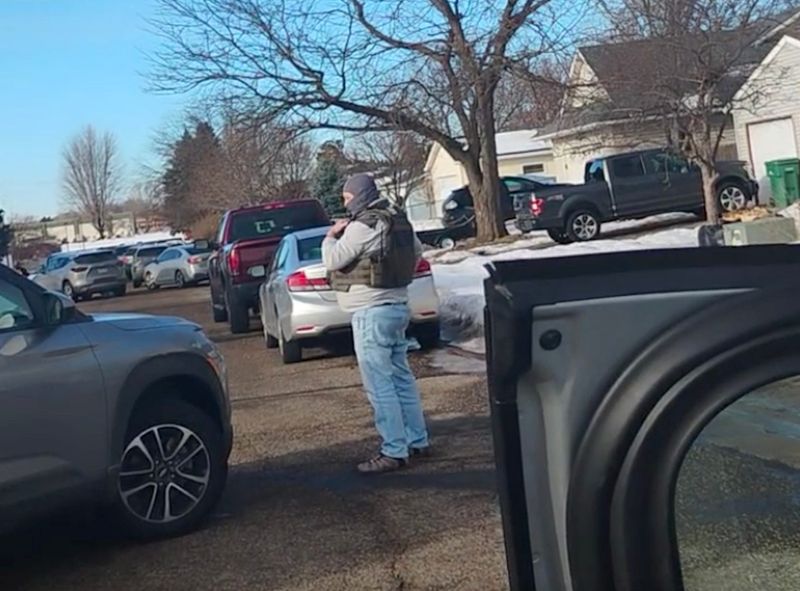
HUDSON – In a video taken inside an Ecuadorian grocery store in Hudson, a masked, plainclothes federal agent forces a terrified girl’s hands behind her back, apparently in preparation for taking her into custody. “She’s 12 years old,” shouts the person taking the video. “She’s a child.”

In a video moments later, outside the shop, an agent shuts the door of an all-white passenger van while the same girl cries from the sidewalk, “Mama, Mama.” Onlookers said the girl was later released, but her mother was taken by the agents.
Footage of that incident on Jan. 5 circulated widely in Hudson, the western Wisconsin town on the Minnesota border. It illustrated that the immigration enforcement surge in the nearby Twin Cities was ramping up in Hudson too, said Sarah O’Neill, a lead organizer for a community defense network in the area.
“That was a real shock to the system for a lot of people,” O’Neill said. People recognized that “it’s not this ambiguous thing that’s happening to people I don’t know. It’s happening right here in my community to people I care about.”
While it’s well-established that as many as 3,000 Department of Homeland Security agents were roving the Twin Cities metro area at one point, observers and advocates say it’s less known that those agents have increasingly fanned out into western Wisconsin, too. They have arrested immigrants who work in restaurants, on farms and in manufacturing plants, the advocates said, even after border czar Tom Homan announced agents were leaving Minnesota.
A deep sense of fear appears to have taken hold among immigrants on the Wisconsin side of the St. Croix River dividing the two states. Many are too scared to leave their homes. Those who do are getting rides to school and work.
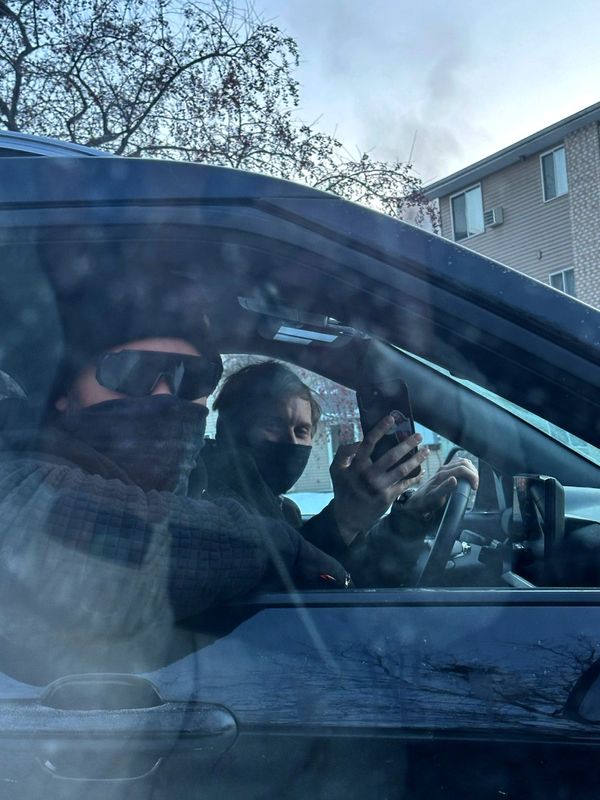
What’s more, the people who observe DHS agents’ activities report they have been intimidated and followed by the agents. One woman said agents lured her into a parking lot, encircled her car and let the air out of a back tire in mid-February.
The surge in western Wisconsin comes with challenges distinct from those in Minnesota. St. Croix County is lightly populated and people don’t tend to rush onto the street to blow whistles and start filming, as they have in Minneapolis. The county has voted for Republicans for president for more than two decades, and advocates argue city and county leaders haven’t done enough to protect residents.
People trained to observe U.S. Immigration and Customs Enforcement officers in the Hudson area have seen and documented the arrests of 27 people since late December, according to observers’ records reviewed by the Journal Sentinel. It’s likely more arrests took place that were not documented, observers said, because the volunteers are comparatively few in number.
“We’re not interfering with ICE. We’re not harassing them,” said a volunteer named Ben, who, like most volunteers, feared using his name because of the chance of retribution. “We are simply trying to hold the government accountable, making sure that everybody’s safe and accounted for, and that people are not disappearing into the night to never be heard of.”
DHS did not answer questions about whether ICE would continue operating in western Wisconsin. It also did not answer whether it was targeting the region or staying long.
“Every day, DHS enforces the laws of the nation across the country, including in Wisconsin. We do not discuss future or potential operations,” a spokesperson said.
Volunteers mobilize to watch ICE, provide donations
The network of volunteers that’s cropped up takes on all kinds of tasks, according to interviews with several of those involved. They have raised money to pay rent for families with wage-earners in detention, coordinated rides to school for children and donated groceries and household supplies. They’ve repaired cars with windows they say were smashed by immigration agents. They’ve even distributed Valentine’s Day cards to children doing online learning from home.
“There’s a lot more people who care about this than don’t,” said Addison Filiatreaux, a volunteer who coordinates the distribution of donated items. “People can’t always help in huge ways, but it doesn’t matter. Anything helps.”
Hudson, a city of 14,000, is one of the largest cities in the fast-growing St. Croix County. Positioned along Interstate 94 and the St. Croix River, it’s a commercial hub for drivers heading to or from Minneapolis-St. Paul. It’s also considered part of the Twin Cities’ metro area. It is home to an Ecuadorian community as well as other Latino and immigrant groups, advocates said.
Some people live in Hudson and work in manufacturing or farming in nearby smaller towns or the countryside. O’Neill said the network has received reports of ICE sightings across western Wisconsin at times, including in Menomonie, River Falls and Eau Claire. But ICE has been especially concentrated in Hudson and nearby Baldwin, in part because, advocates allege, agents are thought to be staying in hotels there.
Impact on economy, community still being realized
Hudson’s vibrant restaurant scene has struggled during the surge across the region. Local news reports indicate several restaurants such as Azul Tequila Bar & Grill in Hudson and Mariachi Loco in River Falls have closed or reduced hours. Workers across the industry have been detained, others are staying home out of fear, and some establishments, like Rancho Loco in nearby Baldwin, have been raided.
Still, Ben said, it’s been hard to get local elected officials to acknowledge how wide-reaching the surge has been.
“We’re really facing an uphill battle here in [making] people aware that this is not just – you’re going to miss dinner at your favorite restaurant because it’s closed,” Ben said. “It’s more of, these people are being swept away, taken away, split up from families.”
Filiatreaux said an exodus of immigrant residents from Hudson has an impact on many parts of the economy. Less business at the restaurants leads to less foot traffic at other downtown shops. With vacant apartments and tenants who can’t make rent, landlords lose out. Fewer students in Hudson schools means less state cash for education next year.
“This is going to catch up with us,” she said.
Filiatreaux has been advocating for the local Hudson government to take down its Flock cameras, which read license plates, around the city. She also is asking for the city to put up signs saying ICE vehicles are not allowed to stage in city-owned lots. She said leaders have not been open to those ideas.
Hudson Mayor Rich O’Connor did not respond to requests for comment. The Hudson Star-Observer reports that in response to a constituent’s request to discuss Flock cameras in the public comment portion of a Common Council meeting, O’Connor shut down the topic and said it was “crossing the line” to discuss it.
The Hudson police chief, Geoff Willems, told constituents at that same February meeting that the police department would continue working with ICE as it has been, cooperating on cases of “individuals who pose a demonstrated threat to public safety or who are involved in serious criminal activity.”
Randy Morrissette, the Hudson Common Council president, also did not respond to Journal Sentinel requests for comment.
Because Hudson and St. Croix County are Republican strongholds, Filiatreaux said the volunteer and advocacy efforts have been more “on the down-low” than in the Twin Cities. There, city and state leaders have been outspoken about their opposition to ICE.
“The more people see that you are standing up and saying something, the less afraid they are to do something,” she said.
Observers say ICE has followed, intimidated them
Adding to the tension, observers say they have been intimidated while watching ICE make arrests.
Ben, the volunteer who keeps track of ICE arrests, said one recent day around 5 p.m., he was speaking with an observer who was following an ICE vehicle. He started following, too, and when he saw agents park and start walking up to the observer’s car, he honked his horn to alert her, he said. The agents called local police, who gave Ben a warning for honking his horn, he said.
Observers driving around Hudson during the day are largely retirees and stay-at-home moms, Ben said. Those with full-time jobs take shifts at night and on weekends. Several have reported ICE taking photos of their faces and their license plates, and then seeing agents drive past their homes.
“We lose a lot of people that initially get involved in this that are gung-ho, and then they realize that there is something at stake for them – getting put in a database somewhere,” Ben said. “That scares people a lot.”
Tammy, a health care worker who asked that only her first name be used to avoid retribution, read a social media report of ICE vehicles spotted in Hudson. She parked a half block from one of the vehicles, then when it drove off, she followed at what she considered a safe distance.
The ICE vehicle drove past her house, she said, which is not along a major thoroughfare. She interpreted that as a threat that they knew she was following them and knew where she lived. Tammy said she followed the vehicle into the parking lot of a Kwik Trip in Hudson, when three ICE vehicles boxed her in against a curb.
The agents did not try to speak with her, she said, but instead gathered around the back of her car. She stayed inside and waited, and she could see they were touching the back of her car by a tire, she said. She asked a friend to call 911, but police never showed up, she said. Eventually the agents left, she got out of her car and noticed they had taken the cap off and let the air out her her back tire.
“Somehow they felt emboldened that they could do this in broad daylight, and stop me from doing what was legal,” she said.
The volunteers don’t have confidence the agents will leave western Wisconsin anytime soon.
“I’ll believe it when I see it,” said O’Neill, a lead organizer.
The way western Wisconsin residents have rallied to offer support for immigrants has been heartening, O’Neill said. Still, the impact of the surge has been devastating, she said.
“There are going to be a lot of people who’ve been deeply, deeply traumatized, and families that have been separated,” O’Neill said. “I don’t know how you can possibly rectify that.”
Sophie Carson is a general assignment reporter who reports on religion and faith, immigrants and refugees and more. Contact her at scarson@gannett.com or 920-323-5758.
This article originally appeared on Milwaukee Journal Sentinel: ICE surge in western Wisconsin echoes trauma, intimidation of Twin Cities
Reporting by Sophie Carson, Milwaukee Journal Sentinel / Milwaukee Journal Sentinel
USA TODAY Network via Reuters Connect