The nonprofit advocacy group Common Ground is calling for an independent review of the company running the Milwaukee Metropolitan Sewerage District’s massive wastewater treatment system.
Common Ground is set to launch its campaign for a third-party audit of Veolia North America on April 30 at the Milwaukee County War Memorial Center.

The group says the move comes after it received a whistleblower letter from a former high-level MMSD employee raising concerns about mismanagement by Veolia.
Veolia North America is the private operator of Milwaukee Metropolitan Sewerage District’s wastewater treatment system and is one of two firms now competing for a 10‑year contract worth up to roughly $700 million. The company, a subsidiary of the French utility giant Veolia, has run MMSD’s treatment plants under public‑private partnership contracts since 2008.
The whistleblower, Steve Jacquart, previously served as MMSD’s intergovernmental coordinator and was a registered lobbyist for the agency. Jacquart said he decided to come forward with his concerns after seeing devastation from flooding and sewer backups.
“I think about the thousands of people who have suffered financially and emotionally from sewage backing up into their basements,” Jacquart said in prepared remarks, which were shared with the Milwaukee Journal Sentinel. “I think of the damage to the homes and businesses in our community that have been impacted when it rains.”
He added that he believes “taxpayers have the right to know about any actions that threaten public health and the environment.”
MMSD is one of the largest publicly-owned wastewater systems in the U.S. that contracts a private company to run its treatment plants. This means MMSD owns the system, but uses a private company that is responsible for day-to-day upkeep.
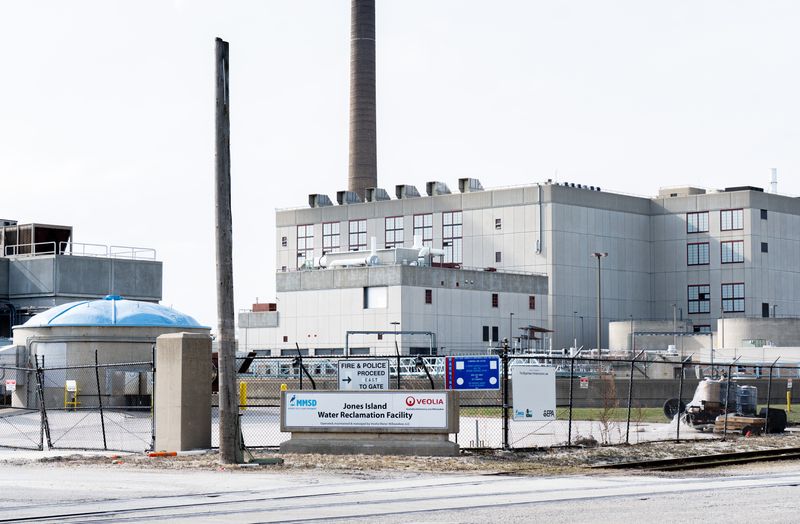
Veolia covers the operation and maintenance of the Jones Island and South Shore wastewater plants, Deep Tunnel system, Milorganite fertilizer factory and regional sewer infrastructure that serves 1.1 million people.
In a statement, Veolia defended its track record and said Common Ground has refused to share its findings with the company.
“We take all allegations seriously, but we firmly reject Common Ground’s misleading assertions about how Veolia has served the people of Milwaukee for the last 18 years,” the statement said.
Veolia’s rival for the deal is Jacobs Solutions, the Dallas‑based engineering giant that, along with Veolia, ranks among the country’s largest private sewerage system operators. The two companies frequently bid head‑to‑head for major municipal contracts.
Whistleblower says change in chemicals made performance worse
Jacquart said that he believes Veolia’s decision to switch to a cheaper chemical for its treatment system in 2017 resulted in “reduced wastewater treatment capacity, increasing the risk of sewerage overflows and basement backups during rain storms.”
“Unfortunately, this reduced treatment capacity can also increase the volume of sewage that is released into our rivers and Lake Michigan when we have overflows,” he added.
Pat Obenauf, MMSD’s manager of contract compliance, said the change in chemicals did not harm Lake Michigan. According to Obenauf, the district and Veolia resolved the issue through mediation and changes to their contract.
The issue is discussed in a 2018 report by engineering consulting group Donohue and Associates, which was contracted by MMSD to determine why the South Shore treatment plant was not meeting its performance standards in 2017.
According to the report and other records, Veolia switched from ferric chloride to ferrous chloride that year.
The report showed that after chemicals were changed at the South Shore treatment plant, the wastewater treatment performance slipped at times, and fecal bacteria limits in the contract were exceeded during some high‑flow periods. In turn, the report showed that discharge quality got worse compared with earlier years and what the contract called for, but still met state standards.
The report said the problems were not just about the chemicals. Instead, they came from several things working together: changes in chemicals, how solids were handled, limits in the aeration system and how disinfection was run.
MMSD responded by amending the contract
In response to the 2018 report, MMSD amended the contract in 2022 and again in 2024.
The 2022 amendment gave MMSD explicit authority to direct how much ferric chloride should be added to the treatment process at South Shore and added a financial penalty if Veolia failed to use the correct amount.
The district agreed to pay for the additional chemical under the amended contract.
In the 2024 amendment, MMSD relaxed one of its performance standards because the South Shore plant could not reliably meet the tighter limit until improvements recommended by the 2018 report were made.
In September 2025, MMSD released a draft for the new, ten-year contract that overhauls its maintenance and cost‑sharing agreement that shifts more of the power and chemical costs in the private operator’s hands.
MMSD commission will pick new operator later this year
Veolia and Jacobs submitted their proposals in January 2025. A committee of five former MMSD commissioners, appointed by MMSD Executive Director Kevin Shafer, has been guiding the selection process and taking part in interviews and technical reviews.
The group is expected to make its recommendation to the MMSD commission this fall. Key dates in the process are:
Mary Spicuzza is an investigative reporter for the Milwaukee Journal Sentinel. Contact her at 414-224-2324 or mary.spicuzza@jrn.com. Follow her on social media @MSpicuzzaMJS.
Caitlin Looby covers the Great Lakes and the environment for the Milwaukee Journal Sentinel. Contact her at clooby@gannett.com. Follow her on social media @caitlooby.
Caitlin is an Outrider Fellow whose reporting also receives support from the Brico Fund, Fund for Lake Michigan, Barbara K. Frank, and individual contributions to the Journal Sentinel Community-Funded Journalism Project. Journal Sentinel editors maintain full editorial control over all content. To support this work, visit jsonline.com/support. Checks can be addressed to Local Media Foundation (memo: “JS Community Journalism”) and mailed to P.O. Box 85015, Chicago, IL 60689.
This fundraising effort is made possible through our partnership with Local Media Foundation, a verified 501(c)3 nonprofit organization (tax ID #36-4427750) and EnMotive Company, LLC, a subsidiary of USA TODAY Co., Inc. USA TODAY Co., Inc. is the parent company of this publication.
The JS Community-Funded Journalism Project is made possible through our partnership with Local Media Foundation, tax ID #36-4427750, a Section 501(c)(3) charitable trust affiliated with Local Media Association, and EnMotive, LLC, a subsidiary of USA TODAY Co., Inc. USA TODAY Co., Inc. is the parent company of this publication
This article originally appeared on Milwaukee Journal Sentinel: Group calls for audit of MMSD operator over flooding, sewage backups
Reporting by Caitlin Looby and Mary Spicuzza, Milwaukee Journal Sentinel / Milwaukee Journal Sentinel
USA TODAY Network via Reuters Connect