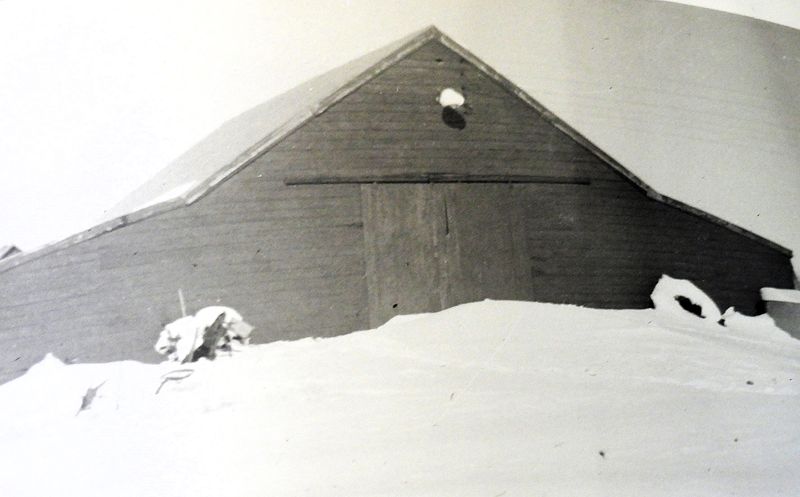
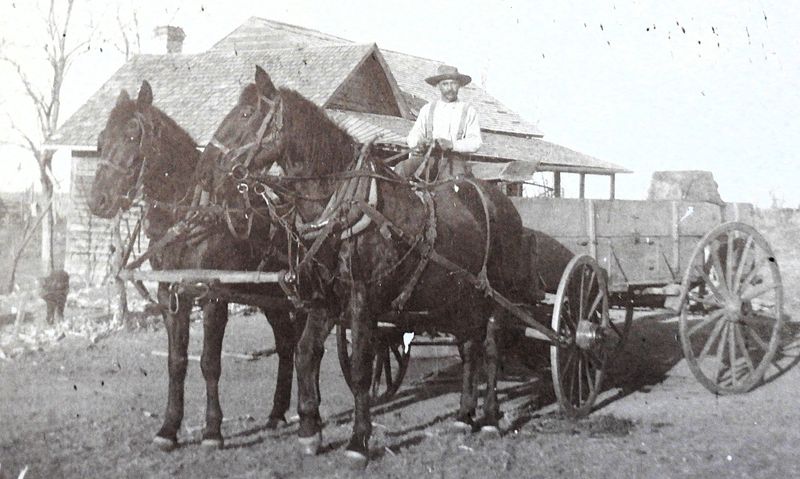
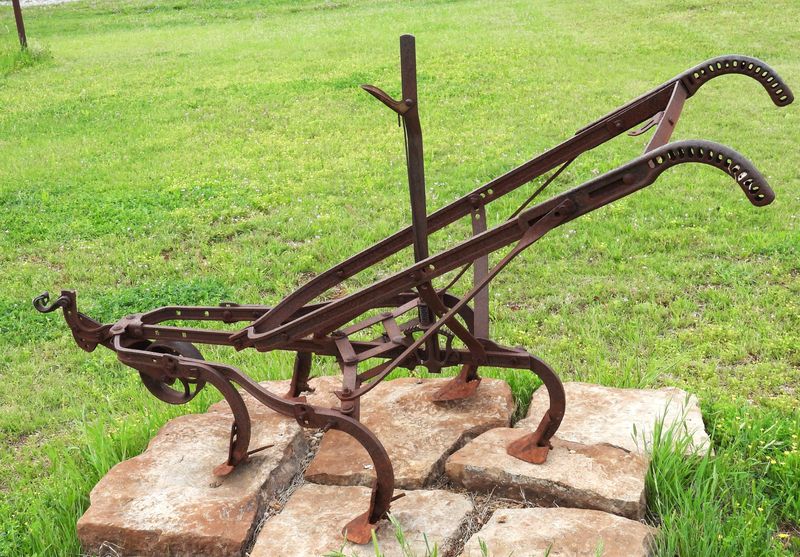
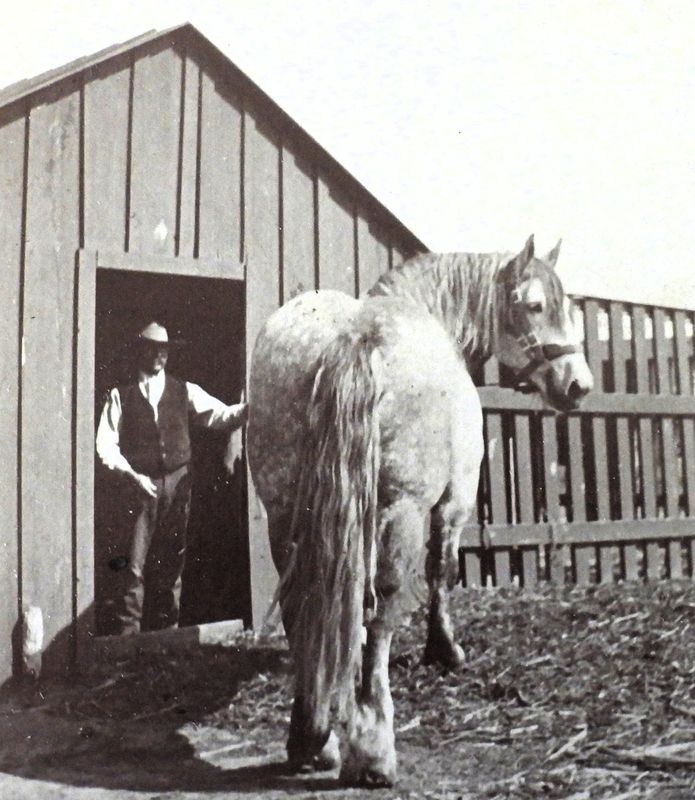
Please find attached a few more photos that might be useful. They show the old wooden barn and stables at my Gandpa Goetze’s place. Also attached are a few examples of the types/sizes of equipment that we still have around the place that were ‘horsepowered’!
It’s a digression from my usual articles, but perhaps it’ll be acceptable and will interest the Readership of the paper. I had to go dig up some old family photo albums and ‘take photos of photos’ — so I hope some will be acceptable! I have a few of some remaining, old, horse-drawn implements that are still around our Grandfather’s old Homeplace near Buffalo Creek Reservoir. You’ll likely spot those pretty easily.

Most of those photos are from my Paternal Grandmother’s family homestead location(s) primarily in Wilbarger County (the Streit Family) — like the Goetze’s, early settlers in the area.
I’ll see about trying to attach most of these photos, along with the manuscript draft, to this email message, but I may have to send one additional email to accommodate a few.
If you’ll allow, Trish, I would like to continue this topic farther into the 20th and 21st centuries and discuss the transition from horses to ‘powered’ equipment and a few of the consequences of those changes (bigger equipment, larger farm sizes, fewer farm families). I don’t have pictures, unfortunately, of some of the oldest tractors. My Grandad had a wood/coal fueled tractor — but he donated it to the WWII scrap metal drive to support that war effort! But I do have photos of one of the first 4 wheel drive tractors produced and also some of farmers using bulldozers to pull larger equipment after WWII.
Let’s slightly digress from the usual style of my columns and partially discuss a subject near-and-dear to me. The primary topic is cultural change on the Rolling Plains since the later 1800’s. However, the culture referred to isn’t the type likely coming to your mind.
For clarification, I refer to culture’s Latin root, colere, which means “to cultivate, tend, till, or inhabit.” In other words, we’ll concern ourselves with the agricultural definition of culture and how cultural practices have changed within Northcentral Texas and Southwestern Oklahoma.
The old barns and their uses
Examination of farmstead photos taken during the late 1800s and early 1900s almost invariably reveals the presence of a farmhouse and at least two structures. These buildings are usually recognized as large, wooden barns and associated stables with livestock pens — at least one of each.
This period’s barns often contain several grain bins, equipment, tack and supply storage rooms, and various configurations for small workshop, blacksmith, and carpentry areas.
Barns and stables were essential elements because these structures housed and supplied the power sources of early area farms — that is, excluding the farm family members. During this period, almost all major and (figuratively speaking) large farm implements were powered by horses and mules, thus, giving the term “horsepower” its true meaning!
A power supply that neighed
James Watt, a Scottish inventor, developed the measure of horsepower to compare a standard amount of work performed by steam engines verses horses. One horsepower is equivalent to the force required to raise 33,000 pounds to a height of 1 foot during a one-minute time span: 550 pounds per second.
Watt developed his measurement after observing horses rotating a mill wheel and, ultimately, horsepower was based upon the average, sustained working rate of a draft horse over a full day’s work. An individual horse is capable of generating 15 horsepower or more but only for brief periods of time.
By comparison, humans can generate short power bursts of approximately 5 horsepower but usually can sustain less than 0.1 horsepower. Modern horsepower is calculated using a machine called a dynamometer to measure the torque and rotational speed of engines and motors.
What were farms like way back when?
However, let us return to the cultural history of days gone by and its influence upon our region.
Sources indicate that there were few farms in Wichita County in the closing decades of the 1800’s (approximately 60 farms in 1880), and most of the land was devoted to cattle ranching with the large Burnett and Waggoner ranches dominating Wichita and Wilbarger counties.
Farming efforts were focused upon production of hay crops, cotton, corn and sustenance agriculture including vegetables and some fruit production. Average family farm sizes ranged from 40 acres to approximately 120 acres. At the beginning of the 20th century, farm numbers had increased to greater than 300, and average family farm size ranged from approximately 160–320 acres.
Early area farms were usually divided into a small portion of cultivated land — 20 acres or slightly more — with the remaining acres consisting of native pasture and timber land. Railroad expansion into Wichita County and surrounding area resulted in conversion of additional acreage into cropland and increased cultivation of winter wheat and cotton cash crops.
However, larger farm sizes and increased acres of cash crops required greater horsepower and appropriate tillage and planting equipment. Barley, corn, oats and hay crops were still produced but were mostly utilized as livestock feed and to help sustain the farmer’s primary engines: the farm’s horses and mules!
Famers’ favorite draft horses
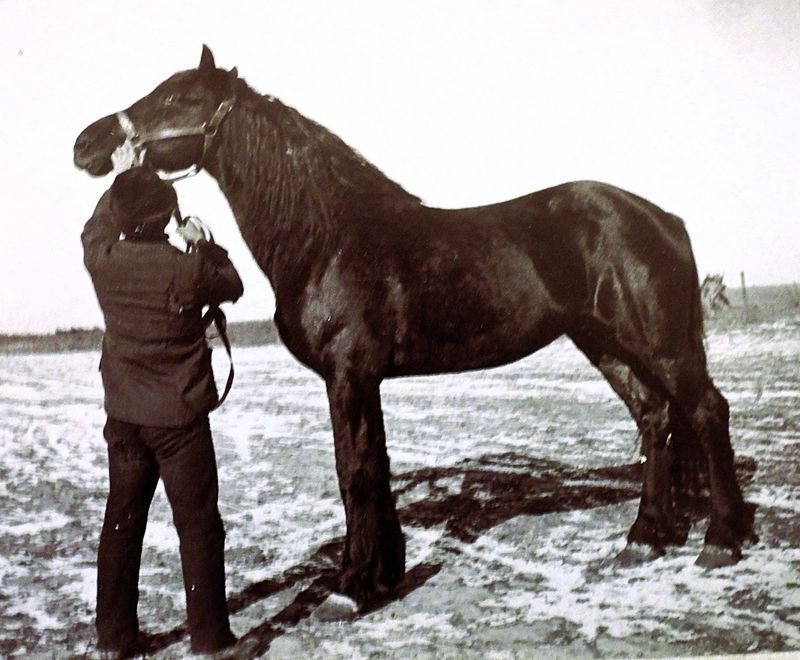
The most widely used draft horses in our region were likely the Belgian, American Belgian and Percheron breeds. Believe it or not, these draft horses are actually larger, at least in terms of weights and musculature, than the familiar Clydesdales of Anheuser-Busch fame.
Weights of mares average approximately 1,500 pounds whereas males’ weights may easily exceed 2,000 pounds. Wither heights — the highest point measured at the horses’ shoulder — of these large horses often exceed 6 feet. These impressive horses require a substantial daily food ration to maintain health and an excellent physical working condition.
Keeping horsepower running
For example, a single Belgian horse may require 30–50 pounds of hay and additional supplements of grain (oats, corn or mixed feed) and minerals. Individual, per annum hay consumption may range between 5–9 tons. Farms requiring multiple, working horse teams had to dedicate land for feed and hay crops and set aside significant pasture areas and housing space for the health and maintenance of their equine engines.
Despite hitching multiple draft horses to specialized farm equipment and wagons, these implements were small compared to later-developed, more modern farm equipment.
Tools of the trade
Large-sized disk plows, cultivators, hay rakes, reaper-binders and grain drills rarely exceeded 10-foot widths, and even these implements usually required teams of three or four horses for each piece of equipment.
Two-row cotton seeders were considered large in the later 1800s and early 1900s, and they required multiple horses to draw them through fields during a full day’s work.
My grandfather still utilized a few horse-drawn implements when my father was a young boy, and I remember Dad once remarking that you often could take a rock and throw it across the width of all a field’s furrows that were plowed, cultivated or planted during a single day’s work!
A nod to these noble beasts
Needless to say, even though farm sizes and total acreage of cash crops increased during this early time period, total production output on individual family farms remained relatively small.
Much effort was devoted to subsistence agriculture, self-sufficiency and maintenance of the farm’s horses and their associated harness, tack and other gear.
Farming technologies on the Rolling and Great Plains changed dramatically after the early 1900s, but that topic is better left for an additional discussion.
For the present, let’s conclude by remembering the vital role once played by actual, living horsepower in agriculture, industry and transportation. These noble beasts, descendants of European war horses, rightfully earned their places in our area’s cultural history!
Jim Goetze is a retired professor of biology and former chairperson of the Natural Sciences Department of Laredo College with an avid interest in all aspects of the natural world. He can be contacted at gonorthtxnature@gmail.com.
This article originally appeared on Wichita Falls Times Record News: How horses powered early Texas farms before tractors | Opinion
Reporting by Jim Goetze, Wichita Falls Times Record News / Wichita Falls Times Record News
USA TODAY Network via Reuters Connect