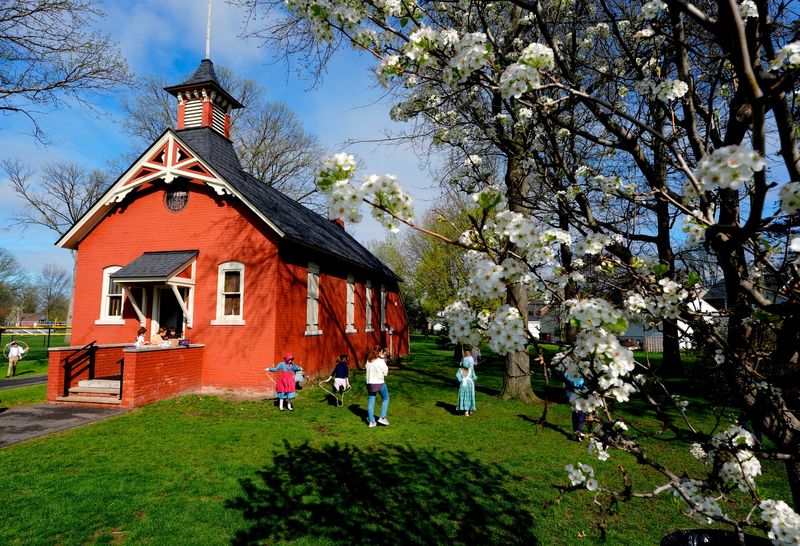
On a sunny spring day, Sarah Neely’s second grade class lined up at the door of the red, one-room schoolhouse, bounded up the steps and entered what would be, for a couple of hours, a time machine.
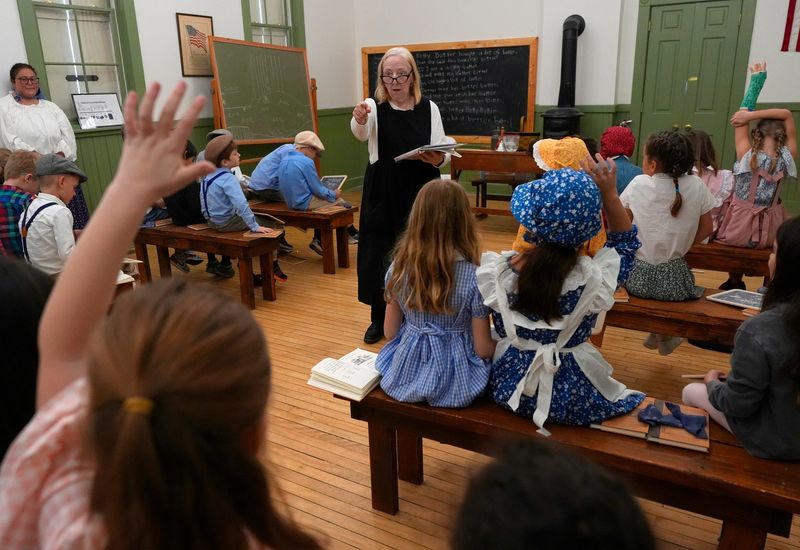
The children — some dressed in bonnets, others in bow ties — took their seats on wooden benches. The girls were directed to sit on one side, the boys on the other. Beneath each child on the wooden floor was an “Eclectic First Reader” and a slate board.

That’s when the guest teacher, the docent for the day, Izzy Donnelly — Miss Donnelly to the boys and girls — began the April 17 field trip lesson, an experience that Ms. Neely and the other teachers in the Grosse Pointe Public School System hoped their students would never forget.
“I want you to close your eyes for a second, and we’re going to go back in time, from 2026 to 1890,” she said. “One. Two. Three. Now we’re back in time. I’m going to put my happy face away and pretend to be really mean. Can you handle it?”
“Yesssss,” a chorus of young, excited voices replied.
“Are you sure?” the teacher asked again. “OK.”
For nearly two weeks, Donnelly and other volunteers gave the same presentation to about 500 second-graders, one class at a time. The two hours went by quickly. The students learned how different school was but also how it was the same.
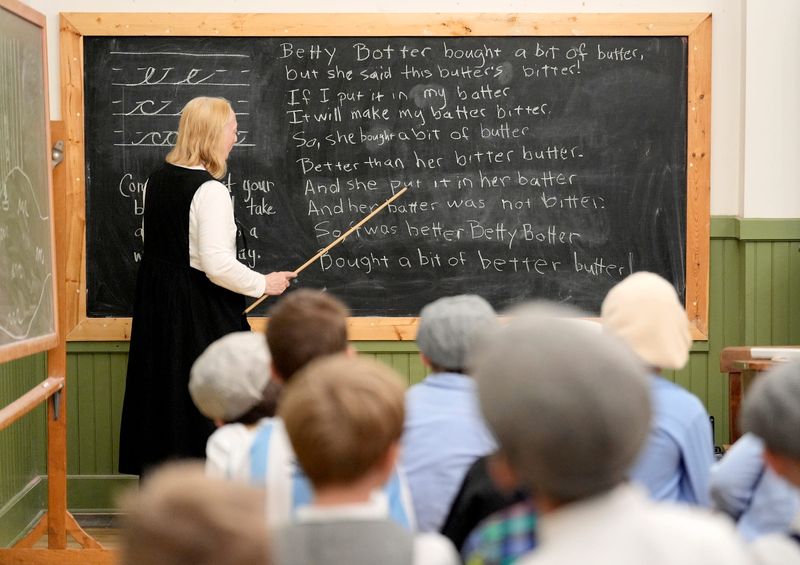
They also got some lessons — in an amusing way — that schools don’t really teach anymore, reminders to respond “yes, ma’am or no, ma’am,” and on elocution, “Betty Botter bought a bit of butter, but she said the butter’s bitter!”
Near the end of the field trip, to the surprise of the teachers — and the half-dozen or so moms who were watching and eventually urged at the end to join in the fun, too — what they seemed to enjoy the most was the 19th-century discipline.
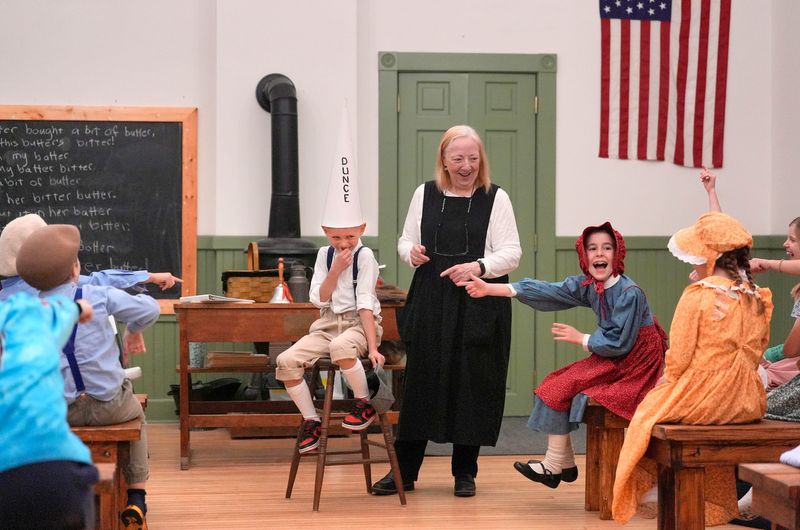
Yes, it included pretend spankings, and, for one boy, donning a dunce cap.
Grosse Pointe Woods’ one-room school
But first, a history lesson.
The one-room school — sometimes referred to as a “little red schoolhouse” because, like barns, they often were painted that color — has long been part of America’s educational lore.
There are many romantic notions about what that was like, especially for those old enough to grow up watching “Little House on the Prairie” on TV, which is being revived. And some are now even trying, through homeschool cooperatives, to replicate the experience.
The schoolhouses were common in rural areas and in frontier settlements.
In Michigan, more than 7,200 of them dotted the state, according to the Michigan One Room Schoolhouse Association. The group has documented them, although only a few, like the Cook Schoolhouse in Grosse Pointe, have survived.
The Cook School — formally known as the Fractional District No. 9 School — was built in 1890 near what is now known as Mack Avenue and Lochmoor Boulevard, before it was moved closer to the Grosse Pointe Woods Community Center.
Locals called it the Cook school because the property was purchased from Louis and Matilda Cook, who owned a farm, according to one account. The school could accommodate 60 students in grades 1-8 and one teacher.
In the first year, about 30 students — children from what was then Grosse Pointe and Gratiot Townships — were enrolled. The curriculum was mostly known back then as the three R’s, reading, writing and arithmetic.
One of the first teachers, Genevieve Vernier, was paid about $30 a month.
The building remained a school, the historical marker in front of it indicates, until 1922, when the small district combined with four others to form the Rural Agricultural School District No. 1.
Since then, the structure has reportedly been a variety of things. Congregations turned it into a church; residents, a home, and businesses, an office. It was modified and expanded, and by the early 2000s, it was slated for demolition.
But it was saved, donated to Grosse Pointe Woods, and moved to where it is now, and is used as a public meeting space — and for a couple of weeks, a field trip destination.
Lessons in individualism and cooperation
In many ways, the two-hour lessons for elementary students — repeated several times for different classes of mostly 7- and 8-year-olds — were a childhood adventure, with plenty of make-believe moments, and also a slice of Americana.
As settlers moved west and staked their claims, their children needed schools.
One teacher, often a young woman, taught students what they would need to make their way in the world, and to learn more — from books on their own — if they wished to educate themselves later.
In winter, the schools were heated with a wood-burning stove.
The students wrote on slate boards, the iPads of their day, with chalk. Desks — if they had them — often included inkwells. The ballpoint pen had barely been invented and was still being perfected.
In the one room, three, four, five dozen kids had to get along. With just one teacher, older students were expected to teach younger ones, a concept educators now call “peer learning.”
When the one-room schoolhouses weren’t filled with youngsters, they doubled as spaces for social gatherings and civic meetings, where important community issues were debated and decided.
The children, who often grew up to be community leaders, learned individualism and cooperation. But after World War II, as education became more sophisticated, the one-room schools began to disappear.
Still, notions of what it was like to learn in these schools live on, with historical groups preserving their memory, and generations of children reading books like the “Little House” series by Laura Ingalls Wilder that included scenes from them.
As late as the 1970s and ‘80s, millions of families watched the historical TV drama, “Little House on the Prairie,” based on the books. The show — set in Walnut Grove, Minnesota — gave people additional glimpses of what such schools were like. It was so popular, Netflix is bringing it back on July 9 with a new cast.
In the first version of the show, little Laura Ingalls — portrayed by a young Melissa Gilbert, who in real life later made Michigan her home — learned all sorts of lessons from Miss Beadle, a nurturing character with high expectations, but also patience and empathy.
An American flag with 43 stars
For the field trip, Miss Donnelly — a retired teacher who also had been director of education for the Grosse Pointe Historical Society — chose to offer the Maire Elementary School students a more austere teacher persona.
It was to make the point that expectations were different back then, and life, by many measures, was much harder. Besides, they were, after all, going back in time, and it was all for pretend.
The students knew what was coming; they had talked about it in class before they went on the field trip, and they might even have heard about it from their friends in other second-grade classes who had gone through it already.
But if they didn’t remember, Miss Donnelly warned them again that she was going to use a stern voice, sending the message that teachers, back then, were stricter. She also reminded them, until it came naturally to them to respond, not just with a “yes” or “no,” but to add “ma’am.”
In the schoolhouse, a portrait of George Washington hung on one wall of the school, and on the opposite one, Abraham Lincoln. One, of course, was the nation’s first president, and the other, during the Civil War, kept it from being divided.
Miss Donnelly pointed out that the American flag in the classroom was different. It had 43 stars, not 50. Michigan, represented by the 26th star, became a state in 1837. But in 1890, America was still expanding.
That year started with an American flag with 42 stars. Idaho, by early July, became the nation’s 43rd state, and a few days later, Wyoming’s star was added to the flag as the 44th.
3 R’s: reading, writing and arithmetic
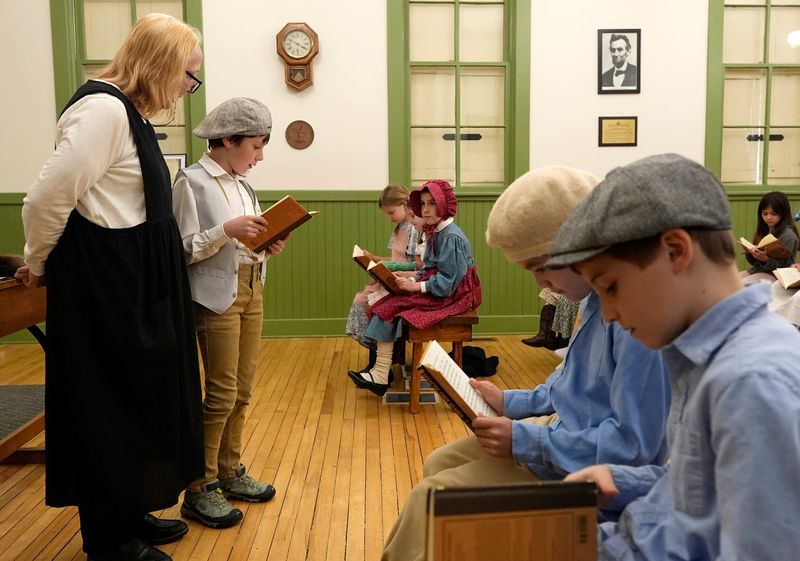
Miss Donnelly told the students about the McGuffey’s readers, standard American textbooks in the 1800s, under their seats and had them read passages — if they chose — in front of the entire class.
It was their first R lesson: reading.
The teacher joked that if they did a good job, she might let them sip well water, a subtle reminder that many modern conveniences that they take for granted, like plumbing, didn’t exist back then.
Eight-year-old Anna Nysson, of Grosse Pointe, was the first student to read a passage to the class. Her passage was about getting a book and keeping it “nice and clean,” a lesson within a lesson.
For the field trip, Anna later told the Free Press, her great-grandnanna had sewn her red bonnet and matching apron. It might have been, she said, what a girl like her in the 1890s might have worn.
“It was so fun,” she said, and “waaay different” from what school normally is like.
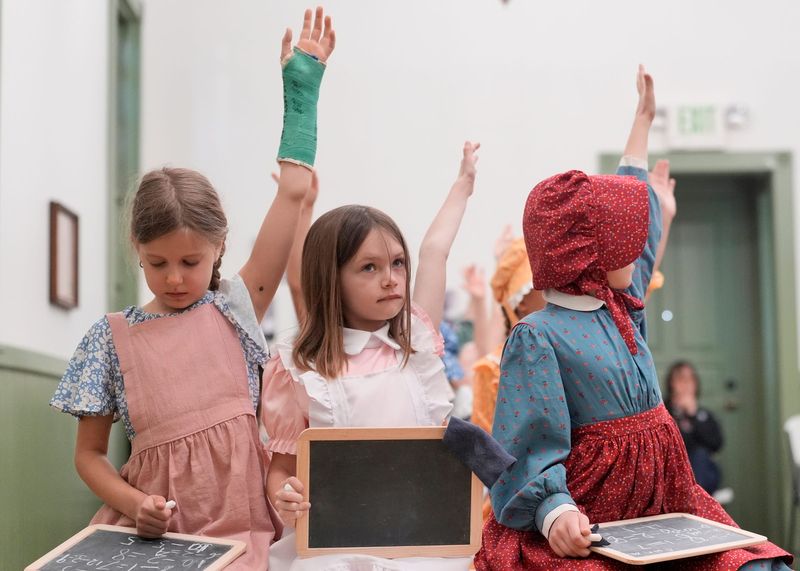
Miss Donnelly had the students practice writing — the second R — with chalk. Penmanship was important, with no digital devices. Each student picked two sentences from the readers to copy and wrote them onto their slates.
“I love the sound of chalk on slate,” the teacher cooed. “It means you are working.”
And she had them do some arithmetic, which covered the remaining R. They solved word problems, which she read aloud, requiring some simple addition and subtraction.
Fire safety, discipline and manners
But Miss Donnelly wasn’t done.
There was a lesson in spelling: She said a word at a time, and the students would write each one down. And one in staying on task.
When one of the kids spotted a spider on the ceiling, it created an uproar. But Miss Donnelly got them all to calm down, redirect their attention to the lesson, and as quickly as the bug had become a distraction, it was forgotten.
The teacher also showed the students how to set up a bucket brigade, which — before the modern fire department — would have been necessary to put out fires. In 1805, for instance, the city of Detroit burned down.
The blaze inspired the city’s Latin motto: “Speramus meliora; resurget cineribus.”
The phrase, sometimes considered two mottos, is credited to Father Gabriel Richard. It translates to: “We hope for better things; it will rise from the ashes,” signifying resilience and renewal. It is also illustrated by the city seal, in which one woman weeps, another points toward a new city rising.
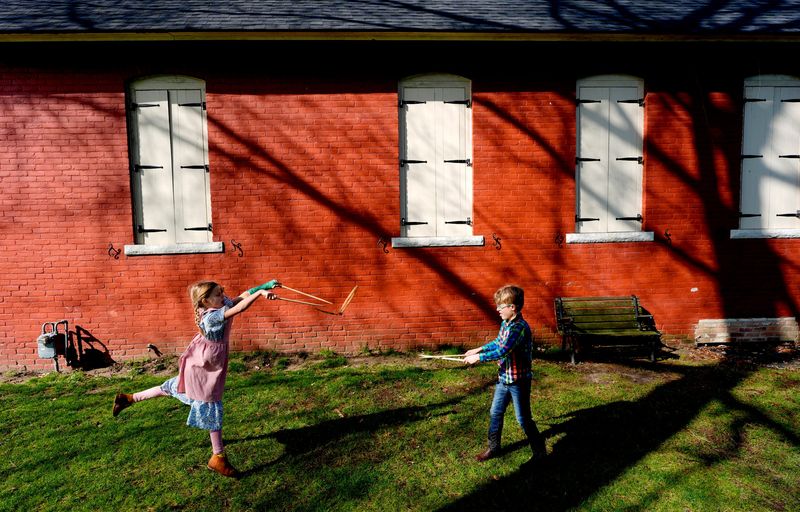
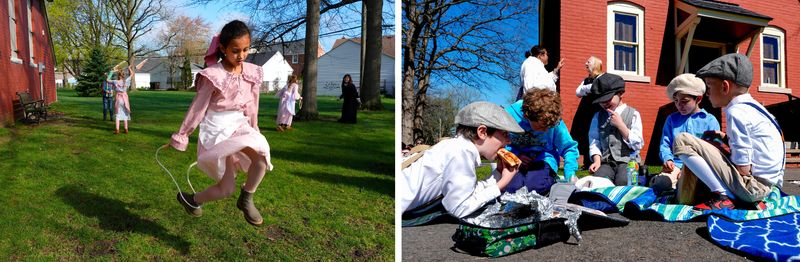
For recess, the second graders played old-fashioned games outside.
Of course, Miss Donnelly saved the youngsters’ favorite lessons, on elocution and corporal punishment, for the end. They had an idea it was coming because when she asked the students who wanted to be disciplined, just about everyone raised their hands.
The teacher selected a girl to pretend to be spanked, and a boy to don a dunce cap in front of the class, eliciting an embarrassed look from the student and the loudest laughter of the day from everyone else.
The last lesson, however, was a reminder that as much as some things in education change, some endure. “Boys and girls,” Ms. Neely said, “What do we say to Miss Donnelly?” In unison, the students replied: “Thaaaaank you!”
Contact Frank Witsil: 313-222-5022 or fwitsil@freepress.com
This article originally appeared on Detroit Free Press: Grosse Pointe 2nd graders go ‘back in time,’ visit 1890s schoolhouse
Reporting by Frank Witsil, Detroit Free Press / Detroit Free Press
USA TODAY Network via Reuters Connect