The question on Joe Forgey’s mind isn’t whether he’s running for reelection to his school board seat.
It’s how he chooses to be listed on the ballot.

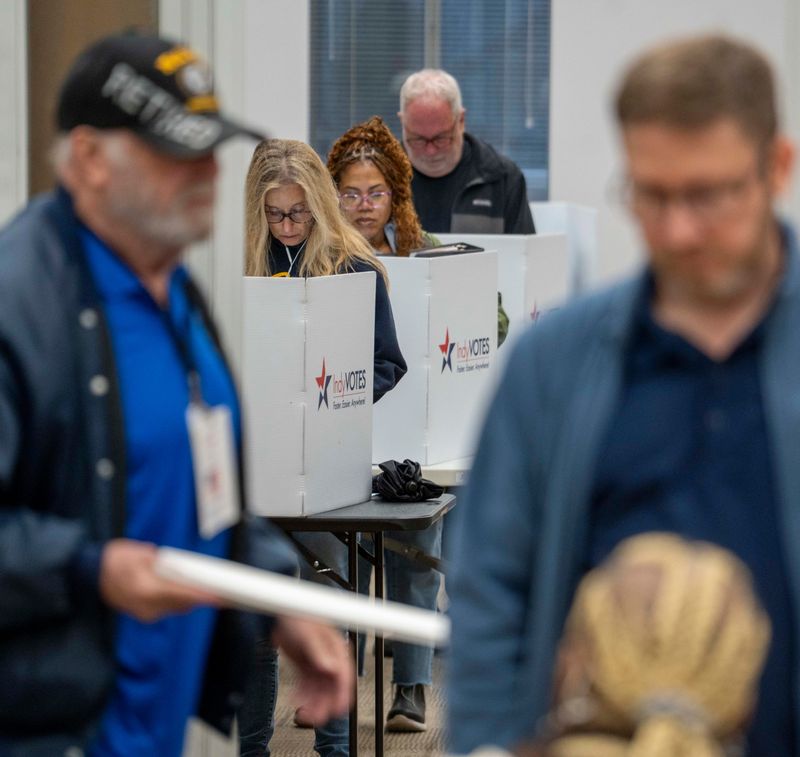
For the first time, candidates can choose to identify as a Republican or Democratic on the ballot during the upcoming General Election. Filing for the first ever truly partisan school board races starts today.
“I think I ought to select independent, and I wish everybody running would do that,” Forgey told IndyStar. “But here’s what you face. There’s an advantage to picking a party when it comes to ballot placement.”
Forgey, the secretary of the Noblesville Schools Board, who was first elected in 2018, said he hasn’t yet made up his mind on if he identifies with a political party, as an independent candidate or chooses not to disclose any affiliation.
The switch to partisan school board elections is due to legislation that was passed by conservative lawmakers, who have said the change will provide voters with more information about candidates. Critics of the new laws have said they could further politicize school boards and have warned the changes could block quality candidates from running who may not want to put a political marker next to their names.
And the changes are taking effect as school board meetings have been entrenched in national politics. Board members across the country have received death threats, fielded angry parents while navigating the COVID-19 pandemic and have been inundated with book banning discussions and scrutiny of curriculum.
In Hamilton County, where Forgey’s Noblesville Schools district is located, party politics and political action committees have already been part of the story in recent school board elections. But, in Forgey’s mind, taking it a step further and having partisan school board elections won’t be an advantage for the operations of school boards or the students impacted by their decisions.
“I see no benefit to this,” Forgey said. “I don’t think putting politics into it makes it better.”
On the other hand, there are school board members running for reelection who think the switch will be positive.
“Voters deserve to know where candidates stand,” Tiffany Pascoe, president of the Hamilton Southeastern Schools Board of Trustees, said. “I don’t believe politics belong in the classroom, but I do think the candidates’ values such as policy positions and overall philosophy are important for voters to understand.”
Pascoe, who was first elected to the HSE School Board in 2022 and ran with a slate of three other conservative candidates, said she’s always been open about her views and it wasn’t a tough decision for her to formally identify herself as a Republican candidate when filing for reelection.
Candidates have until June 18 to file to run for school board seats in the general election, which is set for Nov. 3. Terry Spradlin, executive director of the Indiana School Boards Association, said there’s a lot of unknowns at this point as far as how school board candidates will choose to appear on ballots.
“A lot of this will crystallize at the end of the filing period,” Spradlin said.
What’s changing for voters?
The new laws did not create primary elections for school board candidates — which is why these races were not featured in the May election. This means multiple candidates from one party can run for the same school board seat in the general election, according to the Indiana School Boards Association.
Party affiliations or Independent candidacy statuses will appear on ballots next to candidate names. Candidates can choose not to disclose any party affiliation. If they go that route, the ballot will show only the candidate’s name, followed by a blank space where party information would normally appear.
Laura Merrifield Wilson, an associate professor of political science at the University of Indianapolis, said the switch to partisan elections may cause some candidates not to run, while other candidates will happily declare which party they are affiliated with.
“For voters, this will provide a helpful cognitive shortcut because it’s an easy, quick label that voters can use to make a decision,” Wilson said. “But it’s tricky because school boards aren’t necessarily making partisan decisions. I’m thinking of curriculum, hiring and firing, how they approach policy matters, those are not partisan issues.”
Cathy Fuentes-Rohwer, president of the Indiana Coalition for Public Education, added that she worries voters will select candidates based on party affiliation and not on the qualifications.
“They have to do their homework when there’s no party affiliation,” Fuentes-Rohwer, who previously served on the school board for the Monroe County Community School Corporation, said.
School board races are still excluded from straight-party voting, which means voters must individually select school board candidates, according to the Indiana School Boards Association.
Candidates will be listed on the ballot in a way that’s likely to advantage Republicans in most of the state. That’s because candidates will be grouped by political parties and listed according to the performance of political parties in the most recent election for secretary of state in each county.
Candidates representing the party receiving the highest number of votes for secretary of state are listed first, according to the Indiana School Boards Association.
Candidates representing other political parties will be listed next in the order their party’s candidate for secretary of state finished in the last election. Candidates representing parties that did not have a secretary of state candidate, as well as independent candidates, will be listed next.
Candidates who elect not to disclose any political party affiliation will appear on ballots last. This means Republican school board candidates will appear first on ballots in 87 of Indiana’s 92 counties due to the results of the 2022 secretary of state election.
Being higher up on the ballot can be an advantage, especially in elections where voters have limited information on the candidates, Wilson said.
“It absolutely benefits the Republican Party,” she said. “Remember this legislation was introduced and passed by a Republican supermajority in state legislature.”
Wilson said candidates that choose not to disclose any political party affiliation could be at a disadvantage in elections where their opponents do, because voters would have to do extra research about the non-affiliated candidates.
Wilson cautioned though that this may not have a big impact amongst an educated electorate where voters are paying close attention to school board races. And there could be some cases where choosing independent or no disclosure of party could actually be favorable, she said.
“There could be an instance where leaving off a party label could help instead of having a party label that’s unpopular in certain communities,” Wilson said.
One other change that might not be as obvious to voters could be an increased influence of countywide political parties in school board elections.
“To some extent, at least in my experience, there’s been some political party influence already in these elections,” Jon Shapiro, president of the Carmel Clay School Board, told IndyStar. “At least in the electoral process. I don’t think that has translated to impacting how the school board operates. Depending on the outcome of certain elections, it could change that dynamic.”
Shapiro, elected in 2024, defeated two opponents, who were endorsed by the Hamilton County Republican Party as well as a conservative political action committee.
Josh Lowry, chair of the Hamilton County Democratic Party, told IndyStar that now that school board elections are partisan, his organization will be getting more involved to support certain candidates than it has in the past.
“If a Democrat puts their name on the ballot for a school board seat, we’re going to support them just like we would any other candidate,” Lowry said. “But, we’re not looking to get involved with the school board just for the sake of getting involved with the school board.”
IndyStar reached out to Mario Massillamany, chair of the Hamilton County Republican Party, but he did not respond in time, with info on how his party would handle the partisan elections, to be included in this article.
For Shapiro, the school board member in Carmel, he’s glad he isn’t up for reelection this year because of the questions surrounding the best way for school board candidates to navigate the changes. And besides the switch to partisan elections, there will be lots of other factors that impact school board races in November, he added.
“Which school corporations may or may not be running referendums will be an important piece in many of these races,” Shapiro told IndyStar. “And that will have an influence on voter turnout. Plus, I think for a midterm election, we’re going to see a decent voter turnout just in general.”
Contact Jake Allen at jake.allen@indystar.com. Follow him on X, formerly Twitter, @Jake_Allen19. Click here to get Hamilton County news sent straight to your inbox and subscribe to the IndyStar North newsletter.
Contact breaking politics reporter Marissa Meador at mmeador@indystar.com or find her on X at @marissa_meador.
This article originally appeared on Indianapolis Star: Filing for the first-ever partisan school board races starts today. What that means for voters
Reporting by Jake Allen and Marissa Meador, Indianapolis Star / Indianapolis Star
USA TODAY Network via Reuters Connect