The Department of Natural Resources announced July 15 there will be no sharp-tailed grouse hunting season in Wisconsin in 2026.
Applications, which are typically due in summer in years when a sharpie season is held, will not be available.

The DNR’s decision was expected and consistent with a May 18 recommendation from the state’s Sharp-tailed Grouse Advisory Committee.
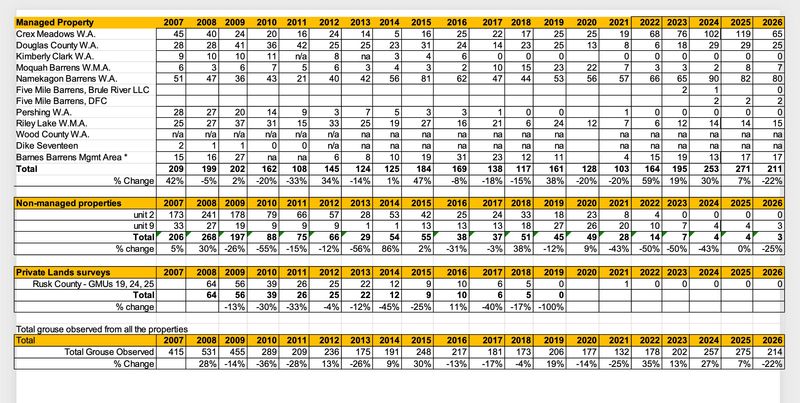
In voting against a 2026 season, the committee cited a notable sharpie population decline. The 2026 spring assessment tallied 214 male sharp-tailed grouse in the state, a 22% year-over-year decline.
Importantly, the data showed the largest drop – from 119 birds in 2025 to 65 in 2026, or 45% – at Crex Meadows Wildlife Area near Grantsburg, the property that in recent years has hosted the most sharpies in the state and was the only area open to hunting last year.
The number of male sharptails declined at all three of the Wisconsin public properties with the most birds, though the drops were smaller at Namekagon Barrens Wildlife Area (year-over-year decline of 2%) and Douglas County Wildlife Area (14%) than Crex.
To monitor the sharp-tailed grouse population, the DNR organizes lek, or breeding ground, surveys in spring.
The work is done by counting male grouse as they dance and joust at 12 public properties and a handful of other sites with known or suspected populations of the species.
Only males are counted on the dancing grounds; it is assumed the population contains about an equal number of females.
The surveys are conducted by DNR employees as well as staff with other agencies, non-profit organizations and volunteers.
The state’s sharp-tailed grouse committee includes DNR staff and representatives of conservation, tribal and other groups. It is led by DNR wildlife supervisor Bob Hanson.
It recommended a sharpie hunt in 2025 after several years of a positive trend in the population. Twelve tags were available to state-licensed hunters and 12 were offered to tribal hunters.
Five sharpies, including four males and one female, were killed by state-licensed hunters at Crex. None were taken by tribal hunters.
The 2025 sharpie hunt was the first in Wisconsin since 2018.
Despite the decision to not hold a hunt in 2026, the sharp-tailed grouse maintains its status as a game bird in Wisconsin.
In its announcement, the DNR said it was important to note populations of grouse species have natural variability and the 22% decline in lek survey indices this year is within an expected range.
Though down this year, sharp-tailed grouse populations in Wisconsin increased in prior years in large part due to “significant habitat restoration efforts” in pine barrens and other core areas in the northwestern portion of the state, according to the DNR.
Agency managers and conservation partners “will continue to focus on long-term recovery and habitat management efforts that will increase population persistence across their primary range,” the DNR said in its statement.
To learn more about sharp-tailed grouse in Wisconsin, read the state’s Sharp-tailed Grouse Management Plan.
Hunting recruitment grants: The Department of Natural Resources is accepting applications for the Hunter Recruitment, Retention and Reactivation (R3) grant program. The deadline to submit grant applications is Sept. 15, 2026.
The Hunter R3 grant supports projects that promote awareness, understanding and participation in safe, ethical hunting and hunting-related outdoor skills. These skills offer individuals a unique connection with nature and wildlife and foster confidence and comfort in wild places, according to the agency.
Past grant recipient projects include private land access programs for hunters, archery range upgrades for urban after-school clubs, support for hunting-related expos focusing on recruiting new or underserved audiences, learn to hunt and learn to shoot programs, high school clay target teams, 4-H shooting sports programs and more.
A total of $75,000 in grant funding is available. Individual grant awards are normally limited to $25,000. Cost-sharing funds can be awarded to individuals or community-based organizations, Wisconsin tribes, universities and schools.
The grant is a sub-award of federal Pittman-Robertson Act funds and is administered as a reimbursement program. Applicants should plan to start projects approximately one year from the application deadline.
Learn more and apply on the DNR’s Hunter R3 Grant Program webpage.
This article originally appeared on Milwaukee Journal Sentinel: DNR announces decision on 2026 sharp-tailed grouse hunting season
Reporting by Paul A. Smith, Milwaukee Journal Sentinel / Milwaukee Journal Sentinel
USA TODAY Network via Reuters Connect
By Paul A. Smith, Milwaukee Journal Sentinel | USA TODAY Network