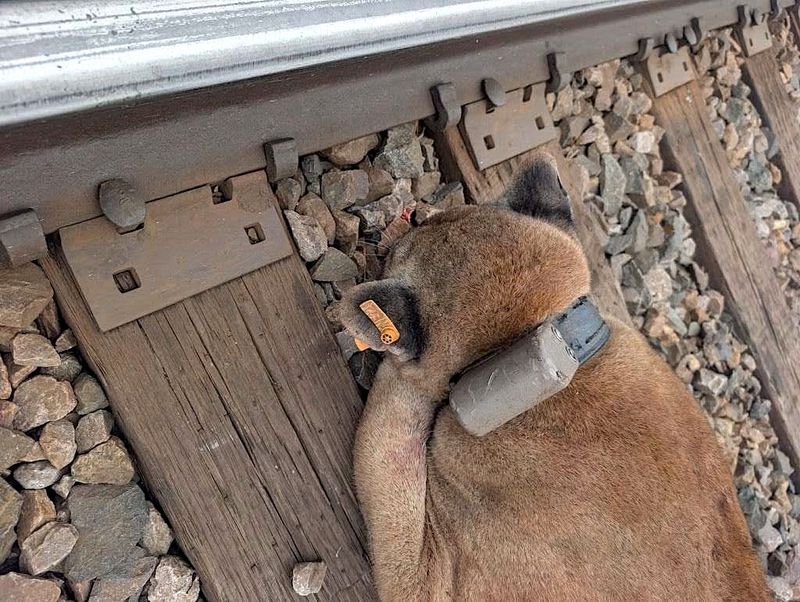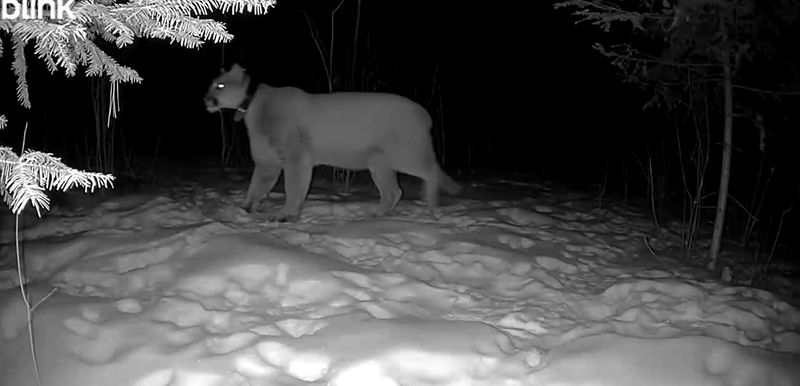
A cougar was found dead Feb. 9 on a railroad track in the Town of Adams, according to the Wisconsin Department of Natural Resources.
While cougars are not known to have a breeding population in Wisconsin and only about a dozen sightings are confirmed in the state each year, the life history of the animal found dead this week was better known than most.

The cougar was a 2-year-old male collared and ear tagged by wildlife officials in Nebraska, according to Randy Johnson, Wisconsin DNR large carnivore specialist.
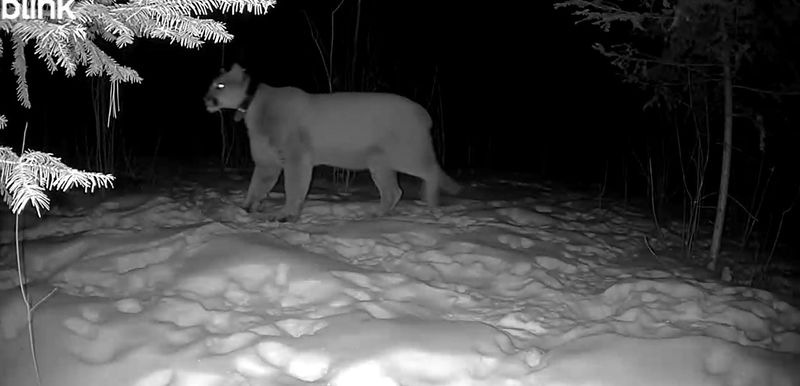
And even though the cougar’s GPS collar had stopped transmitting location data in recent months, biologists were able to track the animal’s movements due to its distinct appearance.
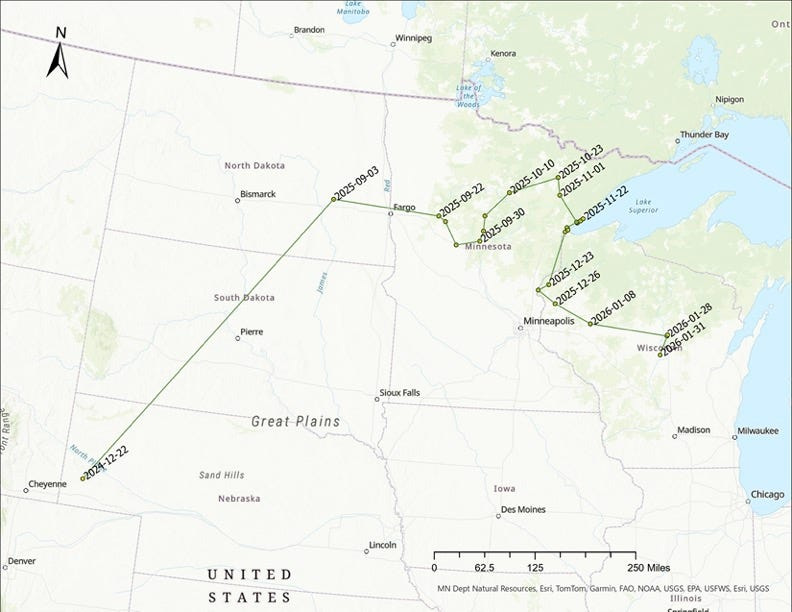
It had been documented at least two dozen times over the last five months, mostly by trail cameras. The eastward path was one observed previously in young male cougars from the closest source population in the Dakotas and Nebraska.
“What’s unique about this cougar is it was wearing a collar and ear tags which gave us the confidence we knew its identity,” Johnson said. “Most often the cougars that we see in Wisconsin aren’t marked. What’s not unique is it was doing what all the other ones have done, and that’s dispersing and looking for a mate or territory.”
The cougar is found from northern Canada, through parts of the U.S. and Mexico, the Amazon rainforest and to the Andes Mountains in southern Argentina and Chile, making it the most widely distributed large mammal in the Western Hemisphere.
The species is also known by other common names including mountain lion, puma, catamount and panther.
Cougars are native to Wisconsin but were wiped out by about 1910, according to DNR records.
Reports of cougar sightings in Wisconsin filtered in over the late 1900s and early 2000s but most could not be verified.
That changed in 2008, when a cougar was seen and confirmed near Milton in southern Wisconsin.
Aided by the growing use of trail cams, confirmed sightings in Wisconsin have increased since, averaging about two dozen annually in recent years.
In one well-documented and highly publicized case in 2011, a male cougar traveled east from the Black Hills in South Dakota, passed through northern Wisconsin and the Upper Peninsula of Michigan and ended up in Connecticut, where it was struck and killed by a vehicle. Wildlife experts estimate the journey covered more than 1,500 miles and spanned three years.
And in November 2023, a bowhunter killed a cougar in Buffalo County after reportedly being threatened by the animal. The hunter, who was in a tree stand, felt his safety was at risk and shot the animal. After a DNR investigation, he was not charged.
Male cougars can travel long distances in search of mates and new territories. Female cougars have smaller dispersal tendencies, according to biologists, although in 2017 a female cougar was documented in south-central Missouri, about 800 miles from the Black Hills of South Dakota where biologists believe it originated.
So far all cougars documented in Wisconsin have been males, Johnson said.
The cougar found dead this week in Adams County was traced back to Nebraska in the summer of 2025. From there, it was confirmed Sept. 3 in North Dakota and Sept. 22 in western Minnesota.
By November the cat had reached Duluth, Minnesota, and crossed into Wisconsin, likely in December.
Numerous trail cams and security cameras picked it up in Wisconsin this year, including Jan. 8 in western Chippewa County, Jan. 28 in central Marathon County, Jan. 31 in northwestern Portage County and Feb. 4 in northwestern Adams County.
Throughout its travels in Wisconsin, the cougar was not reported to threaten humans or prey on livestock.
It was likely about 120 pounds, Johnson said, and appeared healthy.
The DNR collected the body of the cougar, which had been severed by a train, and is doing its “due diligence” and conducting a necropsy on the animal, Johnson said.
The evaluation will include looking for bullet wounds or other signs the cougar might have been killed before it was struck by the train.
Cougars are a protected species in Wisconsin.
Although cougars are rare in the Upper Midwest, the last year brought news of successful reproduction of the species in the Upper Peninsula of Michigan. The two young cats were photographed as kittens and then also at about 1 year of age.
A similar development could take place in Wisconsin if a female cougar disperses to the state, Johnson said.
Report cougar sightings
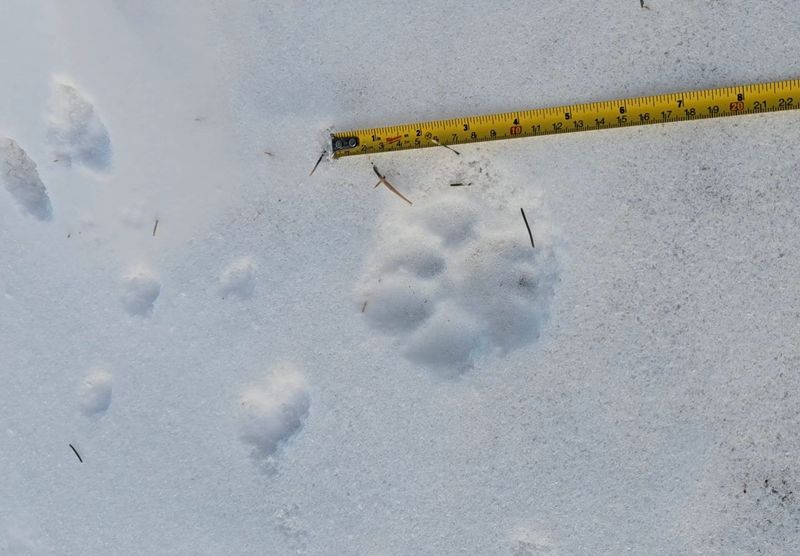
The DNR asks the public to assist with providing cougar reports in Wisconsin by using the wildlife observation form on its website. The form collects information on the location, time, date and description of the animal. Pictures of the animals and its tracks are helpful. Photos of suspected tracks should have a ruler or other measuring tool in the photo.
If available, biological samples such as scat, hair or remains of prey also can be tested to help provide confirmation of a cougar sighting. Samples should be gathered in airproof containers, and people should avoid skin contact with biological samples. The DNR should be contacted before any samples are shipped.
The DNR has the wildlife observation form and more information on the “Cougars in Wisconsin” section of its website. Visit dnr.wi.gov for more information.
This article originally appeared on Milwaukee Journal Sentinel: Collared cougar tracked from Nebraska found dead on Wisconsin railroad track
Reporting by Paul A. Smith, Milwaukee Journal Sentinel / Milwaukee Journal Sentinel
USA TODAY Network via Reuters Connect