Scott Boras has a reputation for not having players who sign extensions before reaching free agency.
But baseball’s most renowned agent budged at the persuasion of a 21-year-old prospect who has yet to step foot on a major-league diamond.

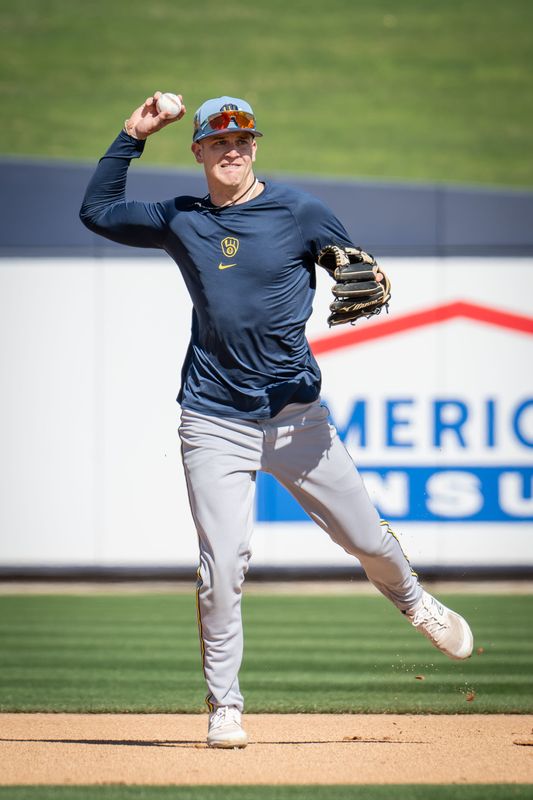
Cooper Pratt’s eight-year, $50 million contract extension with the Milwaukee Brewers came as a surprise to many around the game, and not simply because he had played all of three games at Class AAA at the time of signing but predominantly because of who his agent is.
“Sometimes,” Boras said, “things are miscast, and this is evidence of that. As an attorney, you work for your client.”
Pratt, the No. 51 prospect in baseball according to Baseball America and the Journal Sentinel’s No. 2 prospect in the Brewers organization, could remain with Milwaukee up through 2035 under the current deal, which could maximize at $80 million dollars if two club options are picked up on the back end.
“Me and my family were pretty excited, pretty stoked,” Pratt said in a Zoom news conference alongside Boras on April 4. “They brought it up in spring training, and it just worked out to happen early into the season. But I feel like we made a good decision. I feel like, in my heart, I made a good decision.
“We thought about it, we prayed about it, and we’re super excited to be able to do this with the Brewers, to be able to hopefully be a longtime Brewer.”
While Boras negotiated the numbers with the Brewers, it’s clear the impetus for getting a deal done was on Pratt.
The thinking from the Boras side on early extensions is simple: These deals are, by nature, predominantly team-friendly, with the player typically delaying his entry into free agency in exchange for an early financial guarantee.
Boras may have said that the Pratt deal shows his corporation’s reputation can be “miscast” but history also shows it’s also well-earned. Over the past decade-plus, only a small handful of players represented by Boras have signed an extension. Most of those deals, such as the ones for Stephen Strasburg, Jose Altuve and Xander Bogaerts, came with the player holding all the leverage and receiving massive paydays and opt-out clauses.
That put the burden of proof in Pratt’s court to explain why he felt taking this deal and delaying his free agency by likely three years was worth it.
“As Cooper will tell you, it’s a difficult task,” Boras said.
So how did Pratt do it?
For Pratt, the money was undeniably a factor, but that’s no different from the countless other Boras clients over the years who were intrigued by the financial security and never signed. Pratt, whose mother is a doctor and father is an accountant, comes from a stable financial background, as well.
But what Pratt effectively conveyed to Boras was how a contract would allow him to develop into an even better player because it would unburden him developmentally.
“The point of it that I heard was that, for him, this is something that allowed him to explore a corridor where he could go out and risk and seek optimization without restraint,” Boras said. “And when I heard that, we will end up with a better player on both sides, and a more advanced player and potentially a star-level player. Which, then, will justify the contract concerns I have when you are essentially doing a contract like this that will have substantial economic benefits for the team and delay free agency.
“So believing that this would allow him to have the greatest chance to be a star-level player was really the motivation I heard from Cooper that was most persuasive.”
Pratt expanded on his thinking.
“It’s not going to change anything on how I want to perform. I’m still going to want to go 5 for 5 every night,” he said. “It’s just that thought in the back of your head disappears. You still want to be the best that you can be, but there is no more pressure. There’s pressure, but it’s different – it’s fun pressure. And you get to just enjoy and go and and play and not have to worry about some other things.
“And that was one of the biggest reasons why I kind of decided to do this.”
In the end, Boras felt comfortable with making Pratt, who he has represented since high school, a very rare exception.
“The fact of the matter is I think this turned out very well for everybody,” Boras said. “And the best thing about this is that there’s one person on this call that really knows so much about what he can do as a shortstop, and that’s Cooper. That’s one thing that he really, really made me aware of as to how he feels about what he can do going forward.
“So, that’s what allows me to feel very good about his decision making, because he really is very self-understood at this age.”
Pratt will return to Class AAA the richest man on the Nashville Sounds but with the same goal as everyone else on the team: Make the big leagues. With Pratt on the Brewers 40-man roster, that day will likely come at some point in 2026.
It’s something he can now focus on without any of the outside worries.
“Just the security I’ll have the opportunity to set up like I’ll never have to worry about anything like that, pretty much, the rest of my life,” Pratt said. “I can just play and play the game like how it’s supposed to be played, not think about it as much and also be able to take care of my family for generations.”
This article originally appeared on Milwaukee Journal Sentinel: Boras clients rarely sign extensions. Here’s why Cooper Pratt was an exception
Reporting by Curt Hogg, Milwaukee Journal Sentinel / Milwaukee Journal Sentinel
USA TODAY Network via Reuters Connect