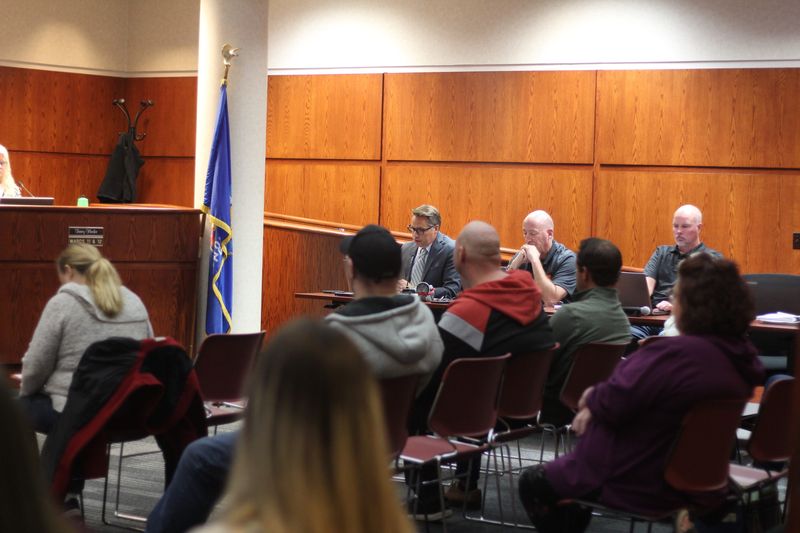
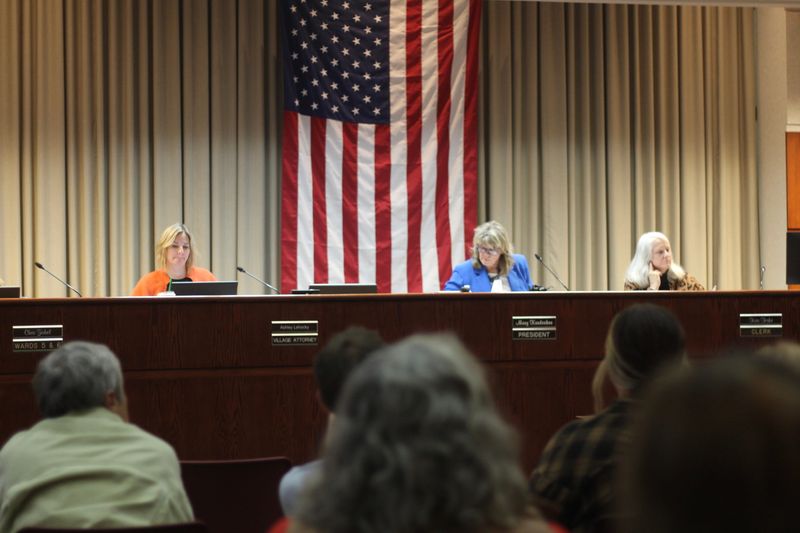
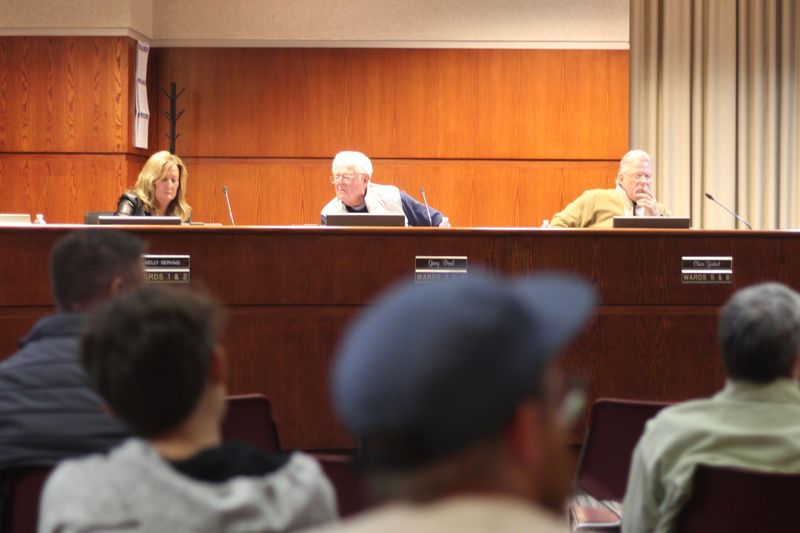
To the surprise of some and at the skepticism of others, an ordinance that would have banned camping on all public property in Ashwaubenon failed muster at the Village Board’s Oct. 28 meeting.
Instead, at the motion of board member Tracy Flucke and the second of board member Ray Krueger, the legislative body unanimously directed village staff to pursue more discussion with local homelessness service providers on how to best provide for those without a home, an issue which was at the center of public testimony, as well as spirited back-and-forth between board members.

The decision went against the expectations of Josh Benti, director of the Greater Green Bay Blueprint initiative aimed at ending homelessness in the area. He’d been near certain the measure would’ve passed, he said.
Village Board member Chris Zirbel indicated later in the meeting that he had been inclined to pass the measure. Board member Gary Paul had said early on that, “I know there’s a lot of discussion that I hope we can calm down a bit.”
‘Who has a right to that space?’: Ashwaubenon elaborates on previous arguments. The public counters.
Pushback to the first version of the law was swift, opposition that Village Administrator Joel Gregozeski had told the Green Bay Press-Gazette he had expected.
Residents had complained of homelessness and public safety officers had seen encampments near lift stations, pump houses, the water tower, along highways, in parks, and were particularly concentrated in wooded areas, Gregozeski had told the Press-Gazette. He elaborated during the meeting that there had been about a dozen resident complaints into his office in the most recent few months, and that several board members had brought forward a handful others.
The issue was local, he said, concerning public safety and health for both residents with a home and those without.
Gregozeski argued the measure would allow public safety officers to connect the homeless to services and, should the village need it, be an enforcement mechanism to remove individuals and their belongings off public property.
Benti in a later interview took issue with that reasoning, pointing to Green Bay and its Homeless Outreach Team.
The village administrator during the meeting elaborated further on his argument that the ordinance was questioning who had the right to use public space. When a child going down a tube slide hits a homeless person sleeping in it, he posited, “Who has a right to that space?”
The ordinance, Gregozeski repeated at the meeting, was a fulfillment of the village’s duty to address resident concerns. All ordinances drafted by city staff were done in that spirit and were not reflective of village staff’s personal beliefs, he added.
The proposed law was written in about a month using Fond du Lac’s as a template, and was unanimously endorsed in early October by the Public Works and Protection Committee.
Homelessness service providers were alarmed. None had been consulted in the ordinance’s drafting. Gregozeski had told the Press-Gazette the reason was because the ordinance was neither a solution for homelessness nor about the homeless themselves. He had said some service providers “may have taken that too seriously thinking it’s an effort to punish people,” and welcomed further discussion on an issue the situation was helping to shed more light on.
Service providers across the board objected to the village’s self-observation. They worried of the consequences, intended and those unintentional, which Gregozeski repeated to the Village Board immediately after noting the suggested ordinance’s perceived benefits: that public spaces were the only places for the homeless to go; that citations would scar people’s records and be red flags to landlords and real estate agents; and that such laws risked pushing people further into seclusion or onto private property.
Providers had been unclear of the village’s motives, which disconcerted many who were left to speculate. Many then read the ordinance’s aim as not wanting to see the homeless in the village and force the issue into communities with fewer restrictions on sleeping in public places.
The 10 attendees who testified in front of the Village Board shared the same read of the situation.
“Why haven’t we come together? Why haven’t we tried to do something on a bigger scale for the people that need us?” said Jennifer Welhouse of Ashwaubenon. “We started as a grassroots community a long, long, long, long time ago, and let’s get back to that.”
Homelessness too large to tackle with laws from the village, board concludes
Village Board President Mary Kardoskee denied the characterization made by service providers of the village’s actions.
“I know every one of these people on this board … and they have a lot of compassion,” she said. “Don’t think this ordinance lacks compassion from this board. It’s not intended to punish anybody.”
Village Board members ultimately had little appetite to pass any enforcement measure. Laws would do little to address homelessness from their perch in the Village Hall, the board concluded, though individual members were split on a path forward.
Flucke and Krueger said the village would do well to learn more from service providers, who lightly applauded the board’s decision. Krueger said passing such a law would be “premature” given all he didn’t know about homelessness or the services in the area and that it was becoming clear to him that more needed to be done to address the issue. Perhaps the village’s action and public reaction was a good thing to happen, Krueger said.
The village could not go it alone to address the regional problem of homelessness, Flucke said, arguing a collaborative approach with the surrounding communities was necessary.
Board members Zirbel and Chris Atkinson expressed their concerns that there was no way of distinguishing between those who had no home but were open to seeking out services and those who wanted to be left alone. Atkinson was not sure of any way a law could legally distinguish between the two groups. Until that point, Zirbel said that the timing of the proposed ordinance “is not right.”
It was Paul who was the most staunch and vocal proponent of the law.
The village has 17,000 other residents to take care of, Paul said, arguing that there was no solution to the long-standing issue of homelessness, nor would the service providers who came to testify find a solution. He said he knew several homeless people who had family they could stay with and refused doctors’ orders.
“If they would do the right thing, they wouldn’t be homeless. … It’s a drug problem,” Paul said.
Green Bay City Council member Eck, who was listening for what would be said about homelessness, was pleased at the village’s ultimate direction. She said the Green Bay City Council has previously lamented feeling that the city was solely taking on the region’s homelessness population.
“So I’d like to say, ‘How about if you start with taking some of that burden on?’” she said. “I think they’ve said over and over again, ‘It’s a regional problem,’ but the reality is that it’s a regional problem and they’re part of the region.”
Jesse Lin is a reporter covering the community of Green Bay and its surroundings, as well as politics in northeastern Wisconsin. Contact him at 920-834-4250 or jlin@gannett.com.
This article originally appeared on Green Bay Press-Gazette: Anti-camping law fails at Ashwaubenon Village Board, irking some and surprising others
Reporting by Jesse Lin, Green Bay Press-Gazette / Green Bay Press-Gazette
USA TODAY Network via Reuters Connect