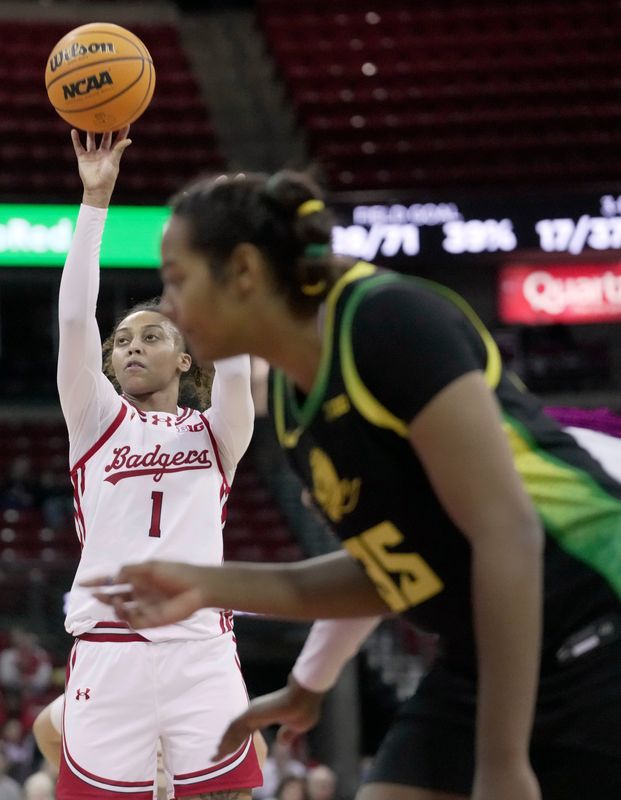
MADISON – Some programs passed on playing in a lower level of the postseason after failing to make the NCAA Tournment. The idea wasn’t part of Robin Pingeton’s thinking.
Actually, quite the contrary.

“Really, it was a no-brainer for us,” the University of Wisconsin women’s basketball coach said.
The Badgers gladly accepted an invitation to the Women’s Basketball Invitation Tournament. On Thursday, March 19, the third-seeded Badgers will face Oregon State at Gill Coliseum in Corvallis, Oregon.
Tip off is 8 p.m. The game will be streamed on ESPN+. A subscription is required.
A victory would set up a matchup Sunday with the Miami-Georgia Southern winner at a time and site to be announced.
The berth marks a step up for Wisconsin, which played in the WNIT two years ago. The WBIT, the NCAA’s secondary postseason option to the NCAA Tournament, is a rung higher in terms of the strength of its field.
Before its 2024 postseason berth, Wisconsin’s last postseason appearance came at the end of the 2010-11 season. That year the Badgers played in the WNIT when it was the secondary option to the NCAA Tournament.
The experience of competing in a tournament should do the Badgers good.
“Postseason is postseason,” Pingeton said. “And who doesn’t want to be playing in March, right? The alternative is to not have an opportunity to go to practice. I feel like we’ve been intentional about creating an environment and a culture in that locker room. These girls really enjoy being around each other.”
The ability to continue to work as a team is an obvious reason playing in the postseason will benefit the Badgers. Here are three others.
Wisconsin gets a chance to get monkey off its back
Though Wisconsin (13-17) finished the regular season with the same record as last season, it was an improved squad overall that didn’t always get rewarded with a win for the strides it made.
The Badgers haven’t won a game since Jan. 21. And they haven’t won on the road since a come-from-behind victory over Rutgers on New Year’s Day.
Being able to snap both streaks would provide a springboard into the offseason no matter how far UW advances after that.
Deeper field will challenge Badgers from the start
What is the difference between playing in the WBIT vs. the WNIT? The WBIT teams have much better résumés. UW’s three WNIT opponents two years ago were 121 or worse in the NCAA’s NET rankings. Oregon State sits at 82 entering play.
The Beavers (23-11) are coached by Scott Rueck, who led the program to the Final Four in 2016 in addition to five Sweet 16s and three Elite Eights. Oregon State tied for third with Santa Clara in the West Coast Conference with a 13-5 record. It has an established winning tradition.
The Beavers and Badgers have two common opponents. Oregon State beat Illinois by five points Nov. 14; UW lost to the Illini by 32 and 12 points. UW beat Oregon in double overtime by two points Jan. 18; the Beavers lost to Oregon by 23 points Dec. 3.
“I think in postseason making sure you can control what you can control [is important]: effort, energy,” Pingeton said. “You’ve got to bring your defense on the road and we’ve got to make sure we’re locked in, because in March anything can happen, and no game’s easy.”
UW gets away from the Big Ten
Part of Wisconsin’s struggles could be tied to the depth of the Big Ten. The 18-team league flexed its muscle as the nation’s deepest conference by leading all leagues with 12 NCAA Tournament berths.
The Badgers’ 10-game losing streak included nine games against NCAA Tournament qualifiers. Getting away from those teams and the league in general – there are no other Big Ten teams in the WBIT field – gives UW another measure of its growth.
By the way, Big Ten teams won the first two WBIT titles: Illinois in 2024 and Minnesota in 2025.
This article originally appeared on Milwaukee Journal Sentinel: Accepting WBIT bid was ‘no-brainer’ for Wisconsin. Here is how it helps Badgers
Reporting by Mark Stewart, Milwaukee Journal Sentinel / Milwaukee Journal Sentinel
USA TODAY Network via Reuters Connect