FREMONT – The Wolf River gurgled past our front porch, under our floor and into the flooded marsh to our east.

In fact the river was everywhere you looked.
But aboard “The Last Resort,” a 20-by-24 foot fishing raft owned by Casey Schalkowski of Fremont, Wis., we were warm and dry.
And we had a Chamber of Commerce view of the sunset.
That’s the beauty of raft fishing. The home-away-from-home is sleeping quarters, kitchen and fishing vessel rolled into one.
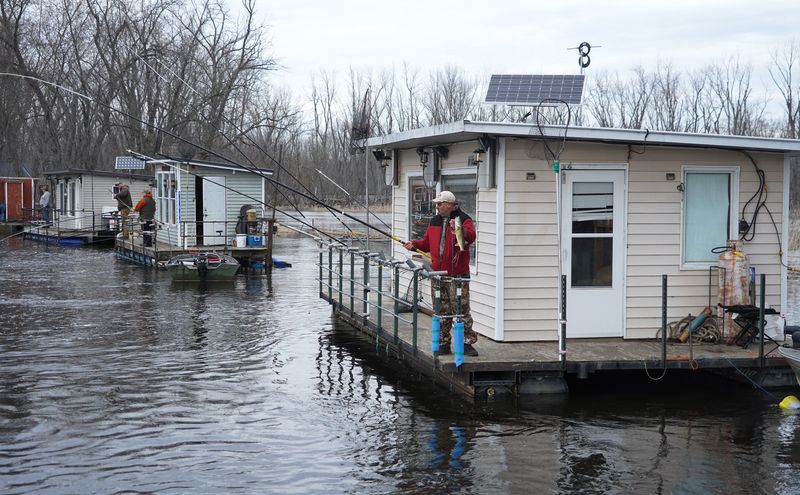
The ingenious creation is designed for a specific purpose – to house anglers on the Wolf River during the spring walleye run.
Dozens of custom-built rafts are launched on the Wolf each spring. It’s a colorful part of the local outdoors culture.
On April 11 and 12, I joined Schalkowski, his 3-year-old son Ivan and his friend Ty Wohlt of Fremont for an outing on Schalkowski’s raft.
“She’s high,” said Schalkowski, 37, nodding at the river in all directions. “About as high as I’ve seen it. But still fishable.”
Most American teenagers dream about owning a car. Schalkowski grew up near the Wolf and always wanted to own a fishing raft.
The floating fish houses are part of the unique outdoors tradition of towns along the river. Schalkowski is a third-generation raft owner, following his late grandfather Ray Schalkowski and father Ray Jr. of Weyauwega.
Schalkowski and friend Eric Peters built their first raft in 2009 on a frame originally used by Ray Sr.
I’ve fished with Schalkowski on rafts beginning in 2011 when the vessel was “Da Fish Barn.”
“The Last Resort” is Schalkowski’s third raft. The other two are not only still in his fleet but are within sight. Both are captained by his brothers, Joe and Micheal, a.k.a. Mugsy.
The Schalkowski contingent is joined by three other rafts in a close-knit, seasonal angling community in a bend of the Wolf between Gill’s Landing and Fremont.
The current here has dug a deep hole, dropping to about 30 feet, and is historically used by migrating fish, especially the most prized species, walleye.
Anglers here refer to “up” and “down” runs as the walleyes migrate from Lake Winnebago to the spawning marshes and back.
The first comes as the ice melts and the river rises in spring, spilling into the marshes, and drawing tens of thousands of walleyes up from the Lake Winnebago system.
The fish spawn along the edges of the river and in the marshes. The females deposit egg masses and are the first to head downriver.
The male walleyes fertilize the eggs and typically stay in the marshes for several more days.
Once the males begin descending to the Winnebago system, the fishing on the Wolf – at least for action and numbers – can peak.
These aren’t your spur of the moment, Huck Finn-like floats.
The rafts require an annual permit as well as an initial inspection fee. They must have an outhouse, a fire extinguisher, smoke and carbon monoxide detectors and life jackets.
The raft fishing culture evolved organically in the region.
The first one was built in 1948 or 1949, according to Jerry Kuppernus of New London.
Kuppernus said a group of five men – Harry Allen, Gus Fuerig, Orville Jossie, Leonard Kuppernus (Jerry’s father) and Coke Simes – hatched the idea during a gathering at Allen’s barber shop in New London.
At the time, crowds of anglers would fish for walleyes in spring from shore at the New London coal dock.
The conditions were often cold and raw.
“As my dad and them were solving the world’s problems in Harry’s barber shop, they decided they’d also like to make something to fish from and get out of the elements,” Jerry Kuppernus said. “It started a little bit of a trend.”
The first raft was made on a platform of creosoted logs, similar to telephone poles, Kuppernus said. A wooden cabin, about 8 feet by 15 feet, was placed on top. A wood stove was used for heat, and a gas cook stove was used for meals. Windows allowed the anglers to watch cane poles set in rod holders on a wooden front rail.
The fishing rafts became a common-enough sight that a section of the river near New London acquired a new name: Shantytown Bend. The common fishing poles used on the rafts led to the moniker of another stretch called Bamboo Bend.
The raft fishing tradition continued to grow over the coming decades but remained a local phenomenon.
The time-honored method of fishing – cane poles and artificial lures – used by many raft anglers is also unique. The long bamboo, graphite or fiberglass poles have just the right blend of limberness and strength to land fish on a relatively short, fixed length of line.
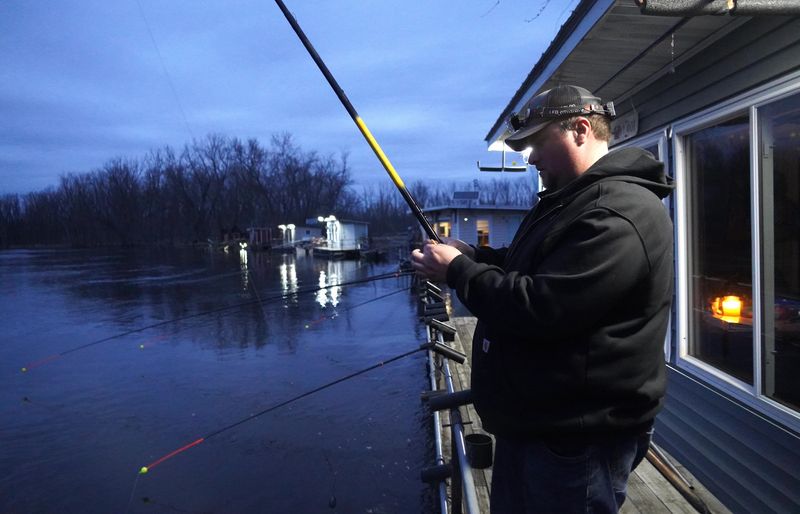
Schalkowski uses telescoping poles from about 10 to 20 feet in length. The rods are most often used to fish a three-way (also known as Wolf River) rig, including a heavy sinker and a floating crank bait.
Different length rods and lengths of line allow anglers to control the depth and placement of the lures.
The artificial lures wobble in the current, enticing passing fish to bite.
We motored out to “The Last Resort” about 5:30 p.m. April 11 with gear typical to a camping outing: sleeping bag, rain gear, food.
But the raft was so well equipped there were no hardships.
Schalkowski had Ivan select a few of his favorite lures, then had him help set out a couple rods. This is the youngsters second season on the raft.
“If he doesn’t get to come, he’s upset,” Schalkowski said. “That’s what I like to see.”
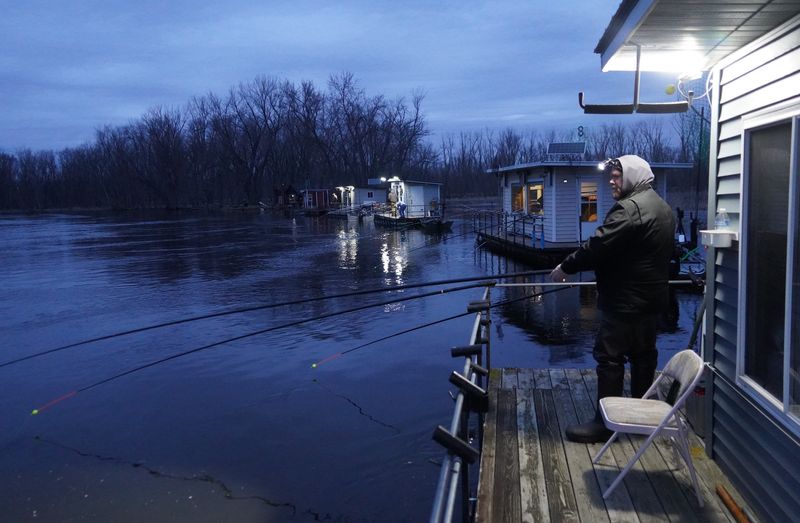
We set out 10 rods with different styles and colors of floating crank baits and designed to run at different depths.
Then we sat or stood and watched for a rod tip to signal a fish. Or debris.
The flood stage river was full of sticks and grass and other material that fouled the lures.
One night this spring Schalkowski was jarred awake when a tree swept into the current banged against the raft.
We kept one eye on the lines and the other on the sunset. Sandhill cranes were near, offering up a chorus of “kadoodles” from the marsh. Two bald eagles did a close-up fly by.
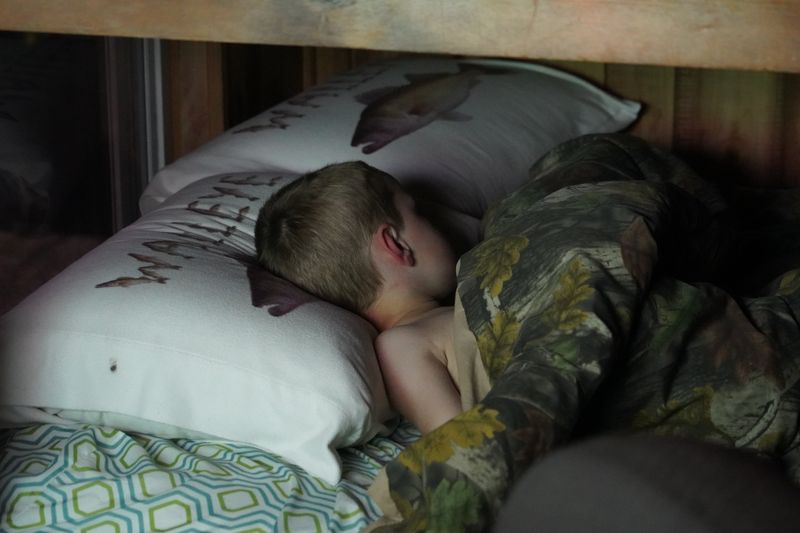
About 7:30 Ivan hit the hay, his head on a pillow adorned with a walleye.
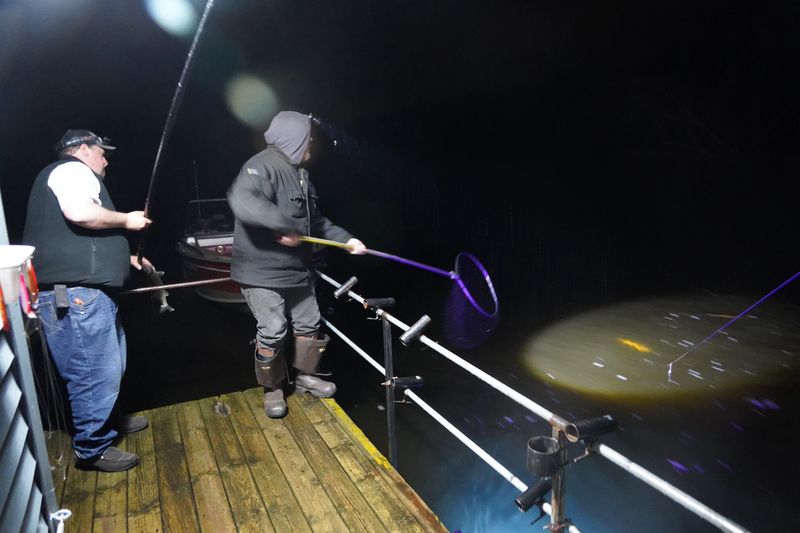
The walleye bite picked up a little bit later. Neighboring rafts started catching about 8 and we had a flurry about 10.
First Schalkowski landed a 16-inch-long walleye, and before he could put that rod down, another long pole began bobbing.
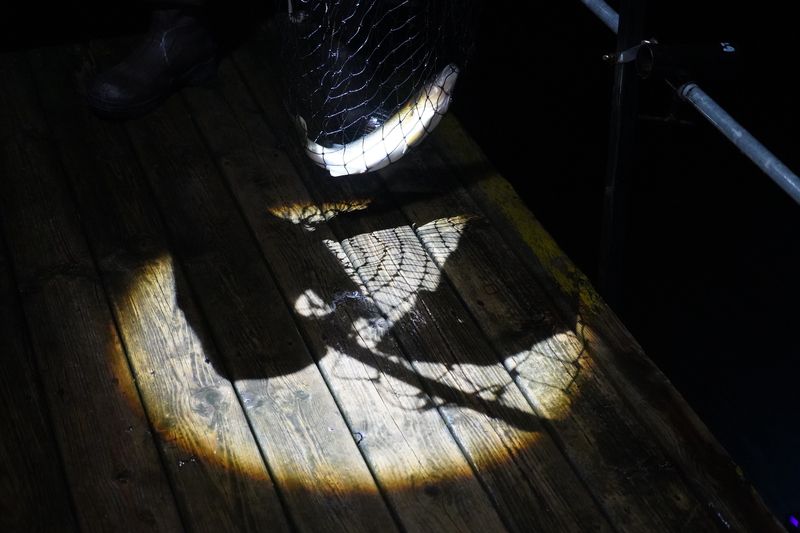
He picked that one up, too, and brought it to the side of the raft where Wohlt netted it. It was an 18.5-inch walleye. Both were spawned out females.
“Well, that was a fast and furious two (fish),” Schalkowski said, recording the details of lure type and color in his log book.
We fished until about 11, then pulled the lines in and prepared to get some sleep ourselves.
No matter how many fish are landed, having his brothers and son on the river in spring is a success, Schalkowski said. Based on Ivan’s enthusiasm, the odds seem good the raft fishing tradition will be passed to a fourth generation in the family.
“That’s why I do this,” Schalkowski said. “I want my family to enjoy and share this passion for walleye fishing on our rafts. You don’t see this anywhere else and I want to do what I can to make sure it continues.”
This article originally appeared on Milwaukee Journal Sentinel: Smith: Wolf River fishing raft culture going strong
Reporting by Paul A. Smith, Milwaukee Journal Sentinel / Milwaukee Journal Sentinel
USA TODAY Network via Reuters Connect