Update: The Launch has been scrubbed due to bad weather. A new target launch date will be announced soon.
A new group of people are about to join more than 60 others who have previously boarded a Blue Origin spacecraft for a brief voyage treating them to stunning views of Earth few have seen.

Blue Origin, the commercial spaceflight company founded by billionaire Jeff Bezos, is preparing to send six more people to the edge of space as early as Saturday, June 21. The impending launch would come just three weeks since the company’s last human spaceflight from its private facilities in West Texas.
Blue Origin also made headlines in March for a highly-publicized launch featuring an all-woman crew that included pop star Katy Perry and broadcast journalist Gayle King.
The six people selected for the upcoming mission, known as NS-33, would join a growing list of celebrities and influential civilians who have had the rare privilege of serving as passengers on the company’s New Shepard spacecraft. During a trip that lasts a matter of minutes, the New Shepard takes its passengers more than 60 miles high to experience weightlessness and spectacular views of Earth.
Here’s everything to know about the upcoming mission, which would be New Shepard’s 13th human spaceflight and 33rd overall.
Does Jeff Bezos own Blue Origin?
Billionaire Jeff Bezos, best known for founding Amazon, is the founder of the private space technology company Blue Origin.
Bezos himself even boarded Blue Origin’s New Shepard for its maiden crewed voyage in July 2021, which came after the spacecraft flew on 15 flight tests beginning in 2012. For nearly four years since its first crewed mission, the New Shepard spacecraft has served as a powerful symbol of Blue Origin’s commercial spaceflight ambitions amid a growing space tourism industry.
In addition to sending space tourists on brief joy rides to the edge of space, Blue Origin has also increasingly sought to compete with Elon Musk’s SpaceX.
Blue Origin’s massive New Glenn rocket, which flew on its inaugural flight test in January, is also being developed for future spaceflights. At 320 feet tall, the spacecraft rivals SpaceX’s 400-foot Starship in size.
Even Amazon is competing with SpaceX by developing its own Kuiper internet satellite constellation in a direct challenge to Starlink.
When is the next Blue Origin launch?
Blue Origin’s next crewed launch, known as NS-33, could get off the ground as early as 8:30 a.m. CT (9:30 a.m. ET) Saturday, June 21, the company announced Tuesday, June 17.
Where do Blue Origin rocket launches happen?
Blue Origin New Shepard rocket launches take place from the company’s private ranch facility known as Launch Site One. The facility is located 30 miles north of the town of Van Horn in Culberson County – more than 140 miles east of El Paso near the U.S.-Mexico border.
Who is the crew of next Blue Origin mission?
The passengers on the next mission, whose names Blue Origin announced Friday, June 13, are a group mostly conservationists and business leaders. When the New Shepard gets off the ground again, the six people selected to board it will join 64 others who have flown on the spacecraft across 12 previous human spaceflights.
Here’s a look at the passengers:
What happens during a Blue Origin rocket launch?
Each spaceflight on a New Shepard vehicle lasts about 11 minutes from liftoff to capsule touchdown.
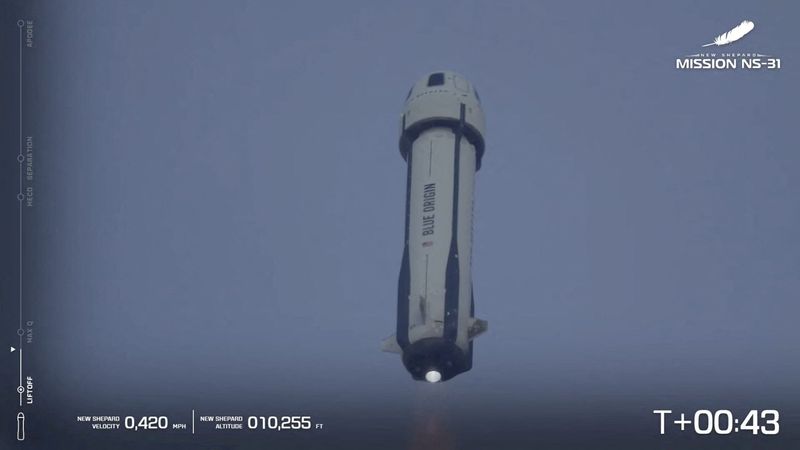
Named after astronaut Alan Shepard, the first American in space, the 60-foot-tall New Shepard rocket is topped with the gum drop-shaped crew capsule. The spacecraft operates completely autonomously, meaning no pilots are aboard.
During its ascent, the spacecraft reaches supersonic speeds surpassing 2,000 mph before the rocket booster separates from the crew capsule. At that point, those aboard the capsule become weightless as the spacecraft continues toward its highest point on its brief voyage above the Kármán Line – the 62-mile-high internationally recognized boundary of space.
While experiencing a few minutes of microgravity, passengers have the opportunity to unstrap themselves from their seats to gaze out the capsule’s large windows and take in a stunning view of Earth.
Meanwhile, the rocket booster heads back to the ground while firing its engines and using its fins to slow and control its descent to land about two miles from the launchpad.
The capsule itself eventually begins what Blue Origin refers to as a “stable freefall” – plummeting back to Earth as three massive parachutes deploy and the capsule makes a soft landing in the desert, sending up plumes of dust.
How much does it cost to ride Blue Origin?
If you have dreams of blasting off to orbit on a Blue Origin spacecraft, you likely need to either have very deep pockets or a name that’s recognizable enough to get you invited as an honored guest.
Though Blue Origin does not publicly list prices on its website, a form to reserve a seat requires customers to agree to a $150,000 deposit alone.
And if the price of the first ticket sold for a Blue Origin spaceflight in 2021 is any indicator, seats likely cost in the millions of dollars. The $28 million ticket price was the winning bid in an auction that included 7,600 people registered to bid from 159 countries.
However, a select few passengers over the years have had their seats aboard New Shepard paid through grants and other funding methods from large institutions.
Eric Lagatta is the Space Connect reporter for the USA TODAY Network. Reach him at elagatta@gannett.com
This article originally appeared on El Paso Times: When is the next Blue Origin crewed launch from Texas? What to know about New Shepard
Reporting by Eric Lagatta, USA TODAY NETWORK / El Paso Times
USA TODAY Network via Reuters Connect