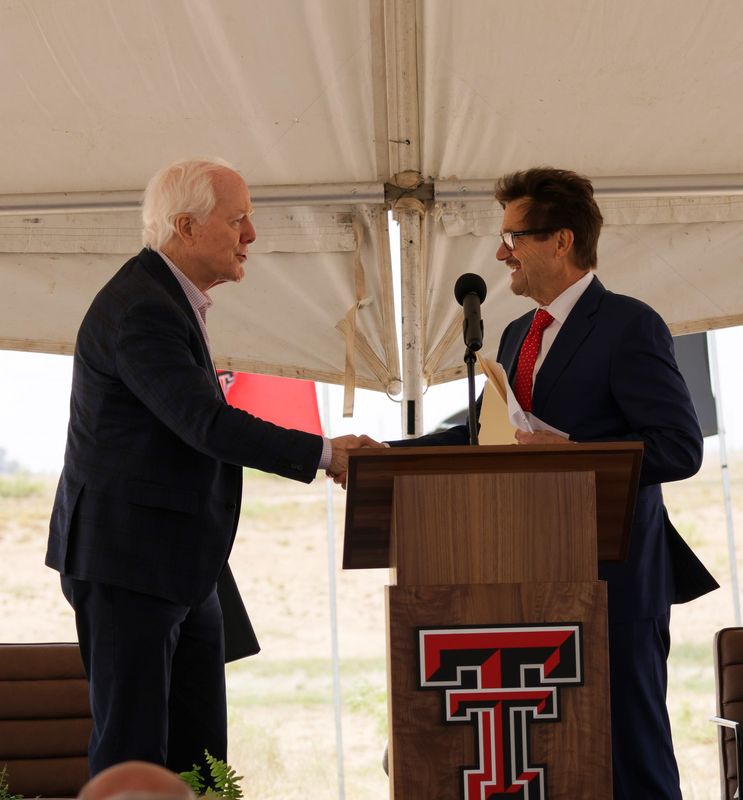
Several Texas political, military, and education officials converged on Lubbock Tuesday to break ground on what they said will impact national security at all levels.
The Critical Infrastructure Security Institute at Reese National Security Complex, 10636 Highway 114 at the former Reese Air Force Base, will become a hub of research and innovation. This groundbreaking was the first major development in the site since House Bill 5092 was passed in May 2025.

“I know you’ve looked forward to this groundbreaking for a long, long time, and I recognize that once completed, it will advance innovative research to strengthen out national security,” said U.S. Sen. John Cornyn, R-Texas. “Everything in this country flows from a secure America. Nothing else really much matters without national security.”
While officials could not fully detail what projects it had in mind, it touched on two goals:
During Cornyn’s speech, he spoke on the increase of cyber attacks, specifically mentioning the recent nationwide Canvas outage that hit during finals week at Texas Tech.
This article continues after the photo gallery.
“These are just a few examples of why having strong and resilient infrastructure is a key to protecting our water, energy, telecommunications, education systems and everything else,” Cornyn said. “The creation of this research center here in Lubbock will ensure that we are properly implementing the very state of the art cyber strategies in improving our critical infrastructure across this great country.”
It is expected to develop solutions to security challenges through what he called “interdisciplinary research, innovative education and strategic partnerships.” It will do this with infrastructure design, threat intelligence, cyber analytics and research capacity.
“Infrastructure is important for the nation, and we kind of fall behind in infrastructure issues, specifically water, grid, energy,” said State Sen. Charles Perry, R-Lubbock. “This initiative, moving forward with the research that’s going on, is about hardening our infrastructure.”
Through the partnerships, CISI will monitor and update critical infrastructure networks and develop standards.
In turn, this will “decrease the vulnerabilities of the electrical grid, water utilities, communication, military and other systems vital to the economies of the region, state and nation,” according to the release.
Three grants have already started building the employment pipeline:
“This site represents a natural evolution of Texas Tech University’s longstanding expertise and research that supports our nation’s security and resilience,” said Texas Tech University President Lawrence Schovanec. “Texas Tech is uniquely positioned to lead in this space, and the Reese National Security Complex gives us the ability to bring together research, workforce development, testing capabilities and strategic partnerships in ways that few universities can.
Lt. Gen. Miles Brown, a soldier since 1989 who was formerly stationed at Reese Air Force Base, is the deputy commanding general of U.S. Army Futures Command. Brown encouraged the crowd to look to the future now.
“In my job as the commander of transformation and training command, I work to build the future I want to see, not wait for the future to happen to me, or my command, or the army or my country,” Brown said. “And that is why I’m here. We have time to get it right. We may not have time to do it twice.”
Alana Edgin writes about business for the Lubbock Avalanche-Journal. Got a news tip? Contact her via email at aedgin@lubbockonline.com.
This article originally appeared on Lubbock Avalanche-Journal: Texas Tech, state leaders tout progress on critical security institute
Reporting by Alana Edgin, Lubbock Avalanche-Journal / Lubbock Avalanche-Journal
USA TODAY Network via Reuters Connect